Chang Cheng, Guo Wennan, Yu Xinbo, Guo Chaoyi, Zhou Nan, Guo Xiaokui, Huang Ru-Lin, Li Qingtian, Zhu Yongzhang
School of Global Health, Chinese Centre for Tropical Diseases Research, Shanghai Jiao Tong University School of Medicine, One Health Center, Shanghai Jiao Tong University-The University of Edinburgh, Shanghai, 200025, China.
Second Dental Center, Shanghai Ninth People's Hospital, Shanghai Jiao Tong University School of Medicine, Shanghai, 201999, China.
Mater Today Bio. 2023 Mar 24;20:100612. doi: 10.1016/j.mtbio.2023.100612. eCollection 2023 Jun.
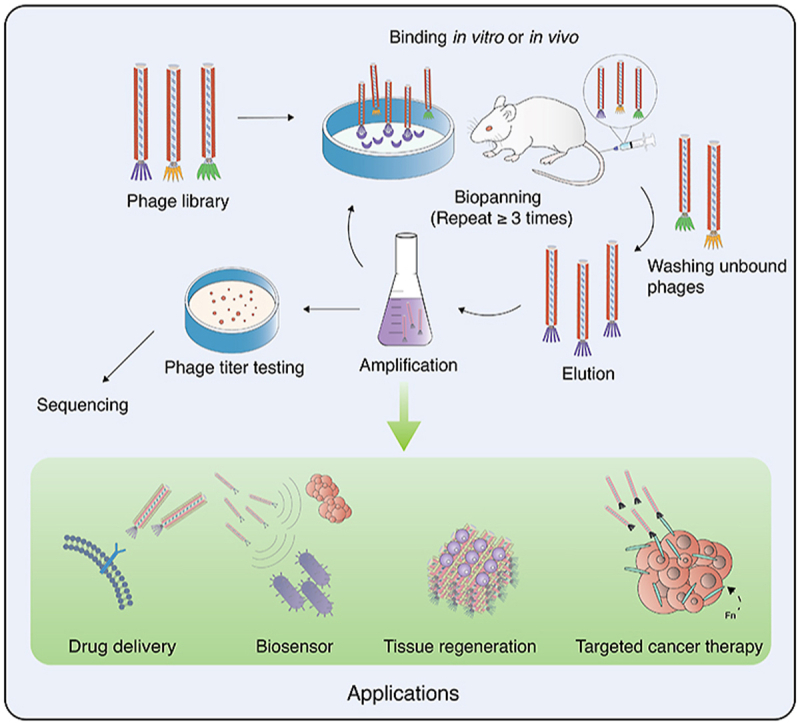
Bacteriophages (phages) are nanostructured viruses with highly selective antibacterial properties that have gained attention beyond eliminating bacteria. Specifically, M13 phages are filamentous phages that have recently been studied in various aspects of nanomedicine due to their biological advantages and more compliant engineering capabilities over other phages. Having nanofiber-like morphology, M13 phages can reach varied target sites and self-assemble into multidimensional scaffolds in a relatively safe and stable way. In addition, genetic modification of the coat proteins enables specific display of peptides and antibodies on the phages, allowing for precise and individualized medicine. M13 phages have also been subjected to novel engineering approaches, including phage-based bionanomaterial engineering and phage-directed nanomaterial combinations that enhance the bionanomaterial properties of M13 phages. In view of these features, researchers have been able to utilize M13 phages for therapeutic applications such as drug delivery, biodetection, tissue regeneration, and targeted cancer therapy. In particular, M13 phages have been utilized as a novel bionanomaterial for precisely mimicking natural tissue environment in order to overcome the shortage in tissue and organ donors. Hence, in this review, we address the recent studies and advances of using M13 phages in the field of nanomedicine as therapeutic agents based upon their characteristics as novel bionanomaterial with biomolecules displayed. This paper also emphasizes the novel engineering approach that enhances M13 phage's bionanomaterial capabilities. Current limitations and future approaches are also discussed to provide insight in further progress for M13 phage-based clinical applications.
噬菌体是具有高度选择性抗菌特性的纳米结构病毒,其作用已不仅局限于杀菌。具体而言,M13噬菌体是丝状噬菌体,由于其生物学优势以及相较于其他噬菌体更具适应性的工程改造能力,近年来在纳米医学的各个方面都得到了研究。M13噬菌体具有类似纳米纤维的形态,能够到达不同的靶点,并以相对安全和稳定的方式自组装成多维支架。此外,对衣壳蛋白进行基因改造可使肽和抗体在噬菌体上特异性展示,从而实现精准和个性化医疗。M13噬菌体还采用了新型工程方法,包括基于噬菌体的生物纳米材料工程和噬菌体导向的纳米材料组合,以增强M13噬菌体的生物纳米材料特性。鉴于这些特性,研究人员已能够将M13噬菌体用于药物递送、生物检测、组织再生和靶向癌症治疗等治疗应用。特别是,M13噬菌体已被用作一种新型生物纳米材料,用于精确模拟自然组织环境,以克服组织和器官供体短缺的问题。因此,在本综述中,我们基于M13噬菌体作为展示生物分子的新型生物纳米材料的特性,阐述了其在纳米医学领域作为治疗剂的最新研究和进展。本文还强调了增强M13噬菌体生物纳米材料能力的新型工程方法。同时讨论了当前的局限性和未来的方法,以为基于M13噬菌体的临床应用的进一步发展提供见解。