Department of Cogno-Mechatronics Engineering, Pusan National University, Busan, 609-735 Korea.
Department of Nanomaterials Engineering, College of Nanoscience & Nanotechnology, Pusan National University, Busan, 609-735 Korea.
Biomater Res. 2014 Oct 3;18:14. doi: 10.1186/2055-7124-18-14. eCollection 2014.
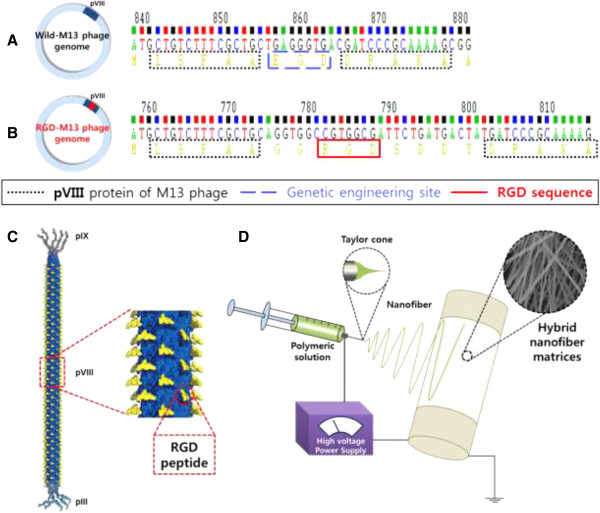
M13 bacteriophages can be readily fabricated as nanofibers due to non-toxic bacterial virus with a nanofiber-like shape. In the present study, we prepared hybrid nanofiber matrices composed of poly(lactic-co-glycolic acid, PLGA) and M13 bacteriophages which were genetically modified to display the RGD peptide on their surface (RGD-M13 phage).
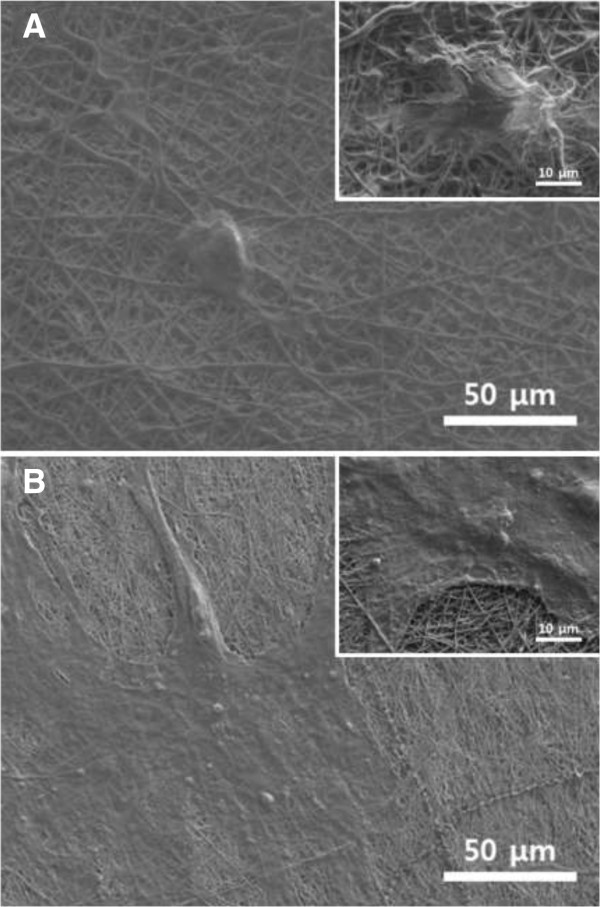
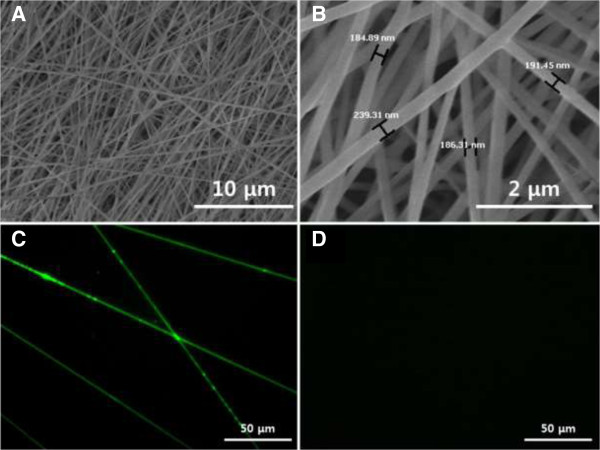
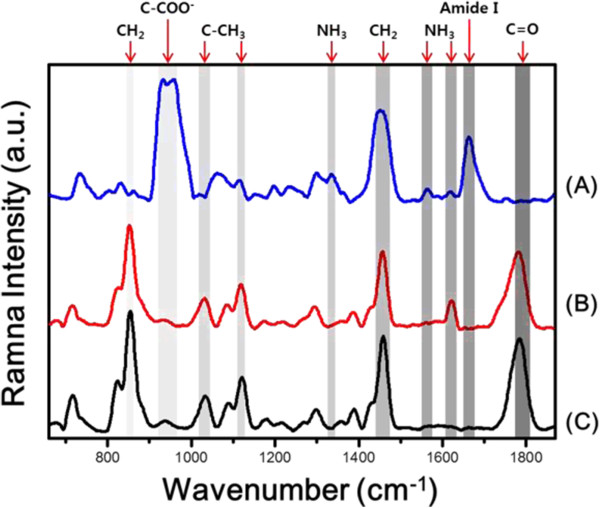
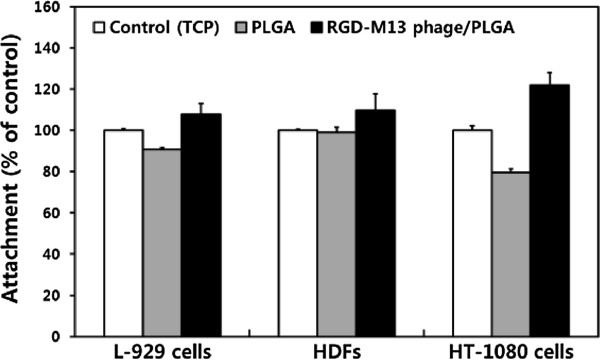
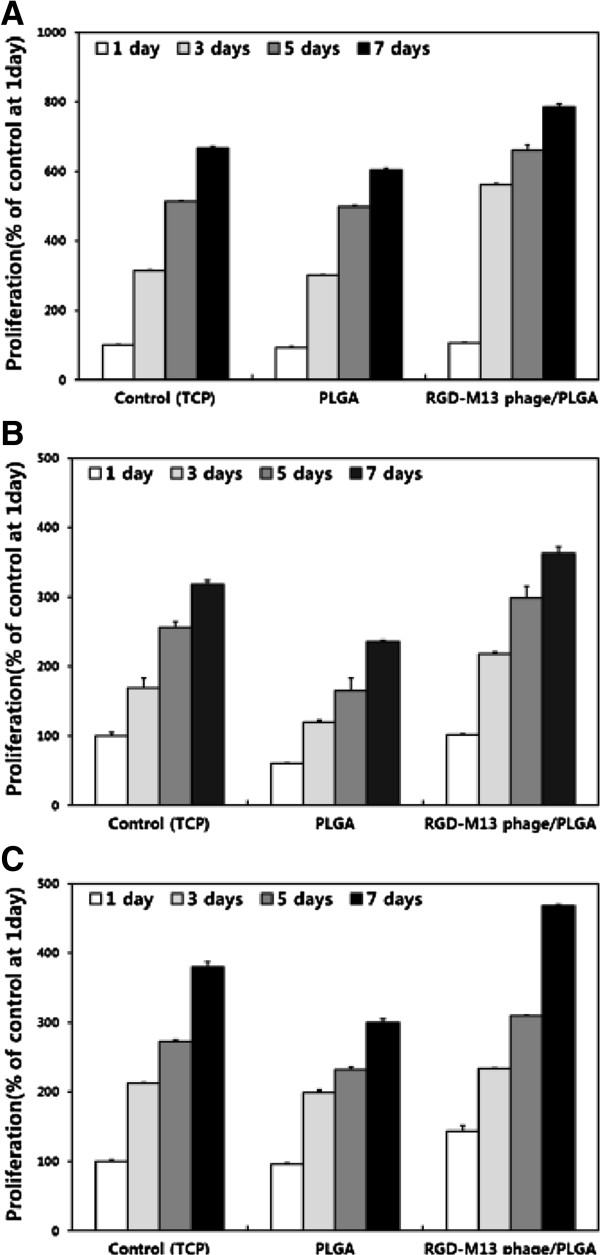
The surface morphology and chemical composition of hybrid nanofiber matrices were characterized by scanning electron microscopy (SEM) and Raman spectroscopy, respectively. Immunofluorescence staining was conducted to investigate the existence of M13 bacteriophages in RGD-M13 phage/PLGA hybrid nanofibers. In addition, the attachment and proliferation of three different types of fibroblasts on RGD-M13 phage/PLGA nanofiber matrices were evaluated to explore how fibroblasts interact with these matrices. SEM images showed that RGD-M13 phage/PLGA hybrid matrices had the non-woven porous structure, quite similar to that of natural extracellular matrices, having an average fiber diameter of about 190 nm. Immunofluorescence images and Raman spectra revealed that RGD-M13 phages were homogeneously distributed in entire matrices. Moreover, the attachment and proliferation of fibroblasts cultured on RGD-M13 phage/PLGA matrices were significantly enhanced due to enriched RGD moieties on hybrid matrices.
These results suggest that RGD-M13 phage/PLGA matrices can be efficiently used as biomimetic scaffolds for tissue engineering applications.
M13 噬菌体由于其无毒的细菌病毒性质和类似纳米纤维的形状,很容易被制成纳米纤维。在本研究中,我们制备了由聚(乳酸-共-乙醇酸,PLGA)和经遗传修饰后表面展示 RGD 肽的 M13 噬菌体组成的杂交纳米纤维基质(RGD-M13 噬菌体)。
通过扫描电子显微镜(SEM)和拉曼光谱分别对杂交纳米纤维基质的表面形态和化学组成进行了表征。通过免疫荧光染色来研究 RGD-M13 噬菌体/PLGA 杂交纳米纤维中 M13 噬菌体的存在。此外,还评估了三种不同类型的成纤维细胞在 RGD-M13 噬菌体/PLGA 纳米纤维基质上的黏附和增殖情况,以探讨成纤维细胞与这些基质的相互作用方式。SEM 图像显示,RGD-M13 噬菌体/PLGA 杂交基质具有非织造多孔结构,与天然细胞外基质非常相似,平均纤维直径约为 190nm。免疫荧光图像和拉曼光谱表明,RGD-M13 噬菌体均匀分布在整个基质中。此外,由于杂交基质中富含 RGD 部分,培养在 RGD-M13 噬菌体/PLGA 基质上的成纤维细胞的黏附和增殖明显增强。
这些结果表明,RGD-M13 噬菌体/PLGA 基质可以有效地用作组织工程应用的仿生支架。