Liver Disease Center, Beijing YouAn Hospital, Capital Medical University, Beijing, China.
Department of Infectious Diseases, Electric Power Teaching Hospital, Capital Medical University, Beijing, China.
Front Cell Infect Microbiol. 2023 Mar 31;13:1083912. doi: 10.3389/fcimb.2023.1083912. eCollection 2023.
BACKGROUNDS & AIMS: Liver inflammation is the main risk factor for developing liver fibrosis, cirrhosis, and even hepatocellular carcinoma in chronic hepatitis B (CHB) patients. To replace biopsy, additional non-invasive biomarkers to diagnose and grade liver necroinflammation are urgently required in clinical practice.
Ninety-four CHB patients, including 74 HBeAg-positive and 20 HBeAg-negative patients, were enrolled and started entecavir or adefovir therapy. Serum HBV RNA, HBV DNA, HBsAg, hepatitis B core-related antigen (HBcrAg), ALT and AST levels, as well as intrahepatic HBV DNA and cccDNA were measured at baseline and during treatment. Liver inflammation was assessed at baseline and month 60 by liver biopsy. Inflammation regression was defined as a ≥1-grade decrease according to the Scheuer scoring system.
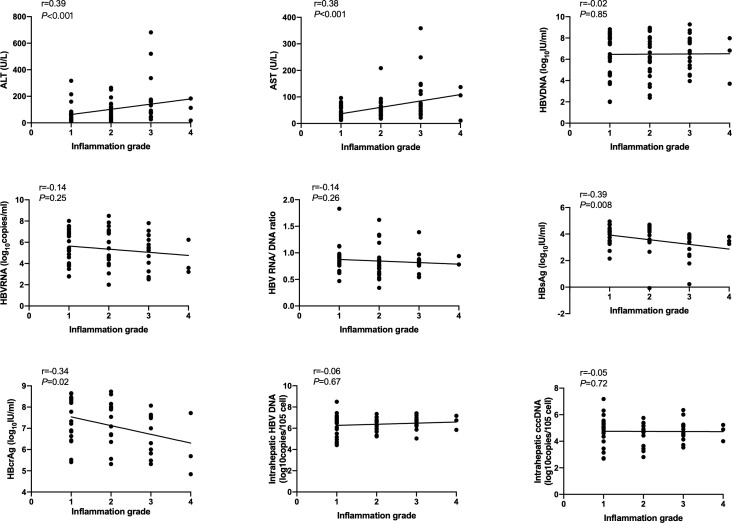
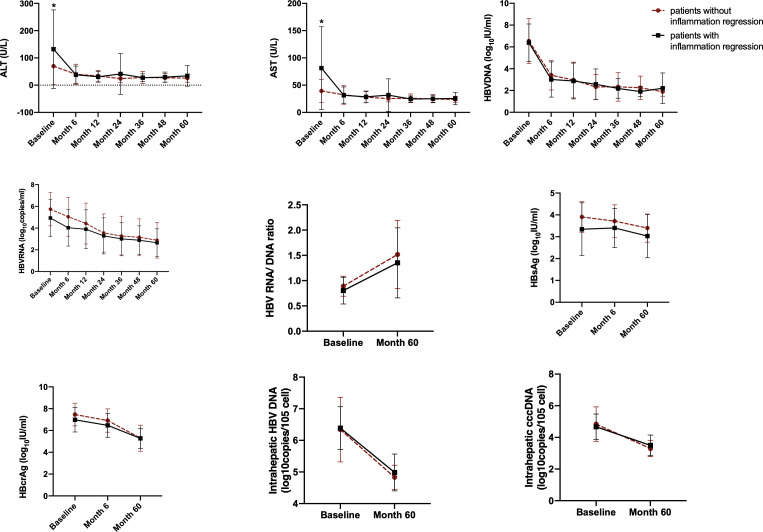
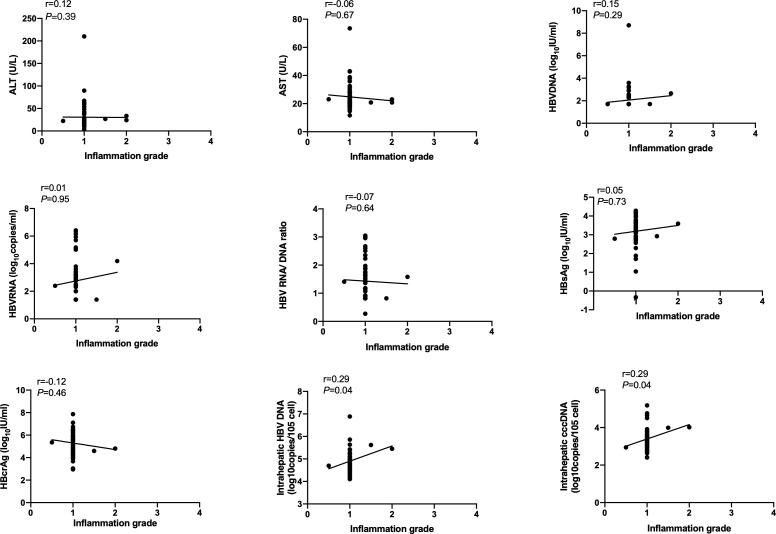
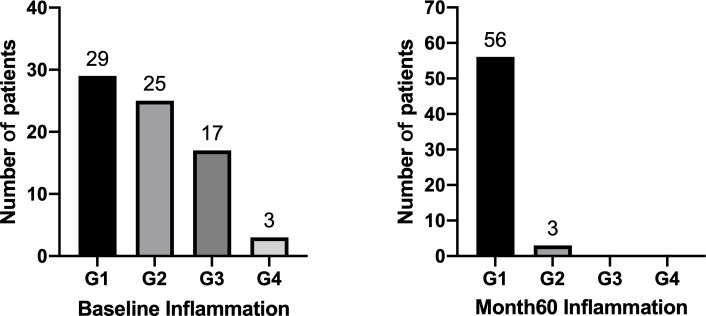
In HBeAg-positive CHB patients, at baseline, serum HBsAg and HBcrAg levels negatively correlated with inflammation grade, while ALT and AST levels positively correlated with inflammation grade. AST plus HBsAg exhibited excellent diagnostic ability for significant inflammation with an AUROC of 0.896. After 60 months of antiviral treatment, almost all the patients' liver inflammation ameliorated to G1, and no patients had inflammation progression.
Besides ALT and AST, serum HBsAg and HBcrAg correlated with inflammation grade in HBeAg-positive CHB patients before NAs treatment. Moreover, the combination of HBsAg and AST exhibited excellent diagnostic ability for significant inflammation.
肝脏炎症是慢性乙型肝炎(CHB)患者发生肝纤维化、肝硬化甚至肝细胞癌的主要危险因素。为了替代肝活检,临床上迫切需要额外的非侵入性生物标志物来诊断和分级肝脏坏死性炎症。
共纳入 94 例 CHB 患者,包括 74 例 HBeAg 阳性和 20 例 HBeAg 阴性患者,他们开始接受恩替卡韦或阿德福韦酯治疗。在基线和治疗期间检测血清 HBV RNA、HBV DNA、HBsAg、乙型肝炎核心相关抗原(HBcrAg)、ALT 和 AST 水平,以及肝内 HBV DNA 和 cccDNA。在基线和 60 个月时通过肝活检评估肝脏炎症。根据 Scheuer 评分系统,炎症消退定义为炎症等级下降≥1 级。
在 HBeAg 阳性 CHB 患者中,基线时血清 HBsAg 和 HBcrAg 水平与炎症等级呈负相关,而 ALT 和 AST 水平与炎症等级呈正相关。AST 加 HBsAg 对显著炎症具有优异的诊断能力,AUROC 为 0.896。经过 60 个月的抗病毒治疗,几乎所有患者的肝脏炎症均改善至 G1 级,且无患者炎症进展。
在 NAs 治疗前,除了 ALT 和 AST,血清 HBsAg 和 HBcrAg 与 HBeAg 阳性 CHB 患者的炎症等级相关。此外,HBsAg 和 AST 的组合对显著炎症具有优异的诊断能力。