• 文献检索
  • 文档翻译
  • 深度研究
  • 学术资讯
  • Suppr Zotero 插件Zotero 插件
  • 邀请有礼
  • 套餐&价格
  • 历史记录
应用&插件
Suppr Zotero 插件Zotero 插件浏览器插件Mac 客户端Windows 客户端微信小程序
定价
高级版会员购买积分包购买API积分包
服务
文献检索文档翻译深度研究API 文档MCP 服务
关于我们
关于 Suppr公司介绍联系我们用户协议隐私条款
关注我们

Suppr 超能文献

核心技术专利:CN118964589B侵权必究
粤ICP备2023148730 号-1Suppr @ 2026

文献检索

告别复杂PubMed语法,用中文像聊天一样搜索,搜遍4000万医学文献。AI智能推荐,让科研检索更轻松。

立即免费搜索

文件翻译

保留排版,准确专业,支持PDF/Word/PPT等文件格式,支持 12+语言互译。

免费翻译文档

深度研究

AI帮你快速写综述,25分钟生成高质量综述,智能提取关键信息,辅助科研写作。

立即免费体验

循环蛋白预测 COVID-19 严重程度。

Circulating proteins to predict COVID-19 severity.

机构信息

Lady Davis Institute for Medical Research, Jewish General Hospital, Pavilion H-413, 3755 Côte-Ste-Catherine Montréal, Montreal, QC, H3T 1E2, Canada.

Department of Computer Science, McGill University, Montréal, QC, Canada.

出版信息

Sci Rep. 2023 Apr 17;13(1):6236. doi: 10.1038/s41598-023-31850-y.

DOI:10.1038/s41598-023-31850-y
PMID:
37069249
原文链接:https://pmc.ncbi.nlm.nih.gov/articles/PMC10107586/
Abstract

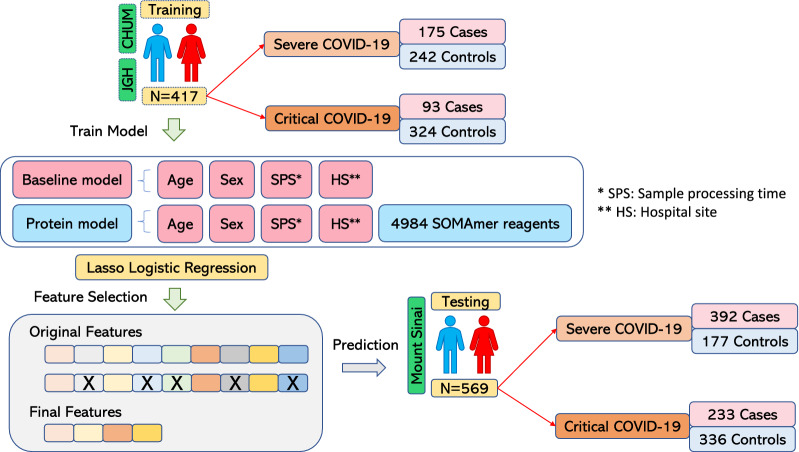
Predicting COVID-19 severity is difficult, and the biological pathways involved are not fully understood. To approach this problem, we measured 4701 circulating human protein abundances in two independent cohorts totaling 986 individuals. We then trained prediction models including protein abundances and clinical risk factors to predict COVID-19 severity in 417 subjects and tested these models in a separate cohort of 569 individuals. For severe COVID-19, a baseline model including age and sex provided an area under the receiver operator curve (AUC) of 65% in the test cohort. Selecting 92 proteins from the 4701 unique protein abundances improved the AUC to 88% in the training cohort, which remained relatively stable in the testing cohort at 86%, suggesting good generalizability. Proteins selected from different COVID-19 severity were enriched for cytokine and cytokine receptors, but more than half of the enriched pathways were not immune-related. Taken together, these findings suggest that circulating proteins measured at early stages of disease progression are reasonably accurate predictors of COVID-19 severity. Further research is needed to understand how to incorporate protein measurement into clinical care.

摘要

预测 COVID-19 的严重程度具有挑战性,且其涉及的生物学途径尚未完全阐明。为了研究这一问题,我们在两个独立队列中共计 986 人检测了 4701 种循环人类蛋白丰度。然后,我们利用包括蛋白丰度和临床风险因素在内的预测模型来预测 417 名受试者的 COVID-19 严重程度,并在 569 名独立受试者的队列中对这些模型进行了测试。对于严重的 COVID-19,在测试队列中,包含年龄和性别的基线模型提供了 65%的接收者操作特征曲线(AUC)。从 4701 种独特的蛋白丰度中选择 92 种蛋白,将 AUC 提高到训练队列中的 88%,在测试队列中保持相对稳定,为 86%,表明具有良好的泛化能力。从不同 COVID-19 严重程度中选择的蛋白富含细胞因子和细胞因子受体,但超过一半的富集途径与免疫无关。总的来说,这些发现表明,在疾病进展的早期阶段测量的循环蛋白是 COVID-19 严重程度的合理准确预测因子。需要进一步的研究来了解如何将蛋白测量纳入临床护理。
https://cdn.ncbi.nlm.nih.gov/pmc/blobs/d508/10110618/f716e339a1a6/41598_2023_31850_Fig3_HTML.jpg
https://cdn.ncbi.nlm.nih.gov/pmc/blobs/d508/10110618/a4d611badfc9/41598_2023_31850_Fig1_HTML.jpg
https://cdn.ncbi.nlm.nih.gov/pmc/blobs/d508/10110618/c29b8d32b962/41598_2023_31850_Fig2_HTML.jpg
https://cdn.ncbi.nlm.nih.gov/pmc/blobs/d508/10110618/f716e339a1a6/41598_2023_31850_Fig3_HTML.jpg
https://cdn.ncbi.nlm.nih.gov/pmc/blobs/d508/10110618/a4d611badfc9/41598_2023_31850_Fig1_HTML.jpg
https://cdn.ncbi.nlm.nih.gov/pmc/blobs/d508/10110618/c29b8d32b962/41598_2023_31850_Fig2_HTML.jpg
https://cdn.ncbi.nlm.nih.gov/pmc/blobs/d508/10110618/f716e339a1a6/41598_2023_31850_Fig3_HTML.jpg

相似文献

1
Circulating proteins to predict COVID-19 severity.循环蛋白预测 COVID-19 严重程度。
Sci Rep. 2023 Apr 17;13(1):6236. doi: 10.1038/s41598-023-31850-y.
2
Development and validation of a prognostic model based on comorbidities to predict COVID-19 severity: a population-based study.基于合并症的 COVID-19 严重程度预测预后模型的建立和验证:一项基于人群的研究。
Int J Epidemiol. 2021 Mar 3;50(1):64-74. doi: 10.1093/ije/dyaa209.
3
Lymphocyte-monocyte-neutrophil index: a predictor of severity of coronavirus disease 2019 patients produced by sparse principal component analysis.淋巴细胞-单核细胞-中性粒细胞指数:稀疏主成分分析预测 2019 年冠状病毒病患者严重程度的指标。
Virol J. 2021 Jun 4;18(1):115. doi: 10.1186/s12985-021-01561-9.
4
Uncovering Clinical Risk Factors and Predicting Severe COVID-19 Cases Using UK Biobank Data: Machine Learning Approach.利用英国生物库数据揭示临床风险因素并预测严重 COVID-19 病例:机器学习方法。
JMIR Public Health Surveill. 2021 Sep 30;7(9):e29544. doi: 10.2196/29544.
5
Development and Validation of a Robust and Interpretable Early Triaging Support System for Patients Hospitalized With COVID-19: Predictive Algorithm Modeling and Interpretation Study.开发和验证用于 COVID-19 住院患者的强大且可解释的早期分诊支持系统:预测算法建模和解释研究。
J Med Internet Res. 2024 Jan 11;26:e52134. doi: 10.2196/52134.
6
Learning From Past Respiratory Infections to Predict COVID-19 Outcomes: Retrospective Study.从既往呼吸道感染预测 COVID-19 结局:回顾性研究。
J Med Internet Res. 2021 Feb 22;23(2):e23026. doi: 10.2196/23026.
7
Early Prediction of Severe COVID-19 in Patients by a Novel Immune-Related Predictive Model.新型免疫相关预测模型对 COVID-19 重症患者的早期预测。
mSphere. 2021 Oct 27;6(5):e0075221. doi: 10.1128/mSphere.00752-21. Epub 2021 Oct 13.
8
Prognostication of patients with COVID-19 using artificial intelligence based on chest x-rays and clinical data: a retrospective study.基于胸部 X 光片和临床数据的人工智能预测 COVID-19 患者的预后:一项回顾性研究。
Lancet Digit Health. 2021 May;3(5):e286-e294. doi: 10.1016/S2589-7500(21)00039-X. Epub 2021 Mar 24.
9
Development and multicenter validation of a CT-based radiomics signature for predicting severe COVID-19 pneumonia.基于 CT 的放射组学特征预测严重 COVID-19 肺炎的构建和多中心验证。
Eur Radiol. 2021 Oct;31(10):7901-7912. doi: 10.1007/s00330-021-07727-x. Epub 2021 Mar 30.
10
Machine Learning-Based Prediction of COVID-19 Severity and Progression to Critical Illness Using CT Imaging and Clinical Data.基于机器学习的 CT 影像学与临床数据预测 COVID-19 严重程度及向危重症的进展。
Korean J Radiol. 2021 Jul;22(7):1213-1224. doi: 10.3348/kjr.2020.1104. Epub 2021 Mar 9.

引用本文的文献

1
Unraveling the COVID-19 Severity Hubs and Interplays in Inflammatory-Related RNA-Protein Networks.解析新冠病毒疾病在炎症相关RNA-蛋白质网络中的严重程度枢纽及相互作用
Int J Mol Sci. 2025 May 6;26(9):4412. doi: 10.3390/ijms26094412.
2
Extracellular acyl-CoA-binding protein as an independent biomarker of COVID-19 disease severity.细胞外酰基辅酶A结合蛋白作为新冠病毒疾病严重程度的独立生物标志物。
Front Immunol. 2025 Jan 6;15:1505752. doi: 10.3389/fimmu.2024.1505752. eCollection 2024.
3
Antibodies to the RBD of SARS-CoV-2 spike mediate productive infection of primary human macrophages.

本文引用的文献

1
Proteomic characterization of acute kidney injury in patients hospitalized with SARS-CoV2 infection.新冠病毒感染住院患者急性肾损伤的蛋白质组学特征分析
Commun Med (Lond). 2023 Jun 12;3(1):81. doi: 10.1038/s43856-023-00307-8.
2
Proteome-wide Mendelian randomization implicates nephronectin as an actionable mediator of the effect of obesity on COVID-19 severity.全蛋白质组孟德尔随机化研究提示,肾病蛋白聚糖作为肥胖对 COVID-19 严重程度影响的可操作介质。
Nat Metab. 2023 Feb;5(2):248-264. doi: 10.1038/s42255-023-00742-w. Epub 2023 Feb 20.
3
Exome-wide association study to identify rare variants influencing COVID-19 outcomes: Results from the Host Genetics Initiative.
针对严重急性呼吸综合征冠状病毒2(SARS-CoV-2)刺突蛋白受体结合域(RBD)的抗体介导原代人巨噬细胞的有效感染。
Nat Commun. 2024 Dec 30;15(1):10764. doi: 10.1038/s41467-024-54458-w.
4
Proteomic signatures of vaccine-induced and breakthrough infection-induced host responses to SARS-CoV-2.疫苗诱导和突破性感染诱导的宿主对SARS-CoV-2反应的蛋白质组学特征
Vaccine. 2025 Jan 1;43(Pt 1):126484. doi: 10.1016/j.vaccine.2024.126484. Epub 2024 Nov 8.
5
Longitudinal analysis of the lung proteome reveals persistent repair months after mild to moderate COVID-19.对肺部蛋白质组的纵向分析揭示了轻度至中度新冠肺炎数月后持续的修复情况。
Cell Rep Med. 2024 Jul 16;5(7):101642. doi: 10.1016/j.xcrm.2024.101642. Epub 2024 Jul 8.
6
Proteomics validate circulating GDF-15 as an independent biomarker for COVID-19 severity.蛋白质组学验证了循环 GDF-15 是 COVID-19 严重程度的独立生物标志物。
Front Immunol. 2024 Apr 15;15:1377126. doi: 10.3389/fimmu.2024.1377126. eCollection 2024.
7
Impact and prevalence of comorbidities and complications on the severity of COVID-19 in association with age, gender, obesity, and pre-existing smoking: A meta-analysis.合并症和并发症对COVID-19严重程度的影响及患病率与年龄、性别、肥胖和既往吸烟的相关性:一项荟萃分析。
Biomedicine (Taipei). 2024 Mar 1;14(1):20-38. doi: 10.37796/2211-8039.1429. eCollection 2024.
外显子组全基因组关联研究鉴定影响 COVID-19 结局的罕见变异:宿主遗传学研究结果。
PLoS Genet. 2022 Nov 3;18(11):e1010367. doi: 10.1371/journal.pgen.1010367. eCollection 2022 Nov.
4
The dynamic changes and sex differences of 147 immune-related proteins during acute COVID-19 in 580 individuals.580名个体急性新冠肺炎期间147种免疫相关蛋白的动态变化及性别差异
Clin Proteomics. 2022 Sep 28;19(1):34. doi: 10.1186/s12014-022-09371-z.
5
Active Smokers Are at Higher Risk of COVID-19 Death: A Systematic Review and Meta-analysis.现役吸烟者死于新冠病毒的风险更高:一项系统评价与荟萃分析
Nicotine Tob Res. 2023 Jan 5;25(2):177-184. doi: 10.1093/ntr/ntac085.
6
Elevated plasma levels of selective cytokines in COVID-19 patients reflect viral load and lung injury.新冠病毒肺炎患者血浆中某些细胞因子水平升高反映了病毒载量和肺损伤。
Natl Sci Rev. 2020 Jun;7(6):1003-1011. doi: 10.1093/nsr/nwaa037. Epub 2020 Mar 9.
7
Age-dependent impact of the major common genetic risk factor for COVID-19 on severity and mortality.年龄依赖性的 COVID-19 主要常见遗传风险因素对严重程度和死亡率的影响。
J Clin Invest. 2021 Dec 1;131(23). doi: 10.1172/JCI152386.
8
The Biobanque québécoise de la COVID-19 (BQC19)-A cohort to prospectively study the clinical and biological determinants of COVID-19 clinical trajectories.魁北克 COVID-19 生物样本库(BQC19)——一个用于前瞻性研究 COVID-19 临床病程的临床和生物学决定因素的队列。
PLoS One. 2021 May 19;16(5):e0245031. doi: 10.1371/journal.pone.0245031. eCollection 2021.
9
Longitudinal proteomic analysis of severe COVID-19 reveals survival-associated signatures, tissue-specific cell death, and cell-cell interactions.重症 COVID-19 的纵向蛋白质组学分析揭示了与生存相关的特征、组织特异性细胞死亡和细胞间相互作用。
Cell Rep Med. 2021 May 18;2(5):100287. doi: 10.1016/j.xcrm.2021.100287. Epub 2021 May 3.
10
Proteomic blood profiling in mild, severe and critical COVID-19 patients.轻度、重度和危重新冠肺炎患者的蛋白质组学血液分析。
Sci Rep. 2021 Mar 18;11(1):6357. doi: 10.1038/s41598-021-85877-0.