• 文献检索
  • 文档翻译
  • 深度研究
  • 学术资讯
  • Suppr Zotero 插件Zotero 插件
  • 邀请有礼
  • 套餐&价格
  • 历史记录
应用&插件
Suppr Zotero 插件Zotero 插件浏览器插件Mac 客户端Windows 客户端微信小程序
定价
高级版会员购买积分包购买API积分包
服务
文献检索文档翻译深度研究API 文档MCP 服务
关于我们
关于 Suppr公司介绍联系我们用户协议隐私条款
关注我们

Suppr 超能文献

核心技术专利:CN118964589B侵权必究
粤ICP备2023148730 号-1Suppr @ 2026

文献检索

告别复杂PubMed语法,用中文像聊天一样搜索,搜遍4000万医学文献。AI智能推荐,让科研检索更轻松。

立即免费搜索

文件翻译

保留排版,准确专业,支持PDF/Word/PPT等文件格式,支持 12+语言互译。

免费翻译文档

深度研究

AI帮你快速写综述,25分钟生成高质量综述,智能提取关键信息,辅助科研写作。

立即免费体验

根据职业领域和痴呆症患者家庭照顾者的满意度分析时间利用。

Time usage analysis according to occupational area and satisfaction level in family caregivers of dementia patients.

机构信息

Department of Occupational Therapy, Kangwon National University, Samcheok-si, Gangwon-do, South Korea.

出版信息

PeerJ. 2023 Apr 14;11:e15178. doi: 10.7717/peerj.15178. eCollection 2023.

DOI:10.7717/peerj.15178
PMID:37077307
原文链接:https://pmc.ncbi.nlm.nih.gov/articles/PMC10108852/
Abstract

BACKGROUND

This study was designed to investigate the difference between the family caregivers of dementia patients (hereafter referred to as dementia family) and the non-family caregivers of dementia patients (hereafter referred to as non-dementia family) in terms of time usage.

METHODOLOGY

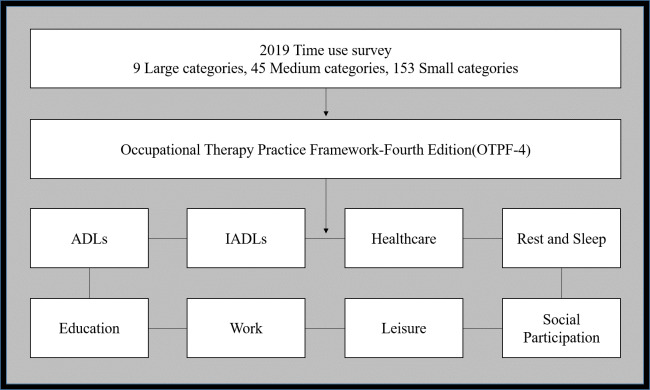
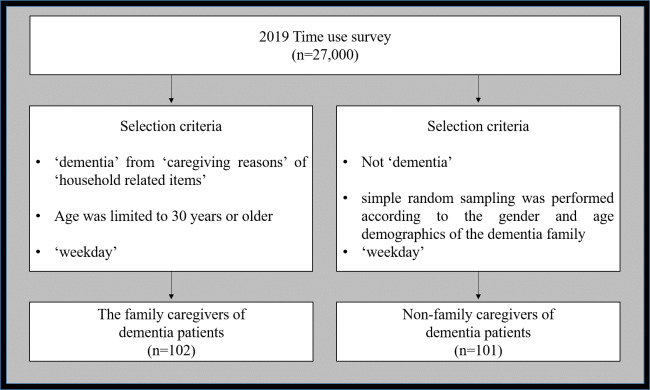
A total of 102 dementia families who responded to the 'time use survey' in 2019 were enrolled in the study. 101 non-dementia families include families who did not respond to the 'dementia' item, and simple random sampling was performed. Time usage according to occupational area and satisfaction level were analyzed based on the Occupational Therapy Practice Framework-Fourth Edition (OTPF-4). Statistical analyses were completed using IBM SPSS 25. The data was analyzed by using frequency analysis and independent two-sample -test. A level of  < 0.05 was used as a cut-off for statistical significance.

RESULTS

As for the time consumption by occupational area of dementia families and non-dementia families, dementia families spent more time than non-dementia families in instrumental daily life activities. The increase in the time for instrumental activities of daily living, including the time for caring for dementia patients, may lead to changes in time use for members of the family with dementia. By comparing the time usage by occupational area according to gender within the dementia families, it was possible to find out the difference between male and female instrumental daily activities and health care time use. The difference in time use according to gender showed that women took on more caring roles than men, and actually spent more time than men.

CONCLUSION

The amount of time used between the dementia family and the non-dementia family differed according to the group and gender. These results suggest that dementia can cause changes in the time usage of dementia family. Therefore, this study recognizes the need for efficient use of time for dementia families and suggests that there is a need for a balanced use of time according to gender.

摘要

背景

本研究旨在调查痴呆患者的家庭照顾者(以下简称痴呆家庭)与痴呆患者的非家庭照顾者(以下简称非痴呆家庭)在时间使用方面的差异。

方法

共纳入 2019 年对“时间使用调查”做出回应的 102 个痴呆家庭。101 个非痴呆家庭包括未对“痴呆”项做出回应的家庭,并进行了简单随机抽样。根据职业治疗实践框架第四版(OTPF-4),分析了按职业领域和满意度划分的时间使用情况。使用 IBM SPSS 25 完成统计分析。使用频率分析和独立两样本 t 检验进行数据分析。<0.05 为统计学显著性的截止值。

结果

就痴呆家庭和非痴呆家庭的职业领域时间消耗而言,痴呆家庭在工具性日常生活活动上花费的时间多于非痴呆家庭。照顾痴呆患者的时间增加,可能导致痴呆患者家庭成员的时间使用发生变化。通过比较痴呆家庭中按性别划分的职业领域时间使用情况,可以发现男性和女性的工具性日常活动和医疗保健时间使用之间的差异。按性别划分的时间使用差异表明,女性承担的照顾角色多于男性,实际上比男性花费更多的时间。

结论

痴呆家庭和非痴呆家庭之间的时间使用量因群体和性别而异。这些结果表明,痴呆可能导致痴呆家庭时间使用的变化。因此,本研究认识到需要有效利用痴呆家庭的时间,并建议根据性别平衡时间使用。
https://cdn.ncbi.nlm.nih.gov/pmc/blobs/968b/10108852/95ae2a76345c/peerj-11-15178-g002.jpg
https://cdn.ncbi.nlm.nih.gov/pmc/blobs/968b/10108852/b6bf01094688/peerj-11-15178-g001.jpg
https://cdn.ncbi.nlm.nih.gov/pmc/blobs/968b/10108852/95ae2a76345c/peerj-11-15178-g002.jpg
https://cdn.ncbi.nlm.nih.gov/pmc/blobs/968b/10108852/b6bf01094688/peerj-11-15178-g001.jpg
https://cdn.ncbi.nlm.nih.gov/pmc/blobs/968b/10108852/95ae2a76345c/peerj-11-15178-g002.jpg

相似文献

1
Time usage analysis according to occupational area and satisfaction level in family caregivers of dementia patients.根据职业领域和痴呆症患者家庭照顾者的满意度分析时间利用。
PeerJ. 2023 Apr 14;11:e15178. doi: 10.7717/peerj.15178. eCollection 2023.
2
Time Usage and Satisfaction Based on Occupational Area Between Weekdays and Weekends of Family Caregivers and Non-family Caregivers of Dementia Patients.基于痴呆症患者家庭照料者和非家庭照料者工作日与周末职业领域的时间使用情况及满意度
Ann Indian Acad Neurol. 2024 Sep 1;27(5):543-551. doi: 10.4103/aian.aian_961_23. Epub 2024 Oct 8.
3
Time usage analysis and satisfaction comparison by occupational area according to the sex of single-parent families.按单亲家庭的性别划分,对各职业领域的时间使用情况进行分析,并比较满意度。
World J Clin Cases. 2023 Jul 26;11(21):5097-5107. doi: 10.12998/wjcc.v11.i21.5097.
4
Analyzing Time Use by Occupation Area between Weekdays and Weekends by Gender of Parents in Single-Parent Families.分析单亲家庭中父母性别在工作日和周末的职业领域时间分配。
Occup Ther Int. 2023 Oct 3;2023:8896891. doi: 10.1155/2023/8896891. eCollection 2023.
5
The roles of unmet needs and formal support in the caregiving satisfaction and caregiving burden of family caregivers for persons with dementia.未满足的需求和正式支持在痴呆患者家庭照顾者的照顾满意度和照顾负担中的作用。
Int Psychogeriatr. 2018 Apr;30(4):557-567. doi: 10.1017/S104161021700196X. Epub 2017 Sep 28.
6
Effectiveness of interventions to improve family-staff relationships in the care of people with dementia in residential aged care: a systematic review protocol.改善老年护理机构中痴呆症患者护理中家庭与工作人员关系的干预措施的有效性:一项系统评价方案。
JBI Database System Rev Implement Rep. 2015 Nov;13(11):52-63. doi: 10.11124/jbisrir-2015-2415.
7
Community Occupational Therapy for people with dementia and family carers (COTiD-UK) versus treatment as usual (Valuing Active Life in Dementia [VALID]) study: A single-blind, randomised controlled trial.社区职业疗法对痴呆症患者和家庭照顾者的影响(COTiD-UK)与常规治疗(痴呆症中的积极生活价值[VALID])研究:一项单盲、随机对照试验。
PLoS Med. 2021 Jan 4;18(1):e1003433. doi: 10.1371/journal.pmed.1003433. eCollection 2021 Jan.
8
[A Prediction Model for Unmet Needs of Elders with Dementia and Caregiving Experiences of Family Caregivers].[痴呆老年人未满足需求及家庭照顾者照顾经历的预测模型]
J Korean Acad Nurs. 2016 Oct;46(5):663-674. doi: 10.4040/jkan.2016.46.5.663.
9
Family caregivers' subjective experiences of satisfaction in dementia care: aspects of burden, subjective health and sense of coherence.家庭照顾者在痴呆症护理中满意度的主观体验:负担、主观健康和连贯感等方面
Scand J Caring Sci. 2005 Jun;19(2):157-68. doi: 10.1111/j.1471-6712.2005.00328.x.
10
Evidence-based occupational therapy for people with dementia and their families: What clinical practice guidelines tell us and implications for practice.基于证据的针对痴呆症患者及其家人的职业疗法:临床实践指南告诉我们什么以及对实践的启示。
Aust Occup Ther J. 2017 Feb;64(1):3-10. doi: 10.1111/1440-1630.12309. Epub 2016 Oct 3.

引用本文的文献

1
Time Usage and Satisfaction Based on Occupational Area Between Weekdays and Weekends of Family Caregivers and Non-family Caregivers of Dementia Patients.基于痴呆症患者家庭照料者和非家庭照料者工作日与周末职业领域的时间使用情况及满意度
Ann Indian Acad Neurol. 2024 Sep 1;27(5):543-551. doi: 10.4103/aian.aian_961_23. Epub 2024 Oct 8.

本文引用的文献

1
Family caregiver quality of life and the care provided to older people living with dementia: qualitative analyses of caregiver interviews.家庭照顾者的生活质量与为老年痴呆症患者提供的照顾:对照顾者访谈的定性分析。
BMC Geriatr. 2022 Jan 31;22(1):86. doi: 10.1186/s12877-022-02787-0.
2
Occupational Therapy Practice Framework: Domain and Process-Fourth Edition.《作业治疗实践框架:领域与过程》第四版。
Am J Occup Ther. 2020 Aug 1;74(Supplement_2):7412410010p1-7412410010p87. doi: 10.5014/ajot.2020.74S2001.
3
[Influence of Self-care on Burnout in Primary Family Caregiver of Person with Dementia].
[自我护理对痴呆症患者初级家庭照顾者职业倦怠的影响]
J Korean Acad Nurs. 2021 Apr;51(2):217-231. doi: 10.4040/jkan.20274.
4
A multicountry perspective on gender differences in time use during COVID-19.多国视角下的 COVID-19 期间时间利用的性别差异。
Proc Natl Acad Sci U S A. 2021 Mar 23;118(12). doi: 10.1073/pnas.2018494118.
5
[Shifting of Centricity: Qualitative Meta Synthetic Approach on Caring Experience of Family Members of Patients with Dementia].[中心性的转变:关于痴呆症患者家庭成员照护体验的质性元综合方法]
J Korean Acad Nurs. 2018 Oct;48(5):601-621. doi: 10.4040/jkan.2018.48.5.601.
6
Longitudinal predictors of informal and formal caregiving time in community-dwelling dementia patients.社区痴呆症患者非正规和正规照料时间的纵向预测因素
Soc Psychiatry Psychiatr Epidemiol. 2016 Apr;51(4):607-16. doi: 10.1007/s00127-015-1138-7. Epub 2015 Oct 23.
7
A scoping review of time-use research in occupational therapy and occupational science.职业治疗与职业科学中时间利用研究的范围综述。
Scand J Occup Ther. 2015 Jan;22(1):1-12. doi: 10.3109/11038128.2014.934918. Epub 2014 Aug 19.
8
[Overcoming experiences of family members caring for elderly patients with dementia at home].[家庭成员在家照顾老年痴呆患者的克服经历]
J Korean Acad Nurs. 2013 Jun;43(3):389-98. doi: 10.4040/jkan.2013.43.3.389.
9
Comparison of time use, role participation and life satisfaction of older people after stroke with a sample without stroke.中风后老年人与未中风样本在时间利用、角色参与和生活满意度方面的比较。
Aust Occup Ther J. 2009 Jun;56(3):177-88. doi: 10.1111/j.1440-1630.2007.00728.x.
10
Trajectories of caregiving time provided by wives to their husbands with dementia.妻子为患痴呆症的丈夫提供照料时间的轨迹。
Alzheimer Dis Assoc Disord. 2008 Apr-Jun;22(2):131-6. doi: 10.1097/WAD.0b013e31815bebba.