Escuela de Kinesiología, Facultad de Salud, Universidad Santo Tomás, Los Ángeles 4440000, Chile.
Centro de Investigación Biomédica, Facultad de Medicina, Universidad Diego Portales, Santiago 8370068, Chile.
Int J Environ Res Public Health. 2023 Apr 12;20(8):5490. doi: 10.3390/ijerph20085490.
Although the importance of walking for promoting a better cardiometabolic health is widely known (this includes both cardiovascular and metabolic/endocrine systems), there is little knowledge regarding its appropriate pace to provide adults with more cardiometabolic benefits.
To analyze the associations between different walking pace categories and cardiometabolic health markers in the adult Chilean population.
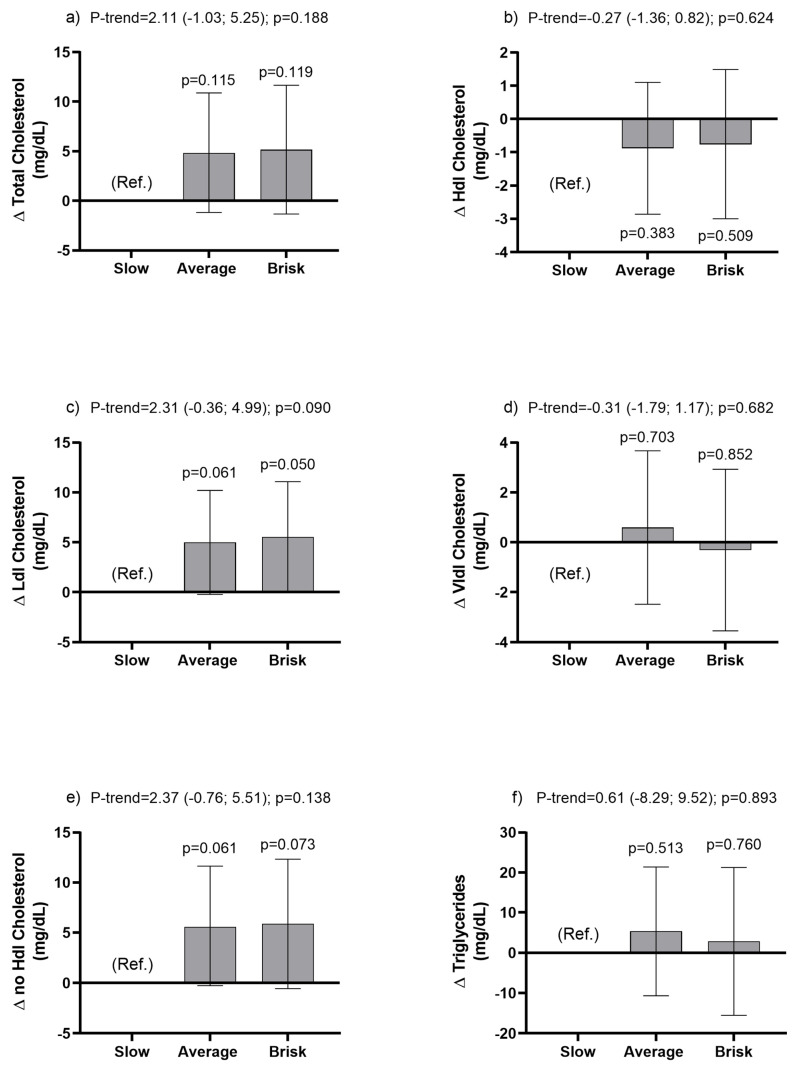
Cross-sectional study. A total of 5520 participants aged 15 to 90 years old from the Chilean National Health Survey (CNHS) 2016-2017 were included. Walking pace categories (slow, average, and brisk) were collected through self-reported methods. Glycaemia, glycosylated hemoglobin (HbA1c), gamma glutamyl transferase (GGT), vitamin D2, vitamin D3, systolic and diastolic blood pressure, and lipid profile (Total, HDL, LDL, VLDL, No HDL cholesterol and triglycerides) were determined using blood sample tests and measured with the standardized methods described in the CNHS 2016-2017.
People who had a brisk walking pace were associated with lower levels of glycaemia, HbA1c, GGT, systolic and diastolic blood pressure, and higher vitamin D3 levels compared with those with a slow walking pace. Moreover, people with a brisk walking pace had lower levels of VLDL cholesterol compared with those with a slow walking pace. However, after adjusting the model to include sociodemographic background, nutritional status, and lifestyle variables, the differences remained only for glycaemia, HbA1c and systolic blood pressure levels.
A brisk walking pace was associated with better cardiometabolic health markers and lipid profile compared with a slow walking pace.
虽然步行对于促进更好的心血代谢健康至关重要(这包括心血管和代谢/内分泌系统),但对于提供成年人更多心血代谢益处的适当步速知之甚少。
分析智利成年人不同步行速度类别与心血代谢健康标志物之间的关联。
横断面研究。共纳入来自智利国家健康调查(CNHS)2016-2017 年的 5520 名年龄在 15 至 90 岁的参与者。步行速度类别(慢、中、快)通过自我报告的方法收集。血糖、糖化血红蛋白(HbA1c)、γ-谷氨酰转移酶(GGT)、维生素 D2、维生素 D3、收缩压和舒张压以及血脂谱(总胆固醇、高密度脂蛋白胆固醇、低密度脂蛋白胆固醇、极低密度脂蛋白胆固醇、无高密度脂蛋白胆固醇和甘油三酯)通过血液样本测试确定,并使用 CNHS 2016-2017 中描述的标准化方法进行测量。
与慢步速相比,快步速与较低的血糖、HbA1c、GGT、收缩压和舒张压水平以及较高的维生素 D3 水平相关。此外,快步速者的 VLDL 胆固醇水平低于慢步速者。然而,在将模型调整为包括社会人口统计学背景、营养状况和生活方式变量后,仅血糖、HbA1c 和收缩压水平的差异仍然存在。
与慢步速相比,快步速与更好的心血代谢健康标志物和血脂谱相关。