Isa Hasan M, Alkharsi Fatema A, Ebrahim Hana A, Walwil Kamel J, Diab Jumana A, Alkowari Nafelah M
Department of Pediatrics, Salmaniya Medical Complex, Manama 26671, Bahrain.
Department of Pediatrics, Arabian Gulf University, Manama 26671, Bahrain.
World J Gastrointest Endosc. 2023 Apr 16;15(4):297-308. doi: 10.4253/wjge.v15.i4.297.
Gastrointestinal bleeding (GIB) is a serious health problem worldwide, particularly during childhood. This can be an alarming sign of an underlying disease. Gastrointestinal endoscopy (GIE) is a safe method for the diagnosis and treatment of GIB in most cases.
To determine the incidence, clinical presentation, and outcomes of GIB in children in Bahrain over the last two decades.
This was a retrospective cohort review of the medical records of children with GIB who underwent endoscopic procedures in the Pediatric Department at Salmaniya Medical Complex, Bahrain, between 1995 and 2022. Demographic data, clinical presentation, endoscopic findings, and clinical outcomes were recorded. GIB was classified into upper (UGIB) and lower (LGIB) GIB according to the site of bleeding. These were compared with respect to patients' sex, age, and nationality using the Fisher's exact, Pearson's , or the Mann-Whitney U tests.
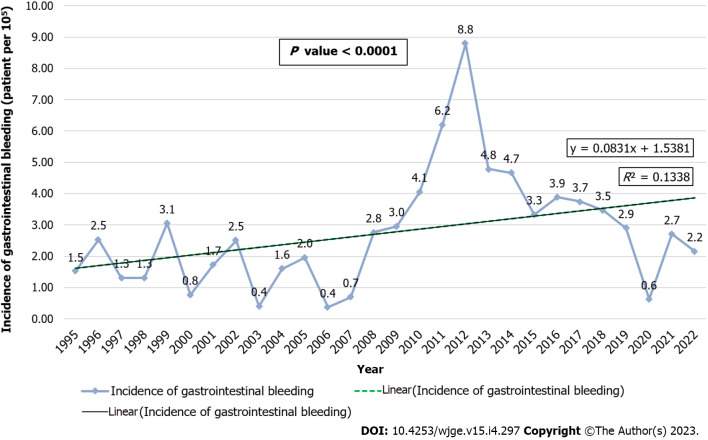
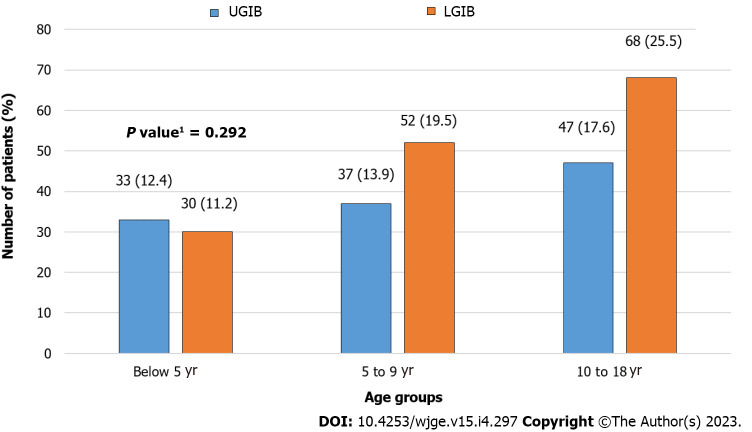
A total of 250 patients were included in this study. The median incidence was 2.6/100000 per year (interquartile range, 1.4-3.7) with a significantly increasing trend over the last two decades ( < 0.0001). Most patients were males ( = 144, 57.6%). The median age at diagnosis was 9 years (5-11). Ninety-eight (39.2%) patients required upper GIE alone, 41 (16.4%) required colonoscopy alone, and 111 (44.4%) required both. LGIB was more frequent ( = 151, 60.4%) than UGIB ( = 119, 47.6%). There were no significant differences in sex ( = 0.710), age ( = 0.185), or nationality ( = 0.525) between the two groups. Abnormal endoscopic findings were detected in 226 (90.4%) patients. The common cause of LGIB was inflammatory bowel disease (IBD) ( = 77, 30.8%). The common cause of UGIB was gastritis ( = 70, 28%). IBD and undetermined cause for bleeding were higher in the 10-18 years group ( = 0.026 and = 0.017, respectively). Intestinal nodular lymphoid hyperplasia, foreign body ingestion, and esophageal varices were more common in the 0-4 years group ( = 0.034, < 0.0001, and = 0.029, respectively). Ten (4%) patients underwent one or more therapeutic interventions. The median follow-up period was two years (0.5-3). No mortality was reported in this study.
GIB in children is an alarming condition, whose significance is increasing. LGIB, commonly due to IBD, was more common than UGIB, commonly due to gastritis.
胃肠道出血(GIB)是全球范围内一个严重的健康问题,尤其是在儿童时期。这可能是潜在疾病的一个警示信号。在大多数情况下,胃肠道内镜检查(GIE)是诊断和治疗GIB的一种安全方法。
确定过去二十年来巴林儿童GIB的发病率、临床表现及治疗结果。
这是一项对1995年至2022年间在巴林萨勒曼尼亚医疗中心儿科接受内镜检查的GIB患儿病历进行的回顾性队列研究。记录人口统计学数据、临床表现、内镜检查结果及临床治疗结果。根据出血部位,GIB分为上消化道出血(UGIB)和下消化道出血(LGIB)。使用Fisher精确检验、Pearson卡方检验或Mann-Whitney U检验对两组患者的性别、年龄和国籍进行比较。
本研究共纳入250例患者。年发病率中位数为2.6/100000(四分位间距为1.4 - 3.7),在过去二十年中有显著上升趋势(P < 0.0001)。大多数患者为男性(n = 144,57.6%)。诊断时的年龄中位数为9岁(5 - 11岁)。98例(39.2%)患者仅需进行上消化道内镜检查,41例(16.4%)患者仅需进行结肠镜检查,111例(44.4%)患者两者均需进行。LGIB比UGIB更常见(n = 151,60.4% 对比 n = 119,47.6%)。两组在性别(P = 0.710)、年龄(P = 0.185)或国籍(P = 0.525)方面无显著差异。226例(90.4%)患者发现有异常内镜检查结果。LGIB的常见病因是炎症性肠病(IBD)(n = 77,30.8%)。UGIB的常见病因是胃炎(n = 70,28%)。IBD和不明原因出血在10 - 18岁年龄组中更高(分别为P = 0.026和P = 0.017)。肠道结节性淋巴组织增生、异物摄入和食管静脉曲张在0 - 4岁年龄组中更常见(分别为P = 0.034、P < 0.0001和P = 0.029)。10例(4%)患者接受了一项或多项治疗干预。中位随访期为两年(0.5 - 3年)。本研究中未报告死亡病例。
儿童GIB是一种令人担忧的疾病,其重要性日益增加。通常由IBD引起的LGIB比通常由胃炎引起的UGIB更常见。