Division of Geological and Planetary Sciences, California Institute of Technology, Pasadena, CA 91125.
Department of Molecular and Cell Biology, University of California, Berkeley, Berkeley, CA 94720.
Proc Natl Acad Sci U S A. 2023 May 16;120(20):e2300466120. doi: 10.1073/pnas.2300466120. Epub 2023 May 8.
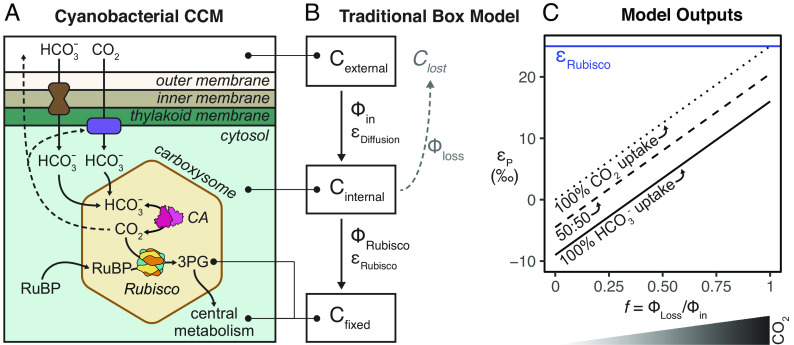
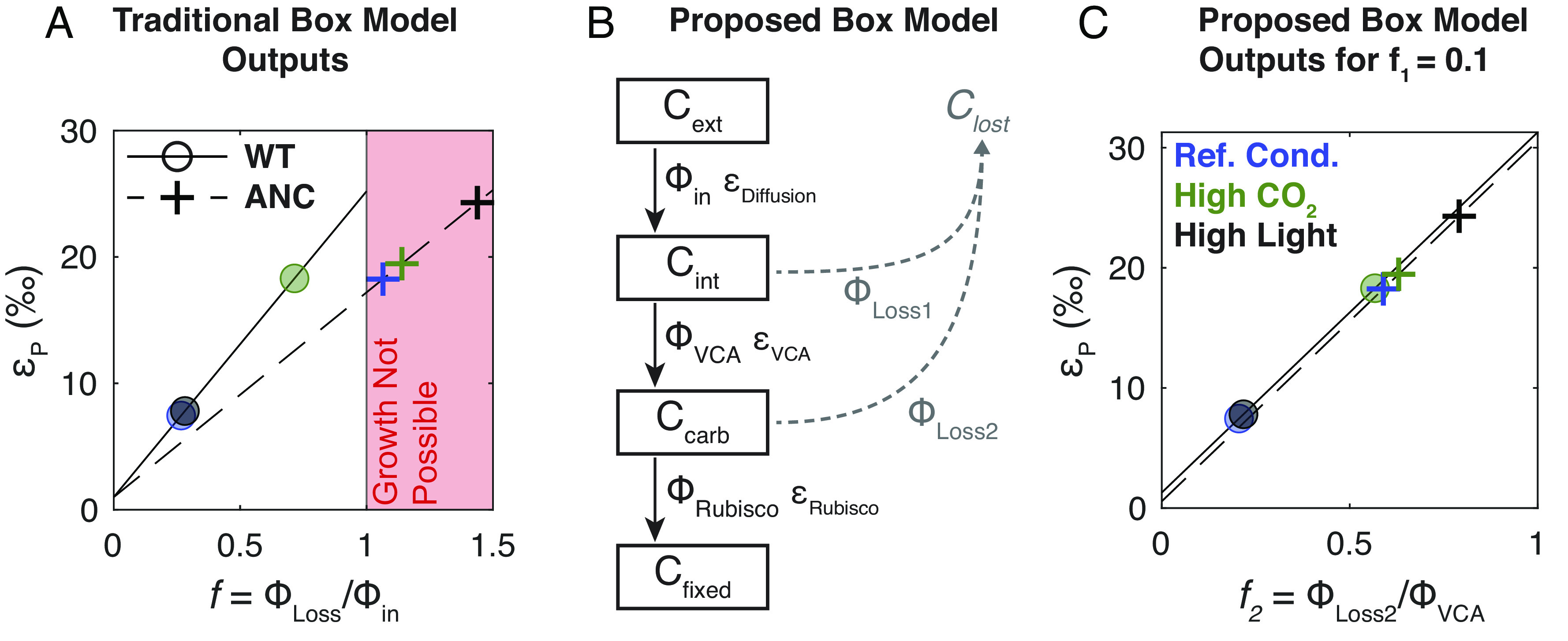
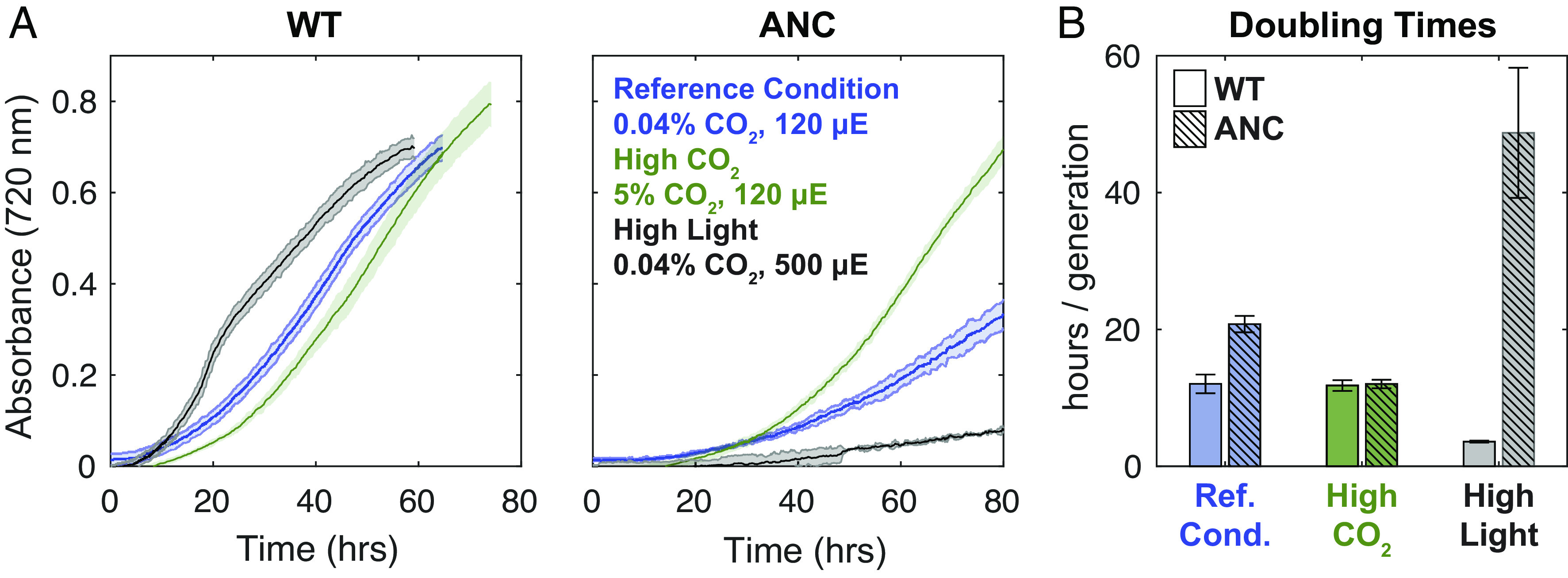
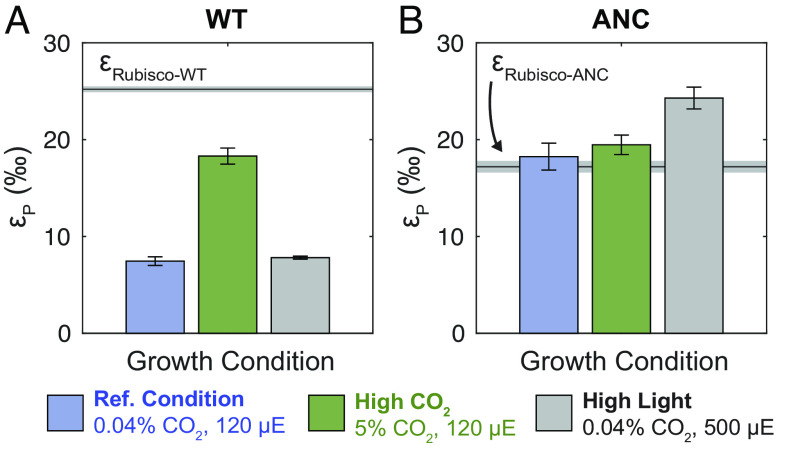
The history of Earth's carbon cycle reflects trends in atmospheric composition convolved with the evolution of photosynthesis. Fortunately, key parts of the carbon cycle have been recorded in the carbon isotope ratios of sedimentary rocks. The dominant model used to interpret this record as a proxy for ancient atmospheric CO is based on carbon isotope fractionations of modern photoautotrophs, and longstanding questions remain about how their evolution might have impacted the record. Therefore, we measured both biomass (ε) and enzymatic (ε) carbon isotope fractionations of a cyanobacterial strain ( PCC 7942) solely expressing a putative ancestral Form 1B rubisco dating to ≫1 Ga. This strain, nicknamed ANC, grows in ambient pCO and displays larger ε values than WT, despite having a much smaller ε (17.23 ± 0.61‰ vs. 25.18 ± 0.31‰, respectively). Surprisingly, ANC ε exceeded ANC ε in all conditions tested, contradicting prevailing models of cyanobacterial carbon isotope fractionation. Such models can be rectified by introducing additional isotopic fractionation associated with powered inorganic carbon uptake mechanisms present in Cyanobacteria, but this amendment hinders the ability to accurately estimate historical pCO from geological data. Understanding the evolution of rubisco and the CO concentrating mechanism is therefore critical for interpreting the carbon isotope record, and fluctuations in the record may reflect the evolving efficiency of carbon fixing metabolisms in addition to changes in atmospheric CO.
地球碳循环的历史反映了大气成分的趋势,与光合作用的演化交织在一起。幸运的是,碳循环的关键部分已经在沉积岩的碳同位素比值中记录下来。解释这一记录作为古代大气 CO 替代物的主要模型是基于现代光自养生物的碳同位素分馏,关于它们的进化如何影响这一记录,仍然存在长期存在的问题。因此,我们仅对一种表达假定的祖先 1B Rubisco 的蓝细菌菌株(PCC 7942)进行了生物量(ε)和酶(ε)碳同位素分馏的测量,该 Rubisco 可追溯到 ≫1 Ga。这种被称为 ANC 的菌株在环境 pCO 下生长,表现出比 WT 更大的 ε 值,尽管 ε 值要小得多(分别为 17.23 ± 0.61‰和 25.18 ± 0.31‰)。令人惊讶的是,在所有测试条件下,ANC ε 都超过了 ANC ε,这与流行的蓝细菌碳同位素分馏模型相矛盾。可以通过引入与蓝细菌中存在的无机碳摄取机制相关的额外同位素分馏来纠正这些模型,但这种修正会阻碍从地质数据准确估计历史 pCO 的能力。因此,了解 Rubisco 的进化和 CO 浓缩机制对于解释碳同位素记录至关重要,记录的波动可能反映了除大气 CO 变化之外,碳固定代谢的进化效率的变化。