Department of Molecular and Cellular Biology, University of Arizona, Tucson, AZ, USA.
Department of Organismic and Evolutionary Biology, Harvard University, Cambridge, MA, USA.
ISME J. 2021 Aug;15(8):2183-2194. doi: 10.1038/s41396-021-00971-5. Epub 2021 Apr 12.
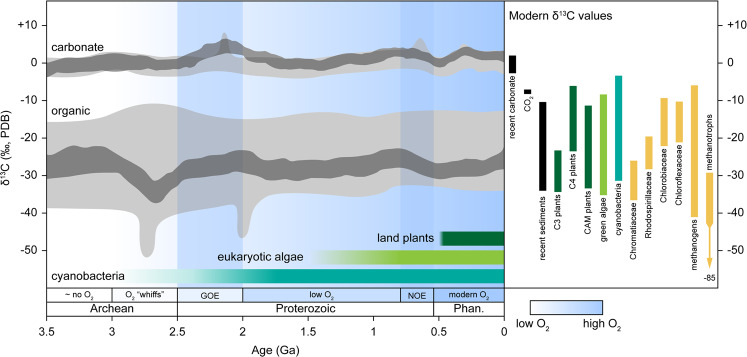
The oldest and most wide-ranging signal of biological activity (biosignature) on our planet is the carbon isotope composition of organic materials preserved in rocks. These biosignatures preserve the long-term evolution of the microorganism-hosted metabolic machinery responsible for producing deviations in the isotopic compositions of inorganic and organic carbon. Despite billions of years of ecosystem turnover, evolutionary innovation, organismic complexification, and geological events, the organic carbon that is a residuum of the global marine biosphere in the rock record tells an essentially static story. The ~25‰ mean deviation between inorganic and organic C/C values has remained remarkably unchanged over >3.5 billion years. The bulk of this record is conventionally attributed to early-evolved, RuBisCO-mediated CO fixation that, in extant oxygenic phototrophs, produces comparable isotopic effects and dominates modern primary production. However, billions of years of environmental transition, for example, in the progressive oxygenation of the Earth's atmosphere, would be expected to have accompanied shifts in the predominant RuBisCO forms as well as enzyme-level adaptive responses in RuBisCO CO-specificity. These factors would also be expected to result in preserved isotopic signatures deviating from those produced by extant RuBisCO in oxygenic phototrophs. Why does the bulk carbon isotope record not reflect these expected environmental transitions and evolutionary innovations? Here, we discuss this apparent discrepancy and highlight the need for greater quantitative understanding of carbon isotope fractionation behavior in extant metabolic pathways. We propose novel, laboratory-based approaches to reconstructing ancestral states of carbon metabolisms and associated enzymes that can constrain isotopic biosignature production in ancient biological systems. Together, these strategies are crucial for integrating the complementary toolsets of biological and geological sciences and for interpretation of the oldest record of life on Earth.
地球上最古老、最广泛的生物活动信号(生物特征)是保存在岩石中的有机物质的碳同位素组成。这些生物特征保存了负责产生无机碳和有机碳同位素组成偏差的微生物宿主代谢机制的长期演化。尽管经历了数十亿年的生态系统更替、进化创新、生物复杂化和地质事件,岩石记录中全球海洋生物圈的残余有机碳讲述了一个基本静态的故事。无机碳和有机碳 C/C 值之间的平均偏差约为 25‰,在超过 35 亿年的时间里保持着惊人的不变。这个记录的大部分通常归因于早期进化的、Rubisco 介导的 CO 固定,在现存的有氧光合生物中,它产生类似的同位素效应,并主导现代初级生产。然而,数十亿年的环境转变,例如地球大气的逐渐氧化,预计会伴随着主要 Rubisco 形式的转变以及 Rubisco CO 特异性的酶水平适应反应。这些因素也预计会导致保留下的同位素特征偏离现存 Rubisco 在有氧光合生物中产生的特征。为什么大部分碳同位素记录没有反映出这些预期的环境转变和进化创新?在这里,我们讨论了这种明显的差异,并强调了需要更深入地了解现存代谢途径中碳同位素分馏行为。我们提出了新的、基于实验室的方法来重建碳代谢和相关酶的祖先状态,这可以限制古代生物系统中同位素生物特征的产生。这些策略共同为整合生物学和地质学科学的互补工具集以及解释地球上最古老的生命记录提供了关键。