Department of Medical Oncology, Sun Yat-sen University Cancer Center, State Key Laboratory of Oncology in South China, Collaborative Innovation Center for Cancer Medicine, Guangdong Key Laboratory of Nasopharyngeal Carcinoma Diagnosis and Therapy, No. 651 Dongfeng East Road, Guangzhou, 510060, China.
Department of Clinical Research, Sun Yat-sen University Cancer Center, State Key Laboratory of Oncology in South China, Collaborative Innovation Center for Cancer Medicine, Guangdong Key Laboratory of Nasopharyngeal Carcinoma Diagnosis and Therapy, No. 651 Dongfeng East Road, Guangzhou, 510060, China.
J Hematol Oncol. 2023 May 8;16(1):50. doi: 10.1186/s13045-023-01445-1.
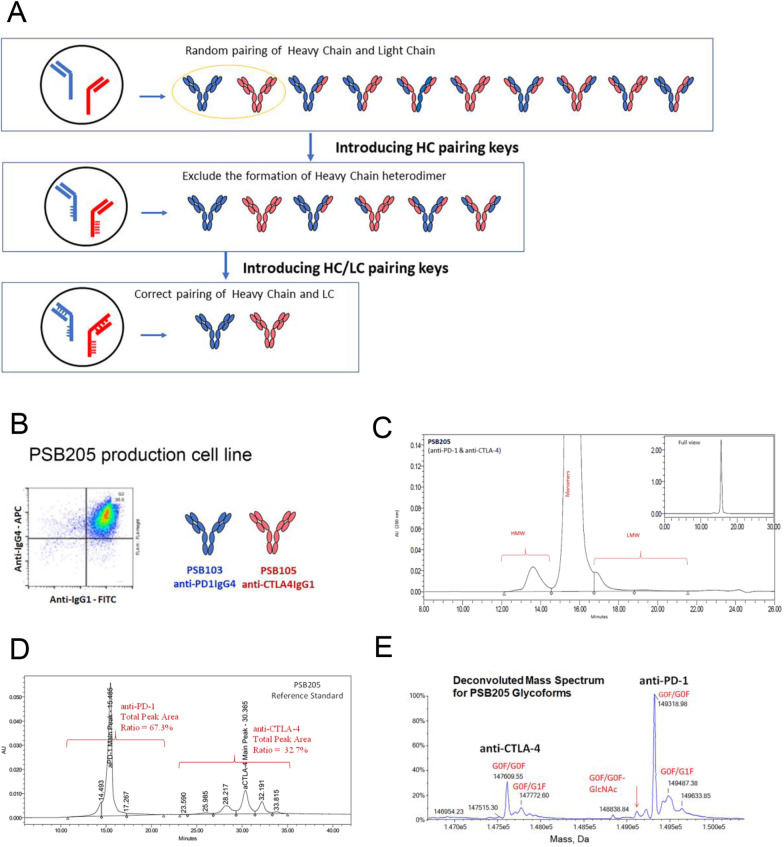
QL1706 (PSB205) is a single bifunctional MabPair (a novel technical platform) product consisting of two engineered monoclonal antibodies (anti-PD-1 IgG4 and anti-CTLA-4 IgG1), with a shorter elimination half-life (t) for CTLA-4. We report results from a phase I/Ib study of QL1706 in patients with advanced solid tumors who failed standard therapies.
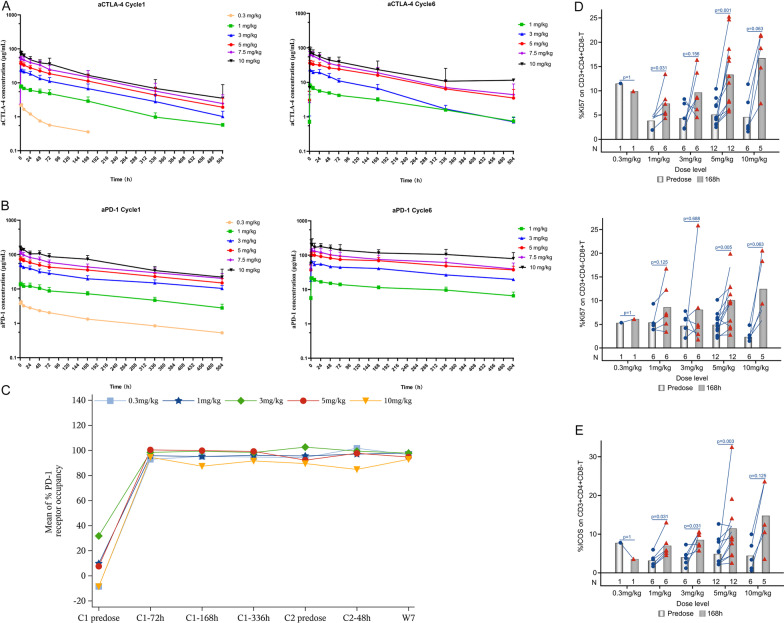
In the phase I study, QL1706 was administered intravenously once every 3 weeks at one of five doses ranging from 0.3 to 10 mg/kg, and the maximum tolerated dose, recommended phase 2 dose (RP2D), safety, pharmacokinetics (PK), and pharmacodynamics (PD) of QL1706 were investigated. In the phase Ib study, QL1706 was administered at the RP2D intravenously every 3 weeks, and the preliminary efficacies in non-small cell lung cancer (NSCLC), nasopharyngeal carcinoma (NPC), cervical cancer (CC), and other solid tumors were evaluated.
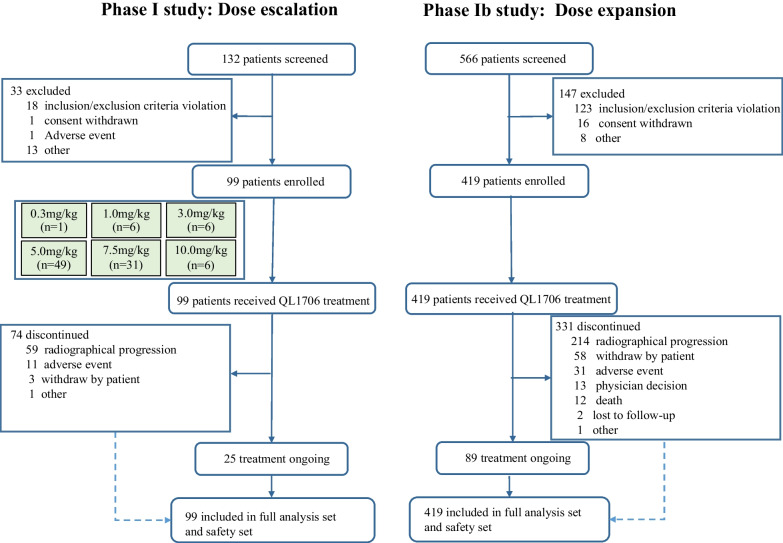
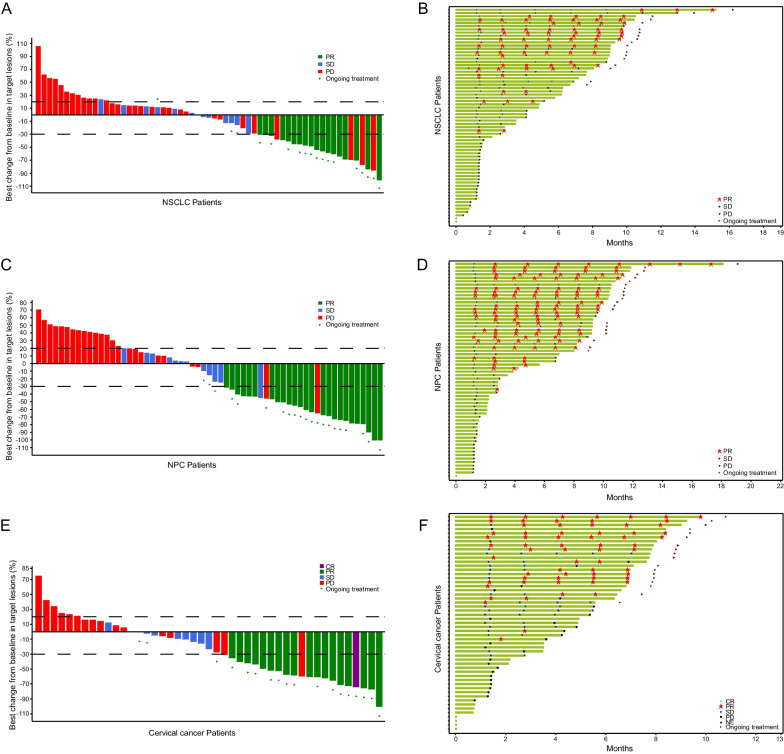
Between March 2020 and July 2021, 518 patients with advanced solid tumors were enrolled (phase I, n = 99; phase Ib, n = 419). For all patients, the three most common treatment-related adverse events (TRAEs) were rash (19.7%), hypothyroidism (13.5%), and pruritus (13.3%). The TRAEs and immune-related adverse events (irAEs) of grade ≥ 3 occurred in 16.0% and 8.1% of patients, respectively. In phase I, 2 of 6 patients in the 10mg/kg group experienced dose-limiting toxicities (DLTs) (grade 3 thrombocytopenia and grade 4 immune-mediated nephritis), so the maximum tolerated dose (MTD) was reached at 10 mg/kg. The RP2D was determined to be 5 mg/kg based on comprehensive analysis of tolerability, PK/PD, and efficacy. For all patients who received QL1706 at the RP2D, the objective response rate (ORR) and median duration of response were 16.9% (79/468) and 11.7 months (8.3-not reached [NR]), respectively; and the ORRs were 14.0% (17/121) in NSCLC, 24.5% (27/110) in NPC, 27.3% (15/55) in CC, 7.4% (2/27) in colorectal cancer, 23.1% (6/26) in small cell lung cancer. For immunotherapy-naive patients, QL1706 exhibited promising antitumor activities, especially in NSCLC, NPC, and CC, with ORRs of 24.2%, 38.7%, and 28.3%, respectively.
QL1706 was well tolerated and demonstrated promising antitumor activity in solid tumors, especially in NSCLC, NPC, and CC patients. It is currently being evaluated in randomized phase II (NCT05576272, NCT05179317) and phase III (NCT05446883, NCT05487391) trials. Trial Registration ClinicalTrials.gov Identifier: NCT04296994 and NCT05171790.
QL1706(PSB205)是一种由两个工程化单克隆抗体(抗 PD-1 IgG4 和抗 CTLA-4 IgG1)组成的单功能 MabPair(一种新型技术平台)产品,其 CTLA-4 的消除半衰期(t)更短。我们报告了在标准治疗失败的晚期实体瘤患者中进行的 QL1706 的 I/ Ib 期研究结果。
在 I 期研究中,QL1706 以 0.3 至 10mg/kg 之间的五个剂量之一每 3 周静脉给药一次,研究了 QL1706 的最大耐受剂量、推荐的 2 期剂量(RP2D)、安全性、药代动力学(PK)和药效学(PD)。在 Ib 期研究中,QL1706 以 RP2D 每 3 周静脉给药一次,评估了非小细胞肺癌(NSCLC)、鼻咽癌(NPC)、宫颈癌(CC)和其他实体瘤的初步疗效。
2020 年 3 月至 2021 年 7 月,共纳入 518 例晚期实体瘤患者(I 期,n=99;Ib 期,n=419)。所有患者中,最常见的三种与治疗相关的不良事件(TRAEs)是皮疹(19.7%)、甲状腺功能减退(13.5%)和瘙痒(13.3%)。16.0%和 8.1%的患者分别发生了 TRAEs 和免疫相关不良事件(irAEs)≥3 级。在 I 期,6 名患者中有 2 名(10mg/kg 组)发生剂量限制毒性(DLT)(3 级血小板减少和 4 级免疫介导的肾炎),因此达到了 10mg/kg 的最大耐受剂量(MTD)。基于对耐受性、PK/PD 和疗效的综合分析,确定 RP2D 为 5mg/kg。所有接受 RP2D QL1706 的患者中,客观缓解率(ORR)和中位缓解持续时间分别为 16.9%(468 例中有 79 例)和 11.7 个月(8.3-NR);在 NSCLC 患者中的 ORR 为 14.0%(121 例中有 17 例),在 NPC 患者中为 24.5%(110 例中有 27 例),在 CC 患者中为 27.3%(55 例中有 15 例),在结直肠癌患者中为 7.4%(27 例中有 2 例),在小细胞肺癌患者中为 23.1%(26 例中有 6 例)。对于免疫治疗初治患者,QL1706 表现出有前景的抗肿瘤活性,特别是在 NSCLC、NPC 和 CC 中,ORR 分别为 24.2%、38.7%和 28.3%。
QL1706 具有良好的耐受性,在实体瘤中表现出有前景的抗肿瘤活性,特别是在 NSCLC、NPC 和 CC 患者中。目前正在进行随机 II 期(NCT05576272、NCT05179317)和 III 期(NCT05446883、NCT05487391)试验评估。临床试验注册ClinicalTrials.gov 标识符:NCT04296994 和 NCT05171790。