AI Sweden, Gothenburg, Sweden.
AI Competence Center, Sahlgrenska University Hospital, Gothenburg, Sweden.
Sci Rep. 2023 May 9;13(1):7555. doi: 10.1038/s41598-023-33863-z.
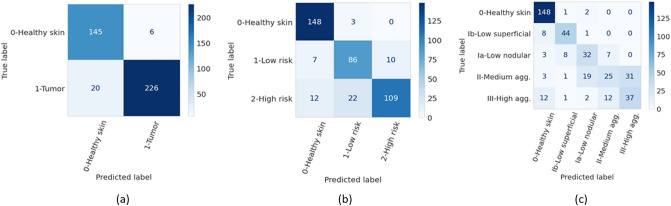
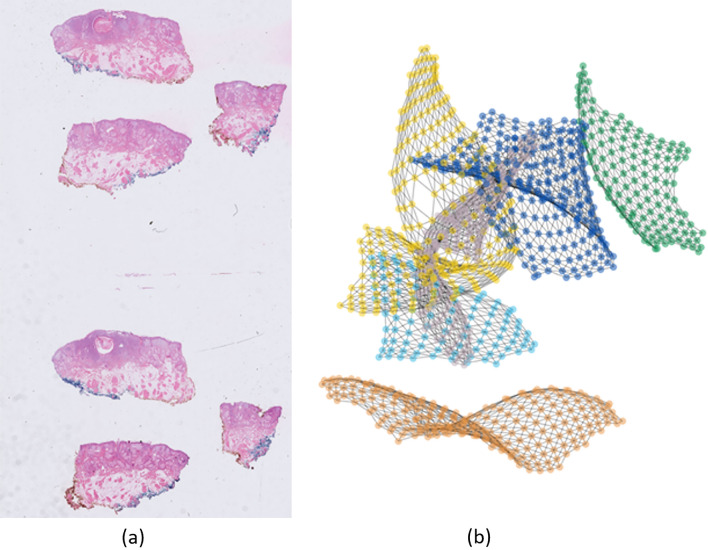
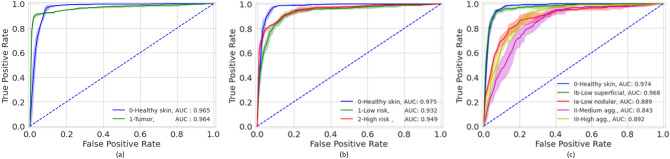
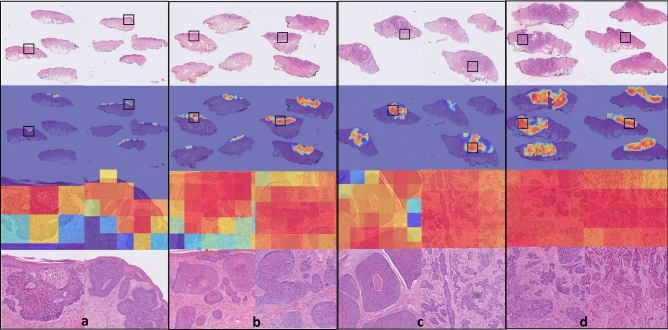
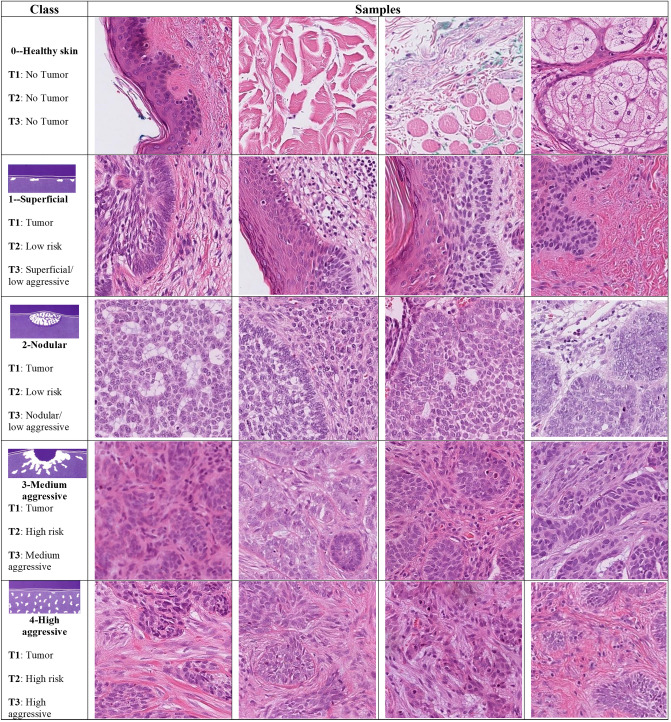
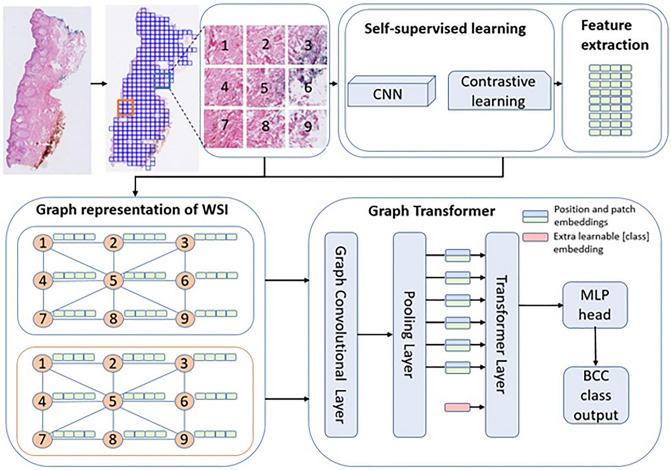
The high incidence rates of basal cell carcinoma (BCC) cause a significant burden at pathology laboratories. The standard diagnostic process is time-consuming and prone to inter-pathologist variability. Despite the application of deep learning approaches in grading of other cancer types, there is limited literature on the application of vision transformers to BCC on whole slide images (WSIs). A total of 1832 WSIs from 479 BCCs, divided into training and validation (1435 WSIs from 369 BCCs) and testing (397 WSIs from 110 BCCs) sets, were weakly annotated into four aggressivity subtypes. We used a combination of a graph neural network and vision transformer to (1) detect the presence of tumor (two classes), (2) classify the tumor into low and high-risk subtypes (three classes), and (3) classify four aggressivity subtypes (five classes). Using an ensemble model comprised of the models from cross-validation, accuracies of 93.5%, 86.4%, and 72% were achieved on two, three, and five class classifications, respectively. These results show high accuracy in both tumor detection and grading of BCCs. The use of automated WSI analysis could increase workflow efficiency.
基底细胞癌 (BCC) 的高发病率给病理实验室带来了巨大负担。标准的诊断过程既耗时又容易受到病理学家之间的差异影响。尽管深度学习方法在其他癌症类型的分级中得到了应用,但将视觉转换器应用于全切片图像 (WSI) 上的 BCC 的文献有限。共有来自 479 个 BCC 的 1832 张 WSI,分为训练和验证集(来自 369 个 BCC 的 1435 张 WSI)和测试集(来自 110 个 BCC 的 397 张 WSI),对侵袭性进行了弱注释,分为四个侵袭性亚型。我们使用图神经网络和视觉转换器的组合来:(1) 检测肿瘤的存在(两类);(2) 将肿瘤分类为低风险和高风险亚型(三类);(3) 将四个侵袭性亚型(五类)进行分类。使用来自交叉验证的模型的集成模型,在两类、三类和五类分类中分别实现了 93.5%、86.4%和 72%的准确率。这些结果表明在 BCC 的肿瘤检测和分级方面具有很高的准确性。自动化 WSI 分析的使用可以提高工作流程效率。