COVID-19 Response, Centers for Disease Control and Prevention, Atlanta, GA 30333, United States.
COVID-19 Response, Centers for Disease Control and Prevention, Atlanta, GA 30333, United States.
Vaccine. 2023 Jun 1;41(24):3604-3610. doi: 10.1016/j.vaccine.2023.04.077. Epub 2023 May 2.
To understand the attitudes towards COVID-19 vaccination and trusted sources of vaccination-related information among persons incarcerated in the Federal Bureau of Prisons.
From June-July 2021, persons incarcerated across 122 facilities operated by the Federal Bureau of Prisons were invited to participate in a survey asking their reasons for receiving or declining COVID-19 vaccination and the information sources they relied upon to make these decisions. Descriptive analyses were conducted.
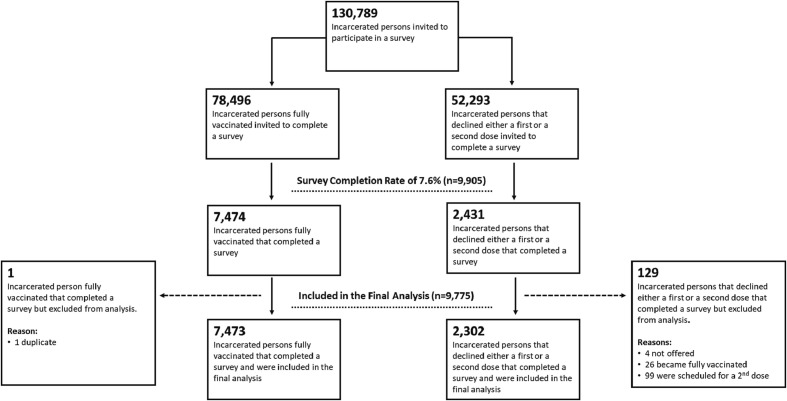
A total of 130,789 incarcerated persons with known vaccination status were invited to participate in the survey. At the time of survey, 78,496 (62%) were fully vaccinated; 3,128 (3%) were partially vaccinated and scheduled to complete their second dose, and 44,394 (35%) had declined either a first or second dose. 7,474 (9.5%) of the fully vaccinated group and 2,302 (4.4%) of the group declining either a first or second dose chose to participate in the survey; an overall survey return rate of 7.6% (n = 9,905). Among vaccinated respondents, the most common reason given for accepting vaccination was to protect their health (n = 5,689; 76.1%). Individuals who declined vaccination cited concerns about vaccine side effects (n = 1,304; 56.6%), mistrust of the vaccine (n = 1,256; 54.6%), and vaccine safety concerns (n = 1,252; 54.4%). Among those who declined, 21.2% (n = 489) reported that they would choose to be vaccinated if the vaccine was offered again. Those who declined also reported that additional information from outside organizations (n = 1128; 49.0%), receiving information regarding vaccine safety (n = 841; 36.5%), and/or speaking with a trusted medical advisor (n = 565; 24.5%) may influence their decision to be vaccinated in the future.
As the COVID-19 pandemic continues, it is important to increase vaccine confidence in prisons, jails, and detention facilities to reduce transmission and severe health outcomes. These survey findings can inform the design of potential interventions to increase COVID-19 vaccine uptake in these settings.
了解联邦监狱中被监禁者对 COVID-19 疫苗接种的态度和信任的疫苗接种相关信息来源。
2021 年 6 月至 7 月,邀请联邦监狱管理局运营的 122 个设施中的被监禁者参与一项调查,询问他们接种 COVID-19 疫苗的原因以及他们用来做出这些决定的信息来源。进行了描述性分析。
共邀请了 130789 名已知接种情况的被监禁者参加调查。在调查时,78496 人(62%)已完全接种疫苗;3128 人(3%)已部分接种疫苗并计划完成第二剂,44394 人(35%)已拒绝接种第一或第二剂。完全接种疫苗组中有 7474 人(9.5%)和拒绝接种第一或第二剂的组中有 2302 人(4.4%)选择参与调查;总体调查回复率为 7.6%(n=9905)。在接种疫苗的受访者中,接受疫苗接种的最常见原因是保护自己的健康(n=5689;76.1%)。拒绝接种疫苗的人提到了对疫苗副作用的担忧(n=1304;56.6%)、对疫苗的不信任(n=1256;54.6%)和疫苗安全性问题(n=1252;54.4%)。在拒绝接种疫苗的人群中,21.2%(n=489)表示如果再次提供疫苗,他们将选择接种疫苗。拒绝接种的人还报告说,来自外部组织的额外信息(n=1128;49.0%)、收到有关疫苗安全性的信息(n=841;36.5%)和/或与值得信赖的医疗顾问交谈(n=565;24.5%)可能会影响他们未来接种疫苗的决定。
随着 COVID-19 大流行的继续,重要的是要提高监狱、拘留所和拘留设施的疫苗信心,以减少传播和严重的健康后果。这些调查结果可以为设计在这些环境中增加 COVID-19 疫苗接种率的潜在干预措施提供信息。