Centre for Outcomes Research and Evaluation, Research Institute of the McGill University Health Centre, Montreal, Quebec, Canada.
Correctional Service Canada (CSC), Ottawa, Ontario, Canada.
PLoS One. 2022 Mar 9;17(3):e0264145. doi: 10.1371/journal.pone.0264145. eCollection 2022.
Vaccine uptake rates have been historically low in correctional settings. To better understand vaccine hesitancy in these high-risk settings, we explored reasons for COVID-19 vaccine refusal among people in federal prisons.
Three maximum security all-male federal prisons in British Columbia, Alberta, and Ontario (Canada) were chosen, representing prisons with the highest proportions of COVID-19 vaccine refusal. Using a qualitative descriptive design and purposive sampling, individual semi-structured interviews were conducted with incarcerated people who had previously refused at least one COVID-19 vaccine until data saturation was achieved. An inductive-deductive thematic analysis of audio-recorded interview transcripts was conducted using the Conceptual Model of Vaccine Hesitancy.
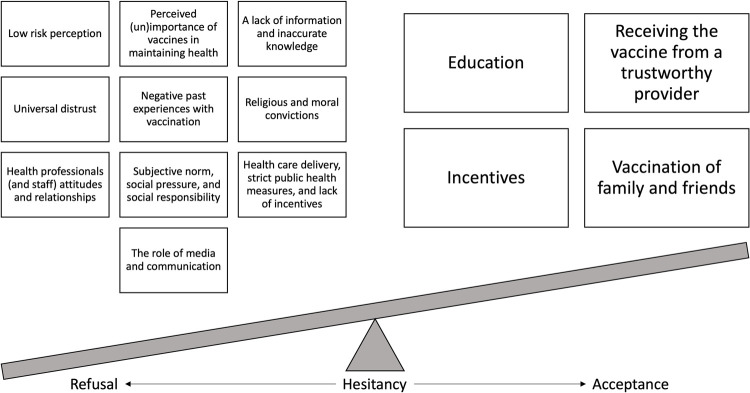
Between May 19-July 8, 2021, 14 participants were interviewed (median age: 30 years; n = 7 Indigenous, n = 4 visible minority, n = 3 White). Individual-, interpersonal-, and system-level factors were identified. Three were particularly relevant to the correctional setting: 1) Risk perception: participants perceived that they were at lower risk of COVID-19 due to restricted visits and interactions; 2) Health care services in prison: participants reported feeling "punished" and stigmatized due to strict COVID-19 restrictions, and failed to identify personal benefits of vaccination due to the lack of incentives; 3) Universal distrust: participants expressed distrust in prison employees, including health care providers.
Reasons for vaccine refusal among people in prison are multifaceted. Educational interventions could seek to address COVID-19 risk misconceptions in prison settings. However, impact may be limited if trust is not fostered and if incentives are not considered in vaccine promotion.
疫苗接种率在监管环境中历来较低。为了更好地了解这些高风险环境中的疫苗犹豫情况,我们探讨了联邦监狱中人们拒绝 COVID-19 疫苗的原因。
在不列颠哥伦比亚省、艾伯塔省和安大略省(加拿大)选择了 3 所最高安全级别的全男性联邦监狱,代表了 COVID-19 疫苗拒绝率最高的监狱。使用定性描述性设计和目的抽样,对至少拒绝过一次 COVID-19 疫苗的在押人员进行了个体半结构化访谈,直到达到数据饱和。使用疫苗犹豫概念模型对音频记录的访谈记录进行了归纳演绎主题分析。
2021 年 5 月 19 日至 7 月 8 日,对 14 名参与者进行了访谈(中位数年龄:30 岁;n = 7 名原住民,n = 4 名少数族裔,n = 3 名白人)。确定了个人、人际和系统层面的因素。其中有 3 个与监管环境特别相关:1)风险感知:参与者认为由于限制访问和互动,他们感染 COVID-19 的风险较低;2)监狱内的医疗服务:参与者报告说,由于严格的 COVID-19 限制,他们感到“受到惩罚”和污名化,并且由于缺乏激励措施,他们无法确定接种疫苗的个人收益;3)普遍不信任:参与者对监狱员工,包括医疗保健提供者,表示不信任。
监狱中人们拒绝疫苗的原因是多方面的。教育干预措施可以试图解决监狱环境中对 COVID-19 风险的误解。然而,如果不信任不被建立,如果在疫苗推广中不考虑激励措施,那么影响可能是有限的。