Department of Neurology, Charité - Universitätsmedizin Berlin, corporate member of Freie Universität Berlin and Humboldt-Universität zu Berlin, Charitéplatz 1, 10117, Berlin, Germany.
Berlin School of Mind and Brain, Humboldt-Universität zu Berlin, Berlin, Germany.
Behav Res Methods. 2024 Mar;56(3):2033-2048. doi: 10.3758/s13428-023-02134-0. Epub 2023 May 11.
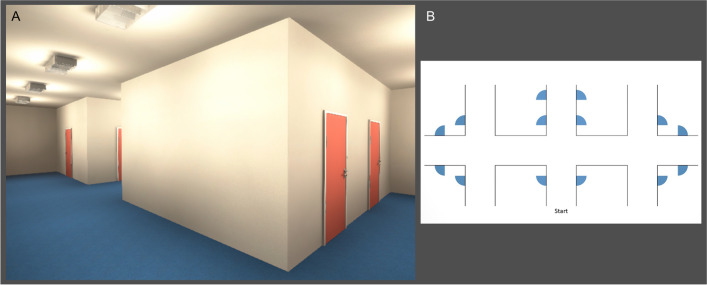
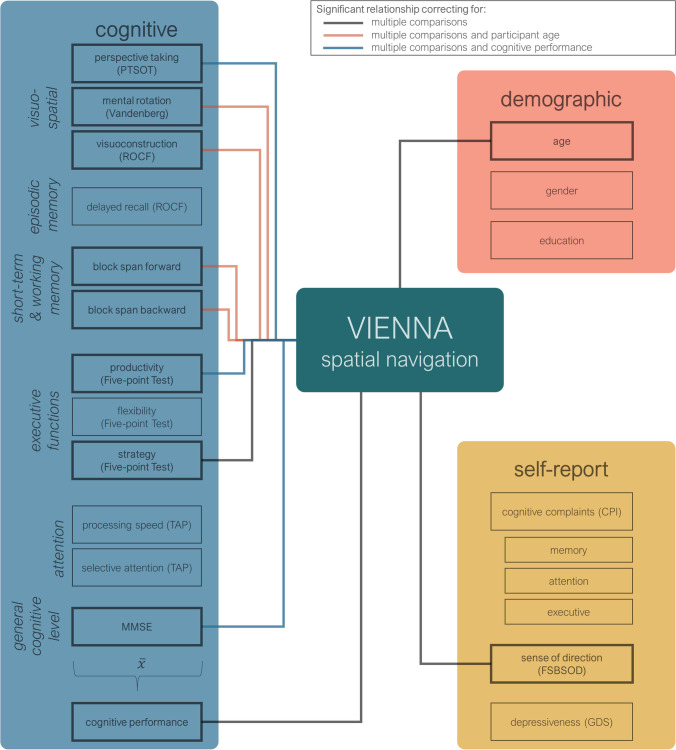
Spatial navigation abilities are frequently impaired in neurological disorders and they also decline with normal aging. Researchers and clinicians therefore need valid and easy-to-use spatial navigation assessment tools to study the impact of different neuropathologies and prevent relevant cognitive impairments from going undetected. However, current experimental paradigms rarely address which cognitive processes they recruit, often have resource-intensive setups, and usually require active navigation, e.g., using a joystick or keyboard, thus confounding cognitive performance with fine motor skills. Yet, for clinical feasibility, time-efficient paradigms are needed that are informative and easy to administer in participants with limited technical experience and diverging impairments. Here, we introduce the virtual environments navigation assessment (VIENNA), a virtual adaptation of a brief, standardized, and intuitive spatial navigation paradigm ( https://osf.io/kp4c5/ ). VIENNA is designed to assess spatial navigation without episodic memory demands, requires no interface device, and takes about 16 min to complete. We evaluated VIENNA in 79 healthy middle-aged to older participants (50-85 years) and provide evidence for its feasibility and construct validity. Tests of visuospatial and executive functions, but not episodic memory or selective attention, were identified as cognitive correlates of VIENNA, even when controlling for participant age and overall cognitive performance. Furthermore, VIENNA scores correlated with subjective navigation ability and age, but not with depressiveness, cognitive complaints, or education. The straightforward administration of VIENNA allows for its integration into routine neuropsychological assessments and enables differentiated evaluation of spatial navigation performance in patients with motor impairments and episodic memory deficits.
空间导航能力在神经障碍中经常受损,而且随着正常衰老而下降。因此,研究人员和临床医生需要有效的、易于使用的空间导航评估工具来研究不同神经病理学的影响,并防止相关认知障碍未被发现。然而,目前的实验范式很少涉及它们招募的认知过程,通常具有资源密集型的设置,并且通常需要主动导航,例如使用操纵杆或键盘,从而将认知表现与精细运动技能混淆。然而,为了临床可行性,需要时间高效的范式,这些范式在具有有限技术经验和不同障碍的参与者中是信息丰富且易于管理的。在这里,我们介绍了虚拟环境导航评估(VIENNA),这是一种简短、标准化和直观的空间导航范式的虚拟改编版(https://osf.io/kp4c5/)。VIENNA 旨在评估无需情节记忆需求的空间导航,不需要接口设备,并且大约需要 16 分钟才能完成。我们在 79 名健康的中老年参与者(50-85 岁)中评估了 VIENNA,并提供了其可行性和结构有效性的证据。即使在控制参与者年龄和整体认知表现的情况下,也发现 VIENNA 与视空间和执行功能测试相关,而与情节记忆或选择性注意力无关。此外,VIENNA 分数与主观导航能力和年龄相关,但与抑郁、认知抱怨或教育无关。VIENNA 的直接管理允许将其集成到常规神经心理评估中,并能够在有运动障碍和情节记忆缺陷的患者中对空间导航表现进行差异化评估。