Yoo Jeong-Ju, Park Man Young, Cho Eun Ju, Yu Su Jong, Kim Sang Gyune, Kim Yoon Jun, Kim Young Seok, Yoon Jung-Hwan
Division of Gastroenterology and Hepatology, Department of Internal Medicine, Soonchunhyang University Bucheon Hospital, Gyeonggi-do 14584, Republic of Korea.
Korea Institute of Oriental Medicine, Daejeon 34054, Republic of Korea.
J Clin Med. 2023 May 8;12(9):3336. doi: 10.3390/jcm12093336.
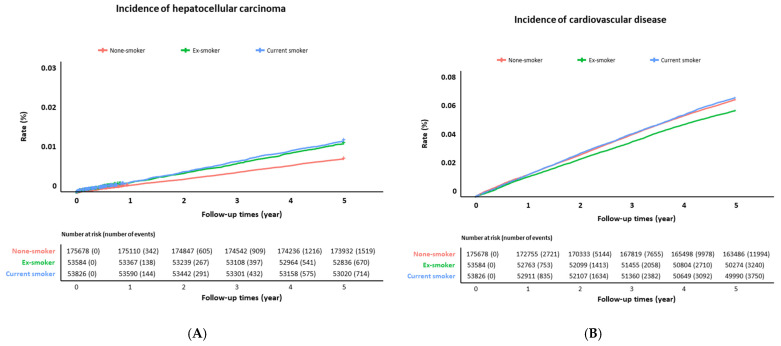
The association of smoking with hepatocellular carcinoma (HCC) or cardiovascular disease (CVD) has been reported, but the study of its relationship with metabolic-associated fatty liver disease (MAFLD) is limited. We aimed to investigate the effect of smoking on the incidence of HCC or CVD in MAFLD patients. Using the Korean nationwide health screening database, we analyzed subjects between 2001 and 2015. A total of 283,088 subjects including 110,863 MAFLD patients and 172,225 controls were analyzed. Smoking status was divided by non-smoker, ex-smoker, or current smoker. In the follow-up period, a total of 2903 (1.0%) subjects developed HCC, and the MAFLD group (1723, 1.6%) had a significantly higher incidence than the control group (1180, 0.7%). In the MAFLD group, current smokers showed significantly higher risk of HCC compared to non-smokers (adjusted HR 1.24, 95% CI 1.08-1.41), whereas the control group did not (adjusted HR 1.07, 95% CI 0.89-1.30). A total of 18,984 (6.7%) patients developed CVD, and the incidence was significantly higher in the MAFLD group (8688, 7.8%) than in the control group (10,296, 6.0%), similar to HCC. The risk of CVD in current smokers increased by 22% compared to non-smokers in the MAFLD group (adjusted HR 1.22, 95% CI 1.15-1.30) and by 21% (adjusted HR 1.21, 95% CI 1.13-1.29) in the control group. Based on sex stratification, men showed increased incidence of both HCC and CVD by smoking, whereas women had only increased risk of CVD. Smoking significantly increases the incidence of HCC and CVD in MAFLD patients; thus, it is highly recommended to quit smoking completely in the population with MAFLD.
吸烟与肝细胞癌(HCC)或心血管疾病(CVD)的关联已有报道,但关于其与代谢相关脂肪性肝病(MAFLD)关系的研究有限。我们旨在研究吸烟对MAFLD患者发生HCC或CVD的影响。利用韩国全国健康筛查数据库,我们分析了2001年至2015年期间的受试者。总共分析了283,088名受试者,包括110,863名MAFLD患者和172,225名对照。吸烟状况分为非吸烟者、既往吸烟者或当前吸烟者。在随访期间,共有2903名(1.0%)受试者发生HCC,MAFLD组(1723例,1.6%)的发病率显著高于对照组(1180例,0.7%)。在MAFLD组中,当前吸烟者发生HCC的风险显著高于非吸烟者(调整后HR 1.24,95%CI 1.08 - 1.41),而对照组则没有(调整后HR 1.07,95%CI 0.89 - 1.30)。共有18,984名(6.7%)患者发生CVD,MAFLD组(8688例,7.8%)的发病率显著高于对照组(10,296例,6.0%),与HCC情况相似。MAFLD组中当前吸烟者发生CVD的风险比非吸烟者增加了22%(调整后HR 1.22,95%CI 1.15 - 1.30),对照组中增加了21%(调整后HR 1.21,95%CI 1.13 - 1.29)。基于性别分层,男性吸烟会使HCC和CVD的发病率均增加,而女性仅CVD风险增加。吸烟显著增加MAFLD患者发生HCC和CVD的发病率;因此,强烈建议MAFLD人群完全戒烟。