Comprehensive Cancer Centre, King's College London, Guy's Campus, Great Maze Pond, London, SE1 1UL, UK.
GRAIL Bio UK Ltd, a subsidiary of GRAIL, LLC, London, WC1V 7HP, UK.
Br J Cancer. 2023 Jul;129(1):72-80. doi: 10.1038/s41416-023-02243-9. Epub 2023 Apr 25.
Screening programmes utilising blood-based multi-cancer early detection (MCED) tests, which can detect a shared cancer signal from any site in the body with a single, low false-positive rate, could reduce cancer burden through early diagnosis.
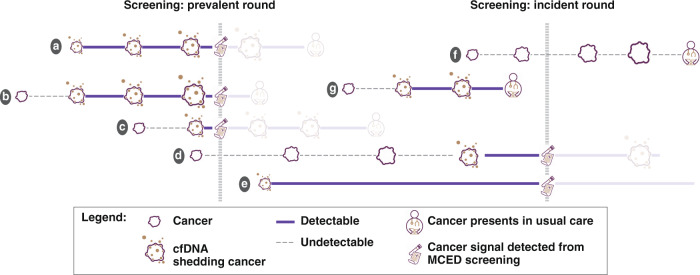
A natural history ('interception') model of cancer was previously used to characterise potential benefits of MCED screening (based on published performance of an MCED test). We built upon this using a two-population survival model to account for an increased risk of death from cfDNA-detectable cancers relative to cfDNA-non-detectable cancers. We developed another model allowing some cancers to metastasise directly from stage I, bypassing intermediate tumour stages. We used incidence and survival-by-stage data from the National Cancer Registration and Analysis Service in England to estimate longer-term benefits to a cohort screened between ages 50-79 years.
Estimated late-stage and mortality reductions were robust to a range of assumptions. With the least favourable dwell (sojourn) time and cfDNA status hazard ratio assumptions, we estimated, among 100,000 screened individuals, 67 (17%) fewer cancer deaths per year corresponding to 2029 fewer deaths in those screened between ages 50-79 years.
Realising the potential benefits of MCED tests could substantially reduce late-stage cancer diagnoses and mortality.
利用基于血液的多癌种早期检测(MCED)检测的筛查计划,这些检测可以通过单次低假阳性率检测到来自身体任何部位的共同癌症信号,从而通过早期诊断来降低癌症负担。
先前使用癌症的自然史(“拦截”)模型来描述 MCED 筛查的潜在益处(基于 MCED 检测的已发表性能)。我们在此基础上使用两人群生存模型来考虑 cfDNA 可检测癌症相对于 cfDNA 不可检测癌症的死亡风险增加。我们还开发了另一个模型,允许一些癌症直接从 I 期转移,绕过中间肿瘤阶段。我们使用英格兰国家癌症登记和分析服务的发病率和按阶段生存数据来估计在 50-79 岁之间进行筛查的队列的长期益处。
估计的晚期和死亡率降低对各种假设具有稳健性。根据最不利的停留(逗留)时间和 cfDNA 状态风险比假设,我们估计在 100,000 名筛查个体中,每年减少 67 例(17%)癌症死亡,相当于在 50-79 岁之间进行筛查的人群中减少 2029 例死亡。
实现 MCED 检测的潜在益处可能会大大减少晚期癌症诊断和死亡率。