Division of Informatics Imaging and Data Sciences, School of Health Sciences, Faculty of Biology, Medicine and Health, Manchester Academic Health Science Centre, Centre for Health Informatics, The University of Manchester, Manchester, United Kingdom.
Department of Health Services and Hospitals Administration, Faculty of Economics and Administration, King Abdulaziz University, Jeddah, Saudi Arabia.
J Med Internet Res. 2023 May 19;25:e44649. doi: 10.2196/44649.
Mass gatherings (MGs; eg, religious, sporting, musical, sociocultural, and other occasions that draw large crowds) pose public health challenges and concerns related to global health. A leading global concern regarding MGs is the possible importation and exportation of infectious diseases as they spread from the attendees to the general population, resulting in epidemic outbreaks. Governments and health authorities use technological interventions to support public health surveillance and prevent and control infectious diseases.
This study aims to review the evidence on the effectiveness of public health digital surveillance systems for infectious disease prevention and control at MG events.
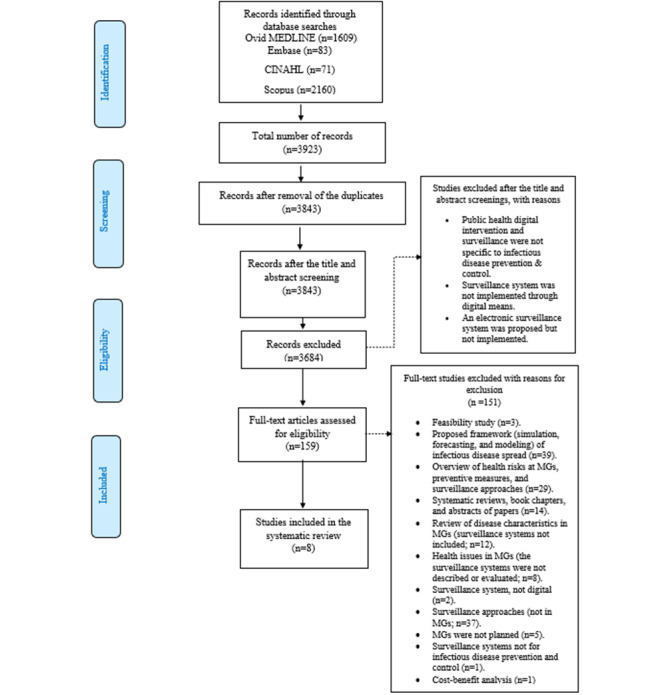
A systematic literature search was conducted in January 2022 using the Ovid MEDLINE, Embase, CINAHL, and Scopus databases to examine relevant articles published in English up to January 2022. Interventional studies describing or evaluating the effectiveness of public health digital surveillance systems for infectious disease prevention and control at MGs were included in the analysis. Owing to the lack of appraisal tools for interventional studies describing and evaluating public health digital surveillance systems at MGs, a critical appraisal tool was developed and used to assess the quality of the included studies.
In total, 8 articles were included in the review, and 3 types of MGs were identified: religious (the Hajj and Prayagraj Kumbh), sporting (the Olympic and Paralympic Games, the Federation International Football Association World Cup, and the Micronesian Games), and cultural (the Festival of Pacific Arts) events. In total, 88% (7/8) of the studies described surveillance systems implemented at MG events, and 12% (1/8) of the studies described and evaluated an enhanced surveillance system that was implemented for an event. In total, 4 studies reported the implementation of a surveillance system: 2 (50%) described the enhancement of the system that was implemented for an event, 1 (25%) reported a pilot implementation of a surveillance system, and 1 (25%) reported an evaluation of an enhanced system. The types of systems investigated were 2 syndromic, 1 participatory, 1 syndromic and event-based, 1 indicator- and event-based, and 1 event-based surveillance system. In total, 62% (5/8) of the studies reported timeliness as an outcome generated after implementing or enhancing the system without measuring its effectiveness. Only 12% (1/8) of the studies followed the Centers for Disease Control and Prevention guidelines for evaluating public health surveillance systems and the outcomes of enhanced systems based on the systems' attributes to measure their effectiveness.
On the basis of the review of the literature and the analysis of the included studies, there is limited evidence of the effectiveness of public health digital surveillance systems for infectious disease prevention and control at MGs because of the absence of evaluation studies.
大型集会(MG;例如,宗教、体育、音乐、社会文化和其他吸引大量人群的活动)对公共卫生构成挑战,并引发与全球健康相关的问题。全球主要关注的问题之一是传染病的可能输入和输出,因为它们会从与会者传播到普通人群,导致疫情爆发。政府和卫生当局使用技术干预措施来支持公共卫生监测,以预防和控制传染病。
本研究旨在回顾关于在 MG 活动中预防和控制传染病的公共卫生数字监测系统的有效性证据。
2022 年 1 月,我们使用 Ovid MEDLINE、Embase、CINAHL 和 Scopus 数据库进行了系统的文献检索,以查阅截至 2022 年 1 月发表的英文相关文章。分析中纳入了描述或评估 MG 中预防和控制传染病的公共卫生数字监测系统有效性的干预性研究。由于缺乏评估描述和评估 MG 中公共卫生数字监测系统的干预性研究的评估工具,因此开发并使用了一个批判性评估工具来评估纳入研究的质量。
共有 8 篇文章被纳入综述,确定了 3 种类型的 MG:宗教(朝觐和普亚格拉杰姆库姆巴)、体育(奥林匹克和残奥会、国际足球联合会世界杯和密克罗尼西亚运动会)和文化(太平洋艺术节)活动。共有 88%(7/8)的研究描述了在 MG 活动中实施的监测系统,12%(1/8)的研究描述和评估了为一项活动实施的增强监测系统。共有 4 项研究报告了监测系统的实施情况:2 项(50%)描述了为一项活动实施的系统增强情况,1 项(25%)报告了监测系统的试点实施情况,1 项(25%)报告了对增强系统的评估情况。所调查的系统类型有 2 种综合征监测系统、1 种参与式监测系统、1 种综合征和基于事件的监测系统、1 种指标和基于事件的监测系统以及 1 种基于事件的监测系统。共有 62%(5/8)的研究报告了在实施或增强系统后作为生成的结果的及时性,而没有衡量其有效性。只有 12%(1/8)的研究遵循了疾病控制和预防中心的指导方针,根据系统属性评估公共卫生监测系统和增强系统的结果,以衡量其有效性。
根据文献综述和纳入研究的分析,由于缺乏评估研究,MG 中预防和控制传染病的公共卫生数字监测系统的有效性证据有限。
