Department of Ophthalmology, The Second Xiangya Hospital, Central South University, Changsha, 410011, Hunan, China.
Hunan Clinical Research Center of Ophthalmic Disease, Changsha, 410011, Hunan, China.
BMC Ophthalmol. 2023 May 22;23(1):229. doi: 10.1186/s12886-023-02959-5.
This cross-sectional study aimed to reveal the association between ocular surface disorders and psychological, physiological situations among autoimmune rheumatic patients.
Ninety autoimmune rheumatic patients (180 eyes) hospitalized in the Department of Rheumatology, The Second Xiangya Hospital, Central South University and 30 controls (60 eyes) were enrolled in the study. All participants were assessed for ocular surface disorders including dry eye disease (DED) by the Ocular Surface Disease Index (OSDI) for symptoms evaluation, and slim lamp examinations for tear break-up time (TBUT), meibomian gland secretion, symblepharon and corneal clarity, Schirmer I test, corneal fluorescein staining (CFS), lid-parallel conjunctival folds (LIPCOF). Systematic conditions were evaluated using the Short Form 36-Health Survey (SF-36) for health-related quality of life, Hospital Anxiety and Depression Scale (HADS) for anxiety and depression, Health Assessment Questionnaire-Disability Index (HAQ-DI) for difficulties in activities of daily living, and Pittsburgh Sleep Quality Index (PSQI) for sleep quality. Pearson and spearman's analysis were conducted to examine the relationship between systematic conditions and ocular surface conditions.
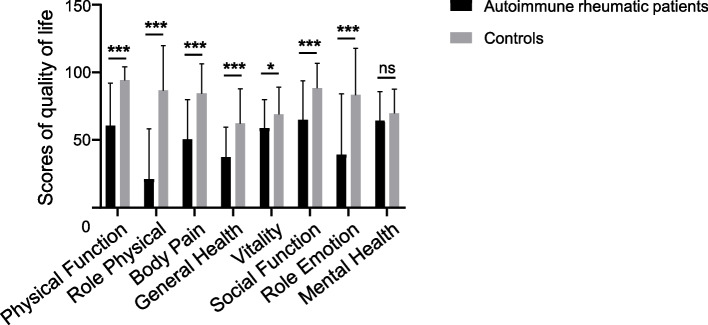
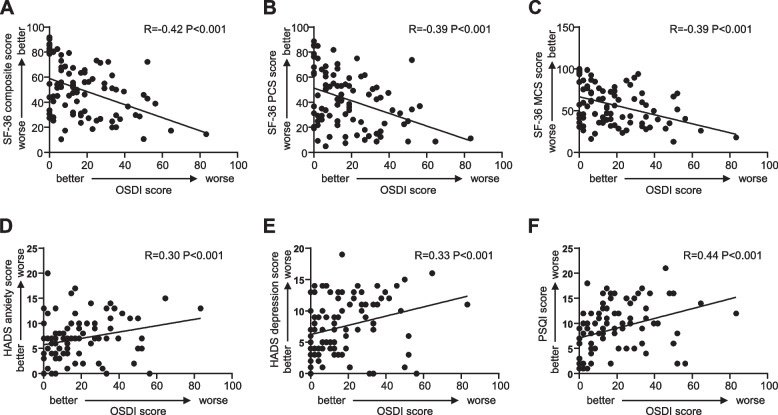
The analyses were controlled for age and sex. 52.22% of eyes (94 in 180) of autoimmune rheumatic patients and 21.67% of eyes (13 in 60) of controls were diagnosed with DED. The autoimmune rheumatic patients showed significant higher OSDI score, fewer basal tear secretion, more severe CFS and conjunctivochalasis than controls. There were no statistically significant differences in TBUT, meibomian gland secretion, symblepharon, and corneal clarity between the two groups. For systematic conditions, autoimmune rheumatic patients had significantly lower SF-36 scores, higher anxiety scores, and HAQ-DI scores than controls. No statistically significant differences were detected in depression scores and PSQI between the two groups. Among autoimmune rheumatic patients, OSDI scores were moderately correlated with quality of life, anxiety, depression and sleep quality.
Factors including quality of life, anxiety, depression, and sleep quality are associated with ocular surface conditions, especially DED symptoms. Management of systemic conditions and psychotherapy should also be considered as part of the treatment among autoimmune rheumatic patients.
本横断面研究旨在揭示自身免疫性风湿病患者的眼表面疾病与心理、生理状况之间的关系。
纳入中南大学湘雅二医院风湿免疫科的 90 例(180 只眼)自身免疫性风湿病患者和 30 例(60 只眼)对照者。所有参与者均接受眼表面疾病评估,包括干眼疾病(DED)的眼表面疾病指数(OSDI)症状评估和泪膜破裂时间(TBUT)、睑板腺分泌、睑球粘连和角膜清晰度的裂隙灯检查、Schirmer I 试验、角膜荧光素染色(CFS)、睑缘平行结膜皱褶(LIPCOF)。使用健康相关生活质量的 36 项健康调查简表(SF-36)、焦虑和抑郁的医院焦虑和抑郁量表(HADS)、日常生活活动困难的健康评估问卷残疾指数(HAQ-DI)和睡眠质量的匹兹堡睡眠质量指数(PSQI)评估系统性疾病。采用 Pearson 和 Spearman 分析评估系统性疾病与眼表面状况之间的关系。
分析时控制了年龄和性别。自身免疫性风湿病患者的 52.22%(180 只眼中的 94 只)和对照组的 21.67%(60 只眼中的 13 只)被诊断为 DED。与对照组相比,自身免疫性风湿病患者的 OSDI 评分更高,基础泪液分泌更少,CFS 和结膜松弛症更严重。两组间 TBUT、睑板腺分泌、睑球粘连和角膜清晰度无统计学差异。在系统性疾病方面,自身免疫性风湿病患者的 SF-36 评分、焦虑评分和 HAQ-DI 评分均明显低于对照组。两组间抑郁评分和 PSQI 无统计学差异。在自身免疫性风湿病患者中,OSDI 评分与生活质量、焦虑、抑郁和睡眠质量呈中度相关。
生活质量、焦虑、抑郁和睡眠质量等因素与眼表面状况相关,尤其是 DED 症状。在自身免疫性风湿病患者中,应考虑系统性疾病的管理和心理治疗作为治疗的一部分。