Yi Yuxi, Lu Weiqing, Shen Lijun, Wu Yang, Zhang Zhen
Department of Radiation Oncology, Fudan University Shanghai Cancer Center, Shanghai, China.
Department of Oncology, Shanghai Medical College, Fudan University, Shanghai, China.
Exp Hematol Oncol. 2023 May 22;12(1):48. doi: 10.1186/s40164-023-00410-5.
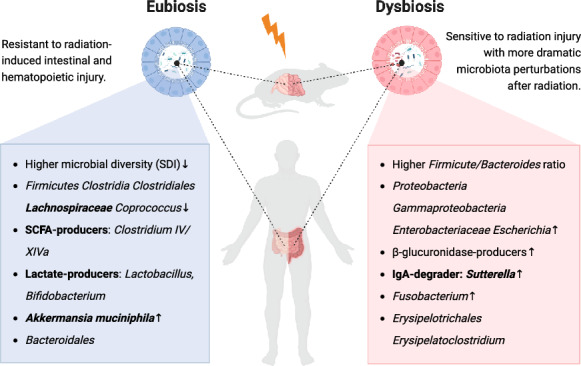
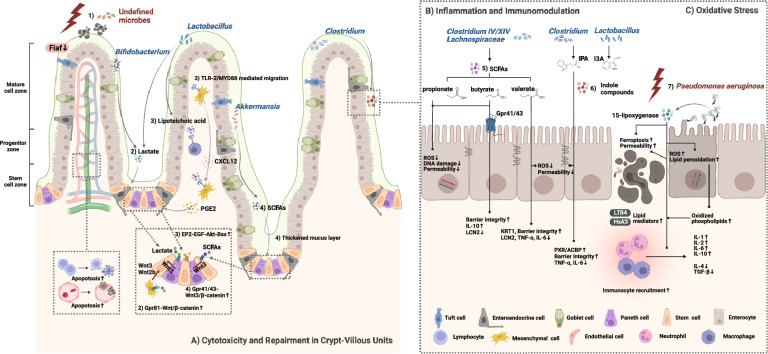
Approximately 60-80% of cancer patients treated with abdominopelvic radiotherapy suffer post-radiotherapy toxicities including radiation enteropathy and myelosuppression. Effective preventive and therapeutic strategies are lacking for such radiation injury. The gut microbiota holds high investigational value for deepening our understanding of the pathogenesis of radiation injury, especially radiation enteropathy which resembles inflammatory bowel disease pathophysiology and for facilitating personalized medicine by providing safer therapies tailored for cancer patients. Preclinical and clinical data consistently support that gut microbiota components including lactate-producers, SCFA-producers, indole compound-producers and Akkermansia impose intestinal and hematopoietic radio-protection. These features serve as potential predictive biomarkers for radiation injury, together with the microbial diversity which robustly predicts milder post-radiotherapy toxicities in multiple types of cancer. The accordingly developed manipulation strategies including selective microbiota transplantation, probiotics, purified functional metabolites and ligands to microbe-host interactive pathways are promising radio-protectors and radio-mitigators that merit extensive validation in clinical trials. With massive mechanistic investigations and pilot clinical trials reinforcing its translational value the gut microbiota may boost the prediction, prevention and mitigation of radiation injury. In this review, we summarize the state-of-the-art landmark researches related with radio-protection to provide illuminating insights for oncologists, gastroenterologists and laboratory scientists interested in this overlooked complexed disorder.
接受腹盆腔放疗的癌症患者中,约60%-80%会出现放疗后毒性反应,包括放射性肠病和骨髓抑制。目前缺乏针对此类放射损伤的有效预防和治疗策略。肠道微生物群对于加深我们对放射损伤发病机制的理解具有很高的研究价值,尤其是对于类似于炎症性肠病病理生理学的放射性肠病,并且通过提供针对癌症患者的更安全疗法来促进个性化医疗。临床前和临床数据一致支持,包括乳酸产生菌、短链脂肪酸产生菌、吲哚化合物产生菌和阿克曼氏菌在内的肠道微生物群成分具有肠道和造血放射保护作用。这些特征可作为放射损伤的潜在预测生物标志物,微生物多样性也能有力地预测多种癌症放疗后较轻的毒性反应。相应开发的干预策略,包括选择性微生物群移植、益生菌、纯化的功能代谢产物以及微生物-宿主相互作用途径的配体,都是很有前景的放射保护剂和放射减轻剂,值得在临床试验中进行广泛验证。随着大量的机制研究和初步临床试验强化了其转化价值,肠道微生物群可能会促进放射损伤的预测、预防和减轻。在这篇综述中,我们总结了与放射保护相关的最新前沿研究,为对这种被忽视的复杂疾病感兴趣的肿瘤学家、胃肠病学家和实验室科学家提供有启发性的见解。