German Centre of Gerontology, Berlin, Germany.
Network Aging Research, Heidelberg University, Heidelberg, Germany.
J Gerontol B Psychol Sci Soc Sci. 2023 Aug 2;78(8):1386-1395. doi: 10.1093/geronb/gbad079.
The main purpose of the study has been to examine changes in Internet use among men and women in 3 age groups (midlife, early old age, and advanced old age) between 2014 and 2021. We tested 2 hypotheses: The complementary hypothesis posits that online activities reproduce gender differences in offline activities. The compensatory hypothesis posits that women are catching up over time in male-typed activities as Internet access approaches saturation for both genders.
We used representative, longitudinal data from the German Ageing Survey collected in 2014, 2017, 2020, and 2021 (n = 21,505, age range 46-90 years). We ran logistic regressions on Internet access and Internet use for 4 different gender-typed activities: social contact (female-typed), shopping (gender-neutral), entertainment (male-typed), and banking (male-typed).
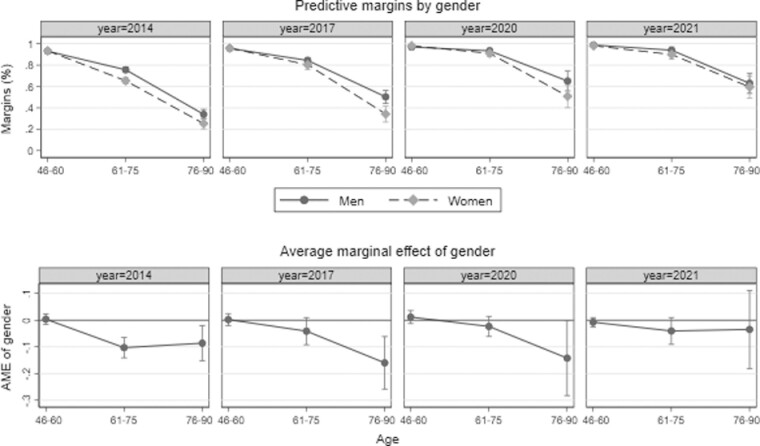
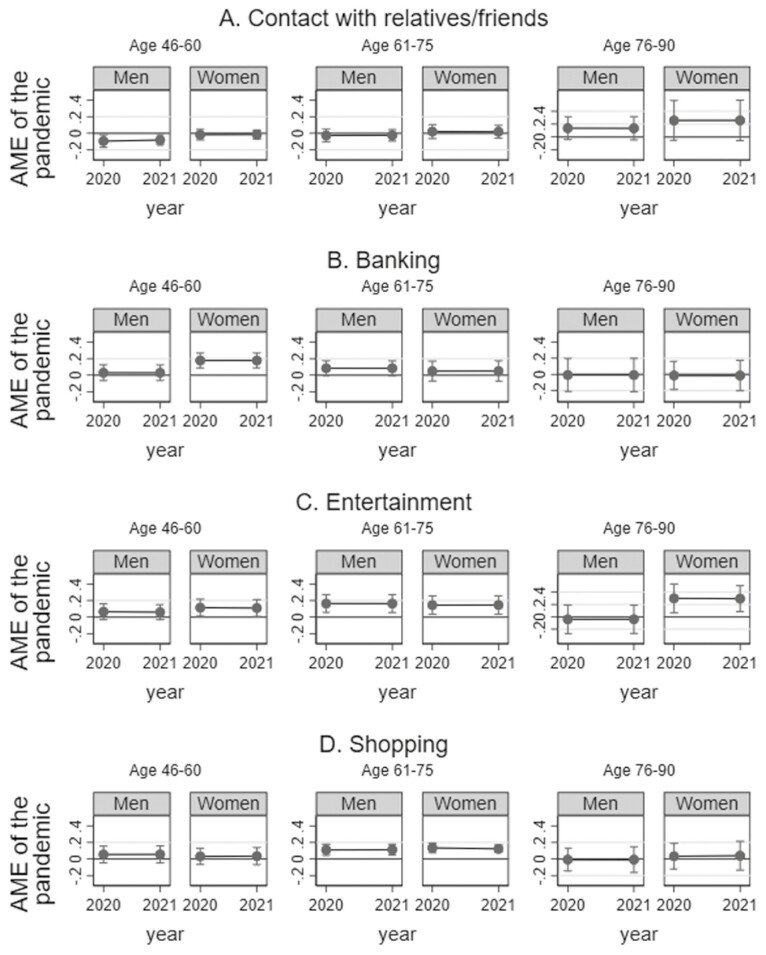
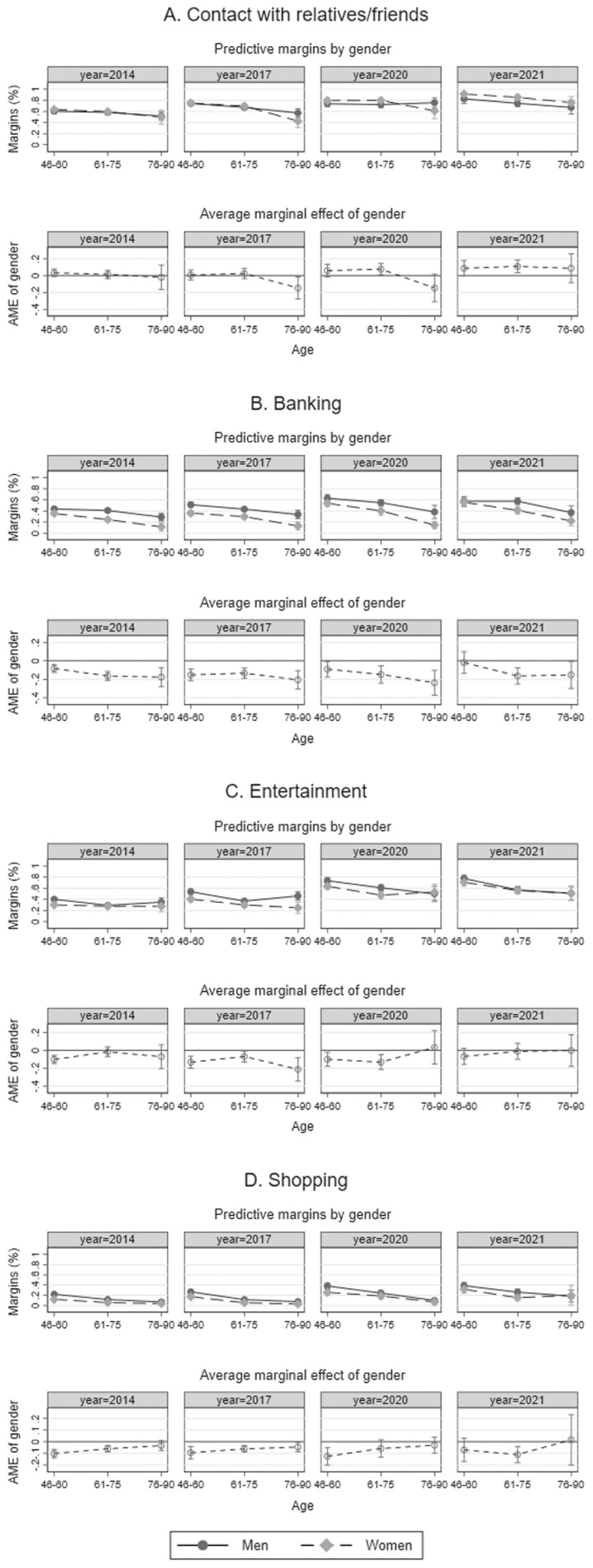
Between 2014 and 2021, women drew level with men in Internet access. Gender differences in all 4 forms of Internet use declined considerably between 2014 and 2021. Women overtook men in using the Internet for social contact. In older age groups, men held the lead regarding online banking. During the coronavirus disease 2019 (COVID-19) crisis, women caught up to men in Internet use, especially for entertainment.
Overall time trends support the complementary hypothesis. By contrast, the finding that women have been catching up in some male-typed online activities during the COVID-19 pandemic supports the compensatory hypothesis.
本研究的主要目的是检验 2014 年至 2021 年间,3 个年龄组(中年、老年早期和老年晚期)的男性和女性在互联网使用方面的变化。我们检验了 2 个假设:互补假设认为,在线活动复制了线下活动中的性别差异。补偿假设认为,随着互联网在两性中接近饱和,女性在男性主导的活动中会随着时间的推移迎头赶上。
我们使用了德国老龄化研究在 2014 年、2017 年、2020 年和 2021 年收集的具有代表性的纵向数据(n=21505,年龄在 46-90 岁之间)。我们对互联网接入和 4 种不同性别类型的活动的互联网使用情况进行了逻辑回归分析:社会联系(女性主导)、购物(性别中立)、娱乐(男性主导)和银行业务(男性主导)。
在 2014 年至 2021 年期间,女性在互联网接入方面与男性持平。2014 年至 2021 年间,所有 4 种形式的互联网使用的性别差异都大大缩小。女性在使用互联网进行社会联系方面超过了男性。在年龄较大的群体中,男性在网上银行业务方面处于领先地位。在 2019 年冠状病毒病(COVID-19)危机期间,女性在互联网使用方面赶上了男性,尤其是在娱乐方面。
总体时间趋势支持互补假设。相比之下,在 COVID-19 大流行期间,女性在一些男性主导的在线活动中迎头赶上的发现支持了补偿假设。