Functional MRI Center, Beilinson Hospital, Rabin Medical Center, Petach Tikva, Israel.
Imaging Department, Beilinson Hospital, Rabin Medical Center, Petach Tikva, Israel.
Hum Brain Mapp. 2023 Aug 1;44(11):4310-4320. doi: 10.1002/hbm.26347. Epub 2023 May 25.
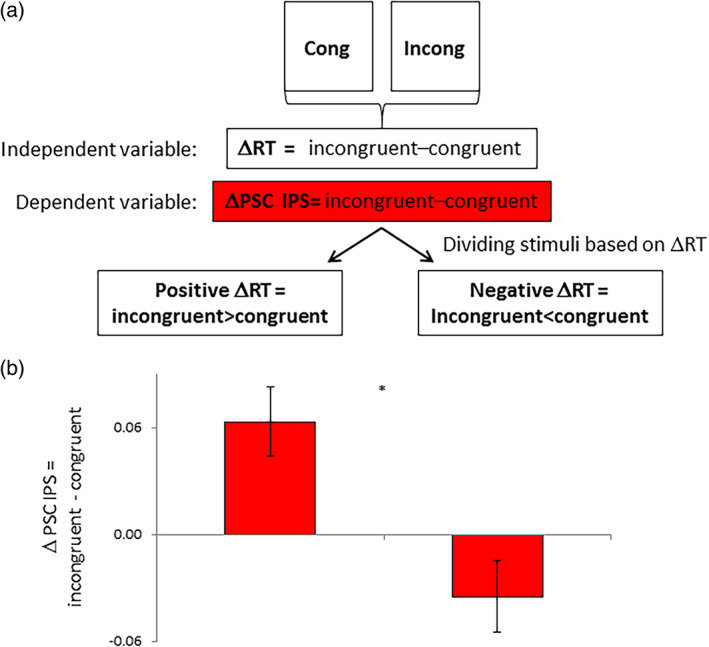
Humans are goal-directed; however, goal-unrelated information still affects us, but how? The Stroop task is often used to answer this question, relying on conflict (incongruency) between attributes, one targeted by the task and another irrelevant to the task. The frontal regions of the brain are known to play a crucial role in processing such conflict, as they show increased activity when we encounter incongruent stimuli. Notably, the Stroop stimuli also consist of conceptual dimensions, such as semantic or emotional content, that are independent of the attributes that define the conflict. Since the non-targeted attribute usually refers to the same conceptual dimension as the targeted-attribute, it is relevant to the task at hand. For example, when naming the emotion of an emotional face superimposed by an emotional word, both the targeted-attribute and the non-targeted attribute refer to the conceptual dimension "emotion". We designed an fMRI paradigm to investigate how conflicts between different conceptual dimensions impact us. Even though the conflict was task-irrelevant, incongruent stimuli resulted in longer reaction times, indicating a behavioral congruency effect. When examining the neural mechanisms that underlie this effect, we found that the frontal regions exhibited repetition suppression, while the bilateral intraparietal sulcus (IPS) showed a congruency effect linked to the behavioral effect. Taken together, these findings suggest that individuals are unable to completely ignore task-irrelevant information, and that the IPS plays a crucial role in processing such information.
人类是有目标导向的;然而,与目标无关的信息仍然会影响我们,但是是如何影响的呢?斯特鲁普任务通常被用来回答这个问题,它依赖于属性之间的冲突(不和谐),一个是任务目标,另一个与任务无关。大脑的额叶区域被认为在处理这种冲突方面起着至关重要的作用,因为当我们遇到不和谐的刺激时,它们会显示出更高的活动。值得注意的是,斯特鲁普刺激还包括概念维度,如语义或情绪内容,这些维度与定义冲突的属性无关。由于非目标属性通常与目标属性指的是相同的概念维度,因此与手头的任务相关。例如,当命名叠加在情绪面孔上的情绪词的情绪时,目标属性和非目标属性都指的是“情绪”这一概念维度。我们设计了一个 fMRI 范式来研究不同概念维度之间的冲突如何影响我们。即使冲突与任务无关,不和谐的刺激也会导致反应时间延长,表明存在行为一致性效应。当我们检查这种效应背后的神经机制时,我们发现额叶区域表现出重复抑制,而双侧顶内沟(IPS)则显示出与行为效应相关的一致性效应。总的来说,这些发现表明,个体无法完全忽略与任务无关的信息,而 IPS 在处理此类信息方面起着至关重要的作用。