Nursing Department, The Second Affiliated Hospital of Zhejiang University School of Medicine, Hangzhou, Zhejiang, China.
Faculty of Nursing, Zhejiang University School of Medicine, Hangzhou, Zhejiang, China.
Front Public Health. 2023 May 9;11:1073121. doi: 10.3389/fpubh.2023.1073121. eCollection 2023.
Risk perception, a critical psychological construct, influences health behavior modification and maintenance of individuals with cardiovascular disease (CVD) risk. Little is known about CVD risk perception among Chinese adults. This research examined the profiles of CVD risk perception of community adults in South China, and explored the characteristics and factors that influence their perception of CVD risk.
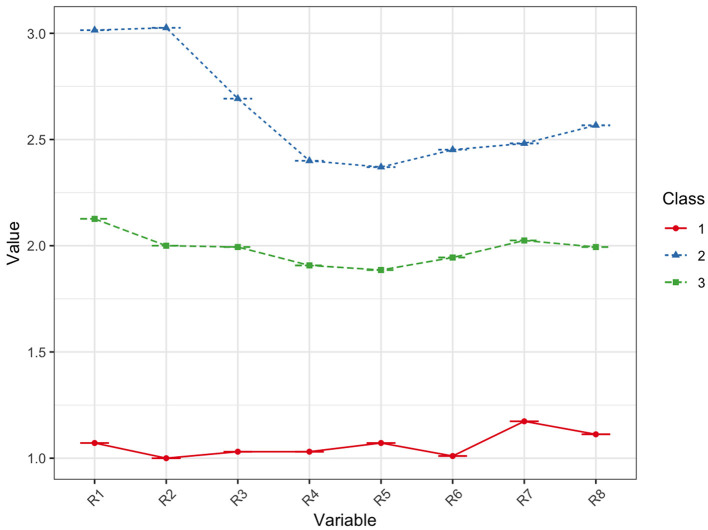
This cross-sectional study was conducted in Hangzhou, Zhejiang Province, in South China from March to July 2022 and included 692 participants. Risk perception was assessed using the Chinese version of the Attitude and Beliefs about Cardiovascular Disease Risk Questionnaire. Latent profile analysis (LPA) was performed to extract latent classes of CVD risk perception. These classes of CVD risk perception were compared with 10-year CVD risk categories to define correctness of estimation. Chi-square tests and multinomial regression analyses were used to identify differences between these categories.
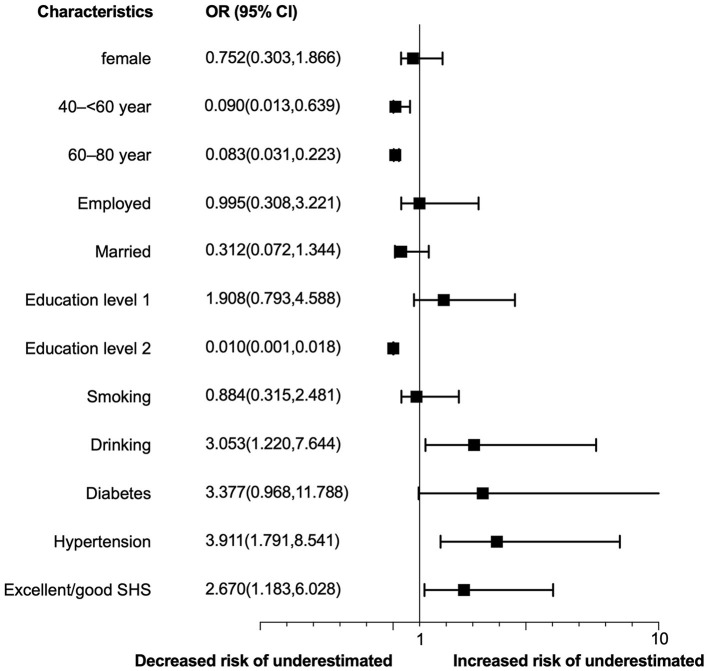
Three CVD risk perception classes were identified by LPA: low risk perception (14.2% of participants), moderate risk perception (46.8%), high risk perception (39.0%). Individuals who were aged with 40-60 year ( = 6.94, 95% = 1.86-25.84), diabetes ( = 6.26, 95% = 1.34-29.17), married ( = 4.52, 95% = 2.30-8.90), better subjective health status ( = 3.23, 95% = 1.15-9.10) and perceived benefits and intention to change physical activity ( = 1.16, 95% = 1.05-1.27) were more likely to be in the high-risk perception class. Compared to absolute 10-year CVD risk based on China-PAR, a third of participants (30.1%) correctly estimated their CVD risk, 63.3% overestimated it and 6.6% underestimated it. CVD risk underestimation was associated with hypertension ( = 3.91, 95% = 1.79-8.54), drinking ( = 3.05, 95% = 1.22-7.64), better subjective health status ( = 2.67, 95% = 1.18-6.03).
Most adults in South China possess a moderate level of CVD risk perception. Advanced age, higher monthly income, diabetes and better health status were significantly related to higher perceived CVD risk. Individuals with hypertension, drinking and better subjective health status were associated with CVD risk underestimation. Healthcare professionals should pay attention to the indicators for different classes and identify underestimation group as early as possible.
风险感知是一个关键的心理构念,它影响着心血管疾病(CVD)风险个体的健康行为改变和维持。关于中国成年人的 CVD 风险感知知之甚少。本研究旨在探讨华南地区社区成年人 CVD 风险感知的特征,并探讨影响其 CVD 风险感知的特征和因素。
本横断面研究于 2022 年 3 月至 7 月在华南浙江省杭州市进行,纳入了 692 名参与者。使用中文版心血管疾病风险态度和信念问卷评估风险感知。采用潜在剖面分析(LPA)提取 CVD 风险感知的潜在类别。将这些 CVD 风险感知类别与 10 年 CVD 风险类别进行比较,以确定估计的正确性。卡方检验和多项回归分析用于识别这些类别的差异。
通过 LPA 确定了三个 CVD 风险感知类别:低风险感知(14.2%的参与者)、中风险感知(46.8%)、高风险感知(39.0%)。年龄在 40-60 岁(=6.94,95%=1.86-25.84)、糖尿病(=6.26,95%=1.34-29.17)、已婚(=4.52,95%=2.30-8.90)、主观健康状况较好(=3.23,95%=1.15-9.10)和感知到的体育锻炼获益和改变意愿(=1.16,95%=1.05-1.27)的个体更有可能处于高风险感知类别。与基于中国 PAR 的绝对 10 年 CVD 风险相比,三分之一的参与者(30.1%)正确估计了他们的 CVD 风险,63.3%的参与者高估了风险,6.6%的参与者低估了风险。CVD 风险低估与高血压(=3.91,95%=1.79-8.54)、饮酒(=3.05,95%=1.22-7.64)、主观健康状况较好(=2.67,95%=1.18-6.03)有关。
华南地区大多数成年人的 CVD 风险感知处于中等水平。年龄较大、月收入较高、糖尿病和较好的健康状况与更高的感知 CVD 风险显著相关。高血压、饮酒和较好的主观健康状况与 CVD 风险低估有关。医疗保健专业人员应关注不同类别的指标,并尽早识别低估组。