Accardo Vivian, Barlati Stefano, Ceraso Anna, Nibbio Gabriele, Vieta Eduard, Vita Antonio
Department of Mental Health and Addiction Services, ASST Spedali Civili of Brescia, 25123 Brescia, Italy.
Department of Clinical and Experimental Sciences, University of Brescia, 25123 Brescia, Italy.
Brain Sci. 2023 Apr 24;13(5):708. doi: 10.3390/brainsci13050708.
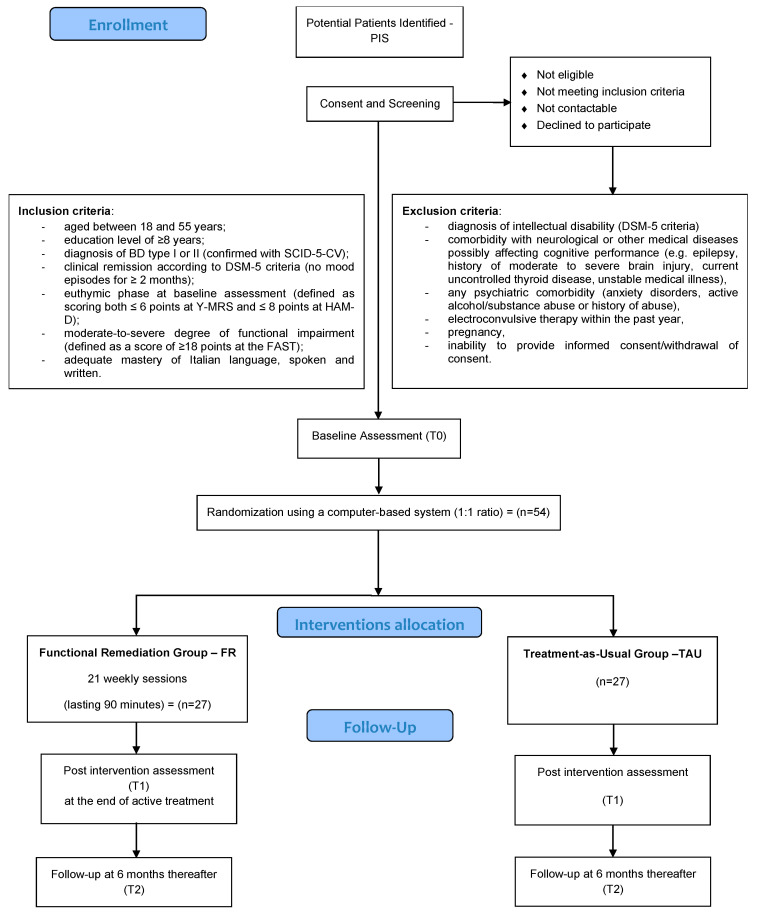
Neurocognitive impairment is a prominent characteristic of bipolar disorder (BD), linked with poor psychosocial functioning. This study's purpose is to evaluate the effectiveness of functional remediation (FR) in enhancing neurocognitive dysfunctions in a sample of remitted patients with diagnosis of BD in comparison to treatment as usual-TAU. To quantify the neurocognitive damage, the Brief Assessment of Cognition in Affective Disorders (BAC-A) will be used, and the overall psychosocial functioning will be measured with the Functioning Assessment Short Test-FAST.
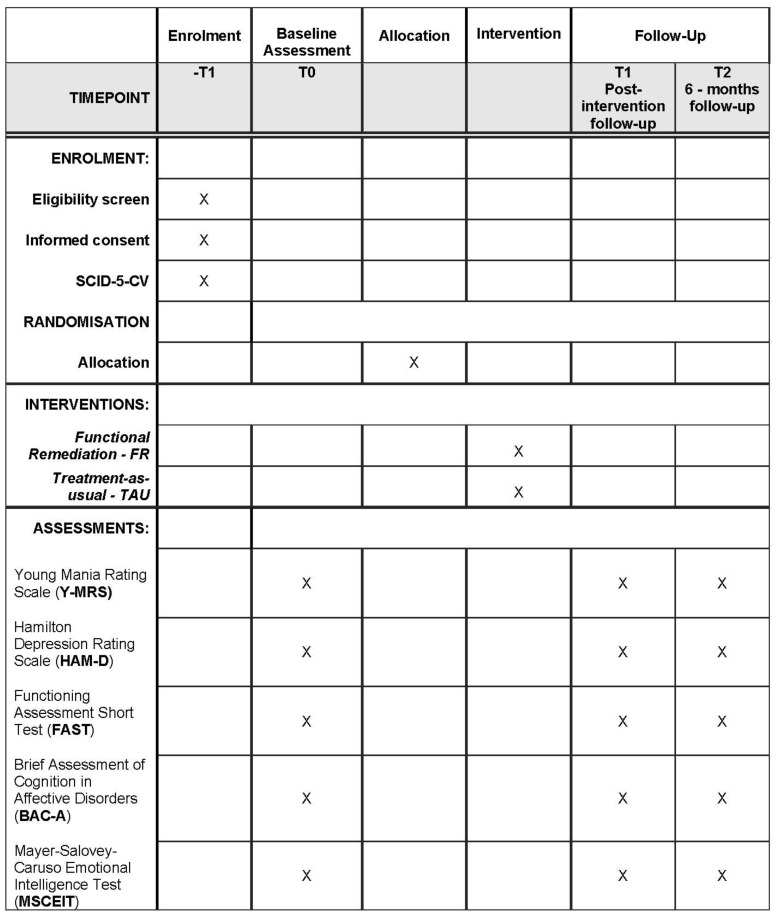
The randomized, rater-blinded, controlled study will include two arms (1:1) encompassing 54 outpatients with diagnosis of BD-I and BD-II, as defined by the DSM-5 criteria. In the experimental phase, remitted patients aged 18-55 years will be involved. At the baseline, at the end of intervention and at the 6-month follow-up, patients will be evaluated using clinical scales (Young Mania Rating Scale (Y-MRS) and Hamilton Depression Rating Scale (HAM-D)). Neurocognitive measurements and psychosocial functioning will be valued, respectively, with BAC-A and FAST.
The primary expected outcome is that following FR intervention, patients will exhibit improved cognitive abilities and psychosocial outcomes compared to the participants in the TAU group. It is now recognized that neurocognitive deficits are potential predictors of functional outcome in patients with BD. In recent years, there has been a growing interest in the implementation of interventions that, in addition to symptomatic remission, are also aimed at neurocognitive dysfunctions in order to achieve a recovery of psychosocial functioning.
神经认知障碍是双相情感障碍(BD)的一个突出特征,与心理社会功能不佳有关。本研究的目的是评估功能修复(FR)在改善一组已缓解的BD诊断患者的神经认知功能障碍方面的有效性,并与常规治疗(TAU)进行比较。为了量化神经认知损害,将使用情感障碍认知简短评估(BAC-A),并通过功能评估简短测试(FAST)来衡量整体心理社会功能。
这项随机、评估者盲法、对照研究将包括两个组(1:1),共有54名根据《精神疾病诊断与统计手册》第5版(DSM-5)标准诊断为BD-I和BD-II的门诊患者。在实验阶段,将纳入18至55岁的已缓解患者。在基线、干预结束时和6个月随访时,将使用临床量表(青年躁狂评定量表(Y-MRS)和汉密尔顿抑郁评定量表(HAM-D))对患者进行评估。神经认知测量和心理社会功能将分别通过BAC-A和FAST进行评估。
主要预期结果是,与TAU组的参与者相比,在FR干预后,患者将表现出改善的认知能力和心理社会结果。现在人们认识到,神经认知缺陷是BD患者功能结果的潜在预测因素。近年来,人们越来越关注实施除症状缓解外还针对神经认知功能障碍的干预措施,以实现心理社会功能的恢复。