Mboussou Franck, Farham Bridget, Nsasiirwe Sheillah, Atagbaza Ajiri, Oyaole Daniel, Atuhebwe Phionah Lynn, Alegana Victor, Osei-Sarpong Fred, Bwaka Ado, Paluku Gilson, Petu Amos, Efe-Aluta Oniovo, Kalu Akpaka, Bagayoko Magaran Monzon, Impouma Benido
World Health Organization, Regional Office for Africa, Brazzaville P.O. Box 06, Congo.
Vaccines (Basel). 2023 May 22;11(5):1010. doi: 10.3390/vaccines11051010.
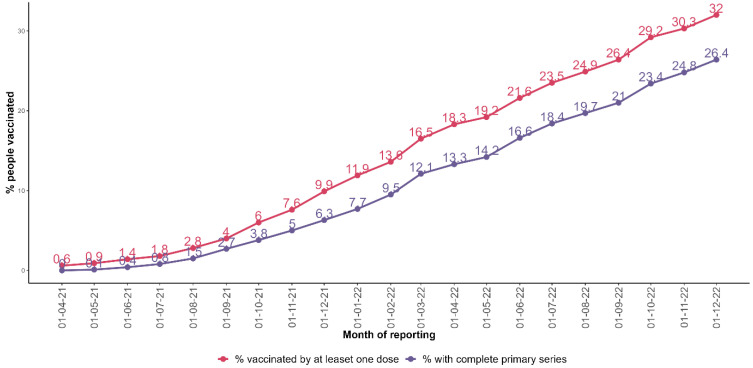
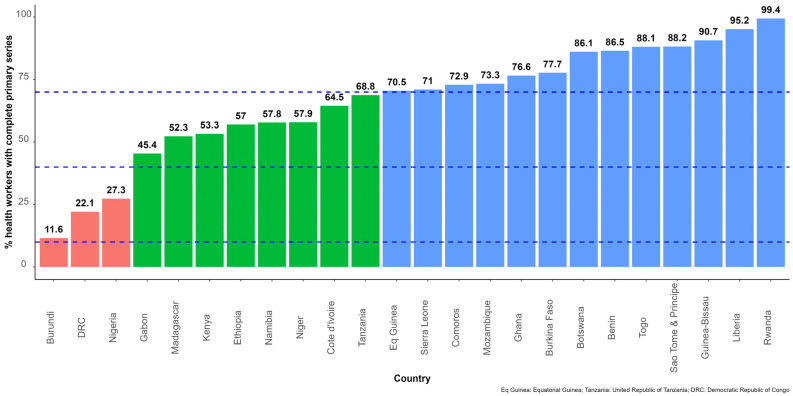
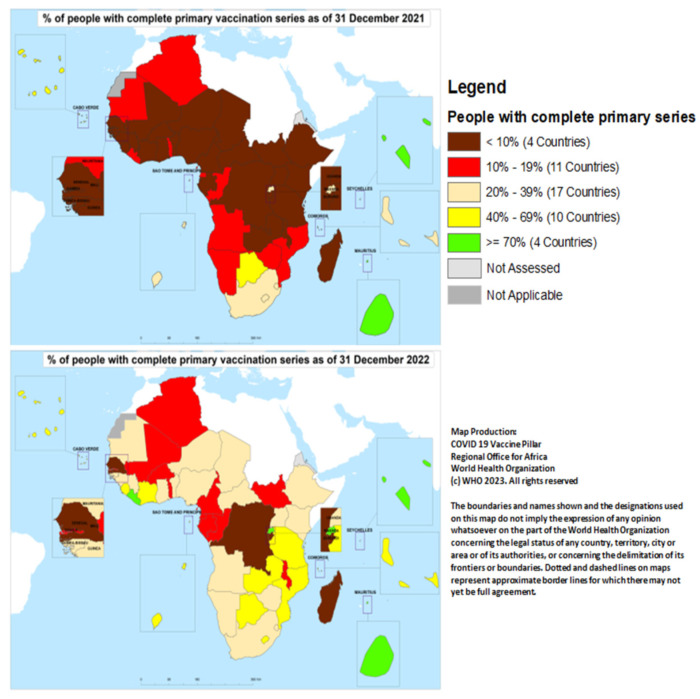
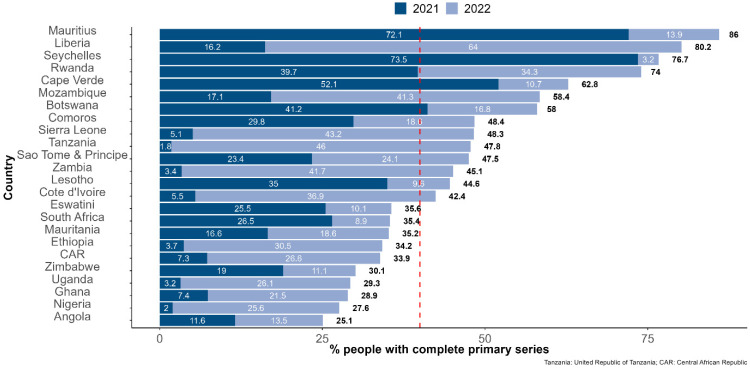
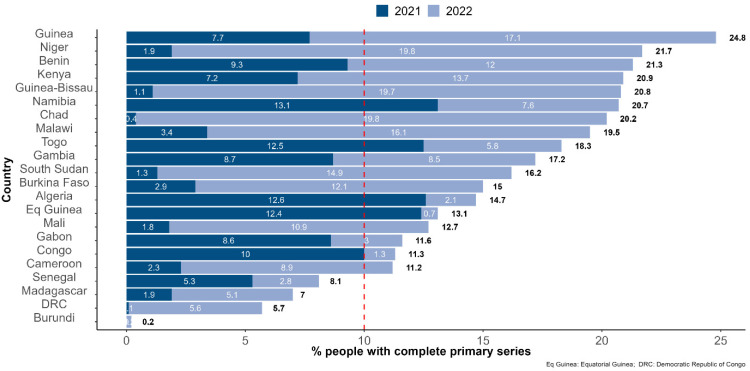
This study summarizes progress made in rolling out COVID-19 vaccinations in the African region in 2022, and analyzes factors associated with vaccination coverage. Data on vaccine uptake reported to the World Health Organization (WHO) Regional Office for Africa by Member States between January 2021 and December 2022, as well as publicly available health and socio-economic data, were used. A negative binomial regression was performed to analyze factors associated with vaccination coverage in 2022. As of the end of 2022, 308.1 million people had completed the primary vaccination series, representing 26.4% of the region's population, compared to 6.3% at the end of 2021. The percentage of health workers with complete primary series was 40.9%. Having carried out at least one high volume mass vaccination campaign in 2022 was associated with high vaccination coverage (β = 0.91, < 0.0001), while higher WHO funding spent per person vaccinated in 2022 was correlated with lower vaccination coverage (β = -0.26, < 0.03). All countries should expand efforts to integrate COVID-19 vaccinations into routine immunization and primary health care, and increase investment in vaccine demand generation during the transition period that follows the acute phase of the pandemic.
本研究总结了2022年非洲地区在推广新冠疫苗接种方面取得的进展,并分析了与疫苗接种覆盖率相关的因素。使用了成员国在2021年1月至2022年12月期间向世界卫生组织(WHO)非洲区域办事处报告的疫苗接种数据,以及公开可用的卫生和社会经济数据。进行了负二项回归分析,以分析与2022年疫苗接种覆盖率相关的因素。截至2022年底,3.081亿人完成了初级疫苗接种系列,占该地区人口的26.4%,而2021年底这一比例为6.3%。完成初级疫苗接种系列的卫生工作者比例为40.9%。2022年至少开展过一次大规模疫苗接种活动与高疫苗接种覆盖率相关(β = 0.91,< 0.0001),而2022年人均获得的WHO资金越高,疫苗接种覆盖率越低(β = -0.26,< 0.03)。所有国家都应加大努力,将新冠疫苗接种纳入常规免疫和初级卫生保健,并在疫情急性期后的过渡阶段增加对疫苗需求推广的投资。