Bouaddi Oumnia, Seedat Farah, Hasaan Mohammed Hassan Edries, Evangelidou Stella, Deal Anna, Requena-Méndez Ana, Khalis Mohamed, Hargreaves Sally
Mohammed VI International School of Public Health, Mohammed VI University of Sciences and Health, Casablanca, Morocco.
Department of Public Health and Clinical Research, Mohammed VI Center for Research and Innovation, Rabat, Morocco.
EClinicalMedicine. 2024 Nov 22;78:102950. doi: 10.1016/j.eclinm.2024.102950. eCollection 2024 Dec.
The Middle East and North African (MENA) region is a major global hotspot for migration with more than 40 million migrants, who may be an under-vaccinated group because of barriers to vaccination within countries of origin, transit, and destination. We systematically synthesised the evidence on coverage, acceptance, drivers of uptake, and policies pertaining to vaccination for children and adult migrants in the region, in order to explore tailored interventions for these groups.
We searched six databases (including Medline, Embase) for peer-reviewed literature, and other websites (including WHO, IOM, ministries of health) for grey literature on coverage, acceptance, drivers of uptake and policies for any vaccination in migrants in the MENA region from between 2000 and 27 August 2024 in any language. We included studies reporting primary data on coverage, acceptance, and drivers of uptake, and any relevant articles on policies. We defined migrants as individuals who move away from their place of habitual residence, within or across international borders, temporarily or permanently. Studies without disaggregated migrant data were excluded. Primary outcomes were coverage (% individuals receiving ≥1 doses of any vaccine) and acceptance (% individuals accepting any vaccine). We separately synthesised data on children (<18 years) and adults (≥18). Estimates were pooled using a random-effects meta-analysis where possible or narratively synthesised, and drivers of uptake were synthesised using the WHO Behavioural and Social Drivers model. PROSPERO protocol: CRD42023401694.
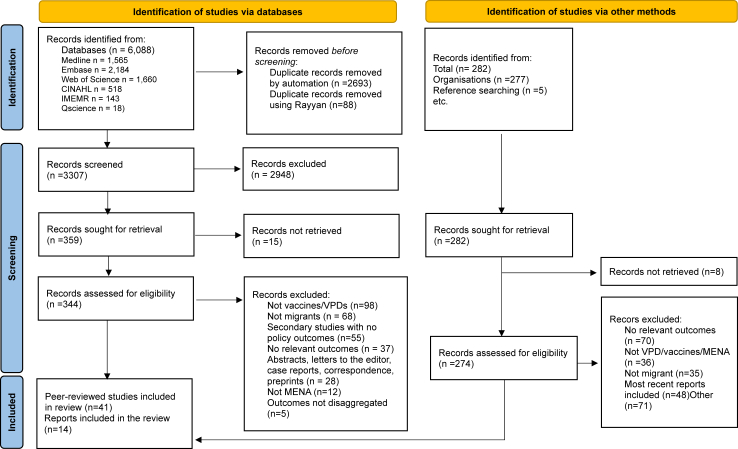
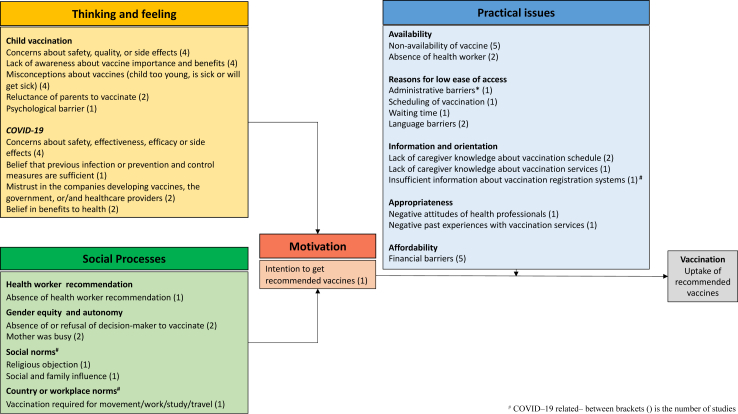
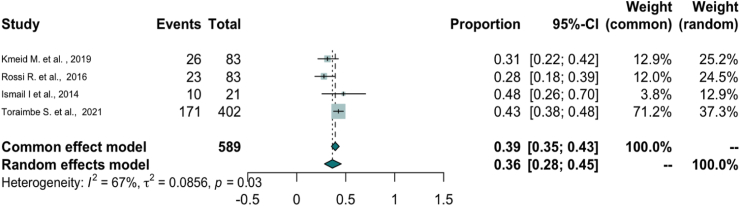
We identified 6088 database and 282 grey literature records and included 55 studies and 1,906,975 migrants across 15 countries (including mostly refugees in the Middle East and expatriates in Gulf Cooperation Council countries). COVID-19 vaccination was reportedly provided free of charge to migrants in all countries whereas childhood vaccinations were reportedly provided to migrant children in seven countries. However, for adolescents and adults, there were wide variations across countries, and we found no policies relating to catch-up vaccination. Coverage for childhood vaccination amongst migrants was reportedly low, with only 36.0% of 589 migrant children fully vaccinated according to national schedules (95% CI 35.0%-43.0%, = 67%; data from migrants in Lebanon, Morocco, Sudan). Likewise, data on specific routine vaccines in children was generally low: measles containing vaccines (MCV): MCV dose 1 63.9%-66.9%; MCV dose 2 25.4%-85.6%; oral polio vaccine (OPV): OPV dose 3 65.1%-76.4%; diphtheria, tetanus and pertussis (DTP) containing vaccines: DTP dose 1 81.8%-86.7%; DTP dose 3 59.7%-76.6%). Drop-out rates across all routine vaccines for subsequent vaccine doses ranged from 12.4 to 38.5%, suggesting that migrants face a range of barriers to vaccine uptake beyond the first dose, that need to be better considered when designing interventions. For adults, we found eleven studies on coverage (including 9 on COVID-19) showing that COVID-19 vaccination coverage ranged 33.5-84.8% in migrants and 25.0-59.0% in host populations. Drivers of uptake of childhood vaccination in migrants included limited availability of vaccines and vaccination personnel, communication and administrative barriers, financial difficulties, lack of caregiver knowledge about services, and concerns expressed by caregivers around safety and benefits. For adults, drivers were mainly related to the COVID-19 vaccine and included concerns around safety, quality, side effects, and mistrust in vaccines and the systems that deliver them.
Migrants have unique risk factors for under-immunisation in the MENA region and have low vaccination coverage despite some level of entitlement to services. Data on vaccination coverage, drivers of uptake and policies for migrants in the MENA region is limited to small-scale studies among accessible groups, mostly focusing on COVID-19 compared to routine childhood and adult vaccination. There is an urgent need to strengthen data collection to better understand coverage across different migrant groups, ages, and MENA countries, especially on adult and catch-up vaccinations for routine immunisations, and develop innovative co-designed strategies to address specific drivers of vaccine uptake among this group.
La Caixa, LCF/PR/SP21/52930003.
中东和北非(MENA)地区是全球主要的移民热点地区,有超过4000万移民,由于原籍国、过境国和目的地国的疫苗接种障碍,他们可能是疫苗接种不足的群体。我们系统地综合了该地区儿童和成年移民疫苗接种覆盖率、接受度、接种驱动因素及相关政策的证据,以探索针对这些群体的定制干预措施。
我们检索了六个数据库(包括Medline、Embase)中的同行评审文献,以及其他网站(包括世界卫生组织、国际移民组织、各国卫生部)中的灰色文献,以获取2000年至2024年8月27日期间关于MENA地区移民任何疫苗接种的覆盖率、接受度、接种驱动因素及政策的文献,不限语言。我们纳入了报告覆盖率、接受度和接种驱动因素的原始数据的研究,以及任何相关政策文章。我们将移民定义为离开其惯常居住地、在国内或跨国界、暂时或永久迁移的个人。未提供分类移民数据的研究被排除。主要结果是覆盖率(接受≥1剂任何疫苗的个体百分比)和接受度(接受任何疫苗的个体百分比)。我们分别综合了儿童(<18岁)和成人(≥18岁)的数据。估计值尽可能使用随机效应荟萃分析进行汇总,或进行叙述性综合,接种驱动因素使用世界卫生组织行为和社会驱动因素模型进行综合。PROSPERO方案:CRD42023401694。
我们识别出6088条数据库记录和282条灰色文献记录,纳入了55项研究,涉及15个国家的1906975名移民(包括中东地区的大多数难民和海湾合作委员会国家的侨民)。据报道,所有国家都为移民免费提供新冠疫苗接种,而据报道,有七个国家为移民儿童提供儿童疫苗接种。然而,对于青少年和成年人,各国之间存在很大差异,我们未发现与补种疫苗相关的政策。据报道,移民中儿童疫苗接种的覆盖率较低,根据国家免疫规划,589名移民儿童中只有36.0%完全接种(95%可信区间35.0%-43.0%,I² = 67%;数据来自黎巴嫩、摩洛哥、苏丹的移民)。同样,儿童特定常规疫苗的数据普遍较低:含麻疹疫苗(MCV):MCV第1剂63.9%-66.9%;MCV第2剂25.4%-85.6%;口服脊髓灰质炎疫苗(OPV):OPV第3剂65.1%-76.4%;含白喉、破伤风和百日咳(DTP)疫苗:DTP第1剂81.8%-86.7%;DTP第3剂59.7%-76.6%)。所有常规疫苗后续剂次的退出率在12.4%至38.5%之间,这表明移民在接种第一剂疫苗后还面临一系列疫苗接种障碍,在设计干预措施时需要更好地考虑这些障碍。对于成年人,我们发现了1项关于覆盖率的研究(包括9项关于新冠疫苗接种的研究),表明移民中新冠疫苗接种覆盖率在33.5%-84.8%之间,宿主人群中为25.0%-59.0%。移民儿童疫苗接种的驱动因素包括疫苗和接种人员供应有限、沟通和行政障碍、经济困难、照顾者对服务缺乏了解,以及照顾者对安全性和益处的担忧。对于成年人,驱动因素主要与新冠疫苗有关,包括对安全性、质量、副作用的担忧,以及对疫苗及其供应系统的不信任。
在中东和北非地区,移民存在免疫接种不足的独特风险因素,尽管有一定程度的服务权益,但疫苗接种覆盖率较低。中东和北非地区移民疫苗接种覆盖率、接种驱动因素及政策的数据仅限于对可接触群体的小规模研究,与常规儿童和成人疫苗接种相比,大多聚焦于新冠疫苗接种。迫切需要加强数据收集,以更好地了解不同移民群体、年龄和中东和北非国家的覆盖率,特别是关于成人和常规免疫接种的补种疫苗情况,并制定创新的共同设计策略,以解决该群体疫苗接种的特定驱动因素。
La Caixa,LCF/PR/SP21/52930003。