Institute of Agricultural Science and Technology, Kyungpook National University, Daegu 41566, Republic of Korea.
School of Food Science and Biotechnology, College of Agriculture and Life Sciences, Kyungpook National University, Daegu 41566, Republic of Korea.
J Microbiol Biotechnol. 2023 May 28;33(5):662-667. doi: 10.4014/jmb.2301.01009. Epub 2023 Feb 6.
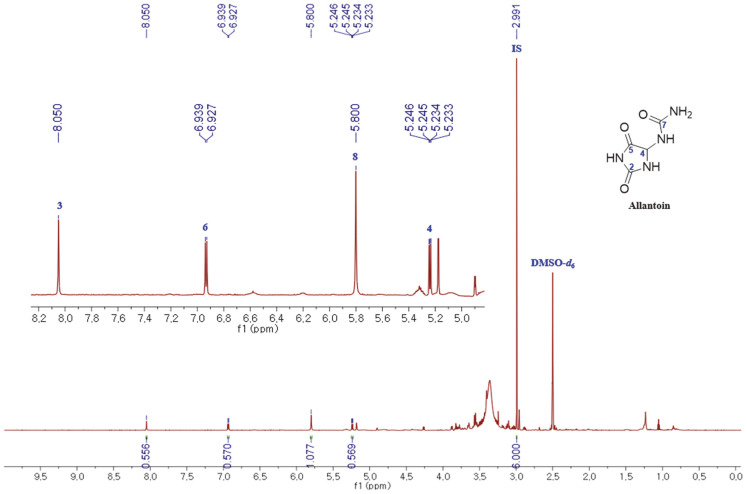
Allantoin is an abundant component of yams and has been known as a skin protectant due to its pharmacological activities. In previous methods for allantoin determination using high-performance liquid chromatography (HPLC), the separation was unsatisfactory. We herein developed a H quantitative nuclear magnetic resonance (qNMR) method for quantification of allantoin in the flesh and peel of yams. The method was carried out based on the relative ratio of signals integration of allantoin to a certain amount of the internal standard dimethyl sulfone (DMSO) and validated in terms of specificity, linearity (range 62.5-2000 μg/ml), sensitivity (limit of detection (LOD) and quantification (LOQ) 4.63 and 14.03 μg/ml, respectively), precision (RSD% 0.02-0.26), and recovery (86.35-92.11%). The method was then applied for the evaluation of allantoin in flesh and peel extracts of four different yams cultivated in Korea.
尿囊素是山药中的一种丰富成分,由于其药理学活性,被称为皮肤保护剂。在以前使用高效液相色谱法(HPLC)测定尿囊素的方法中,分离效果并不理想。本研究建立了一种用于定量测定山药肉质和表皮中尿囊素的 H 定量核磁共振(qNMR)方法。该方法基于尿囊素与一定量内标二甲亚砜(DMSO)信号积分的相对比值进行,并从专属性、线性(范围 62.5-2000μg/ml)、灵敏度(检测限(LOD)和定量限(LOQ)分别为 4.63 和 14.03μg/ml)、精密度(RSD%为 0.02-0.26)和回收率(86.35-92.11%)方面进行了验证。该方法随后应用于评估韩国四种不同栽培山药肉质和表皮提取物中的尿囊素。