Ding Meiling, Zhang Bin, Zhang Shuo, Hao RongRong, Xia Yu, Ma Pengda, Dong Juane
College of Life Sciences, Northwest A&F University, Yangling 712100, China.
Hortic Res. 2023 Apr 10;10(5):uhad066. doi: 10.1093/hr/uhad066. eCollection 2023 May.
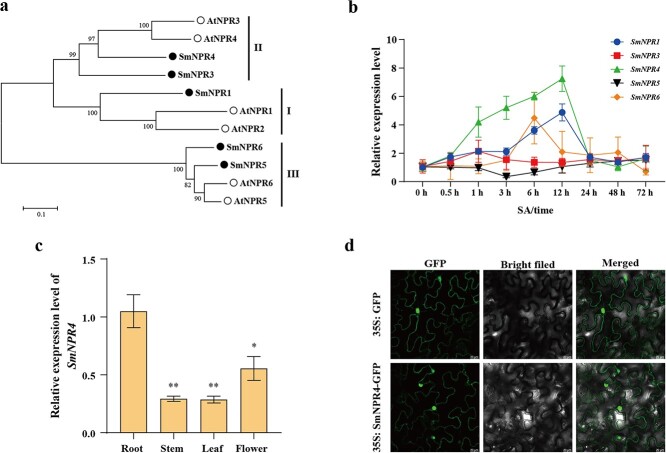
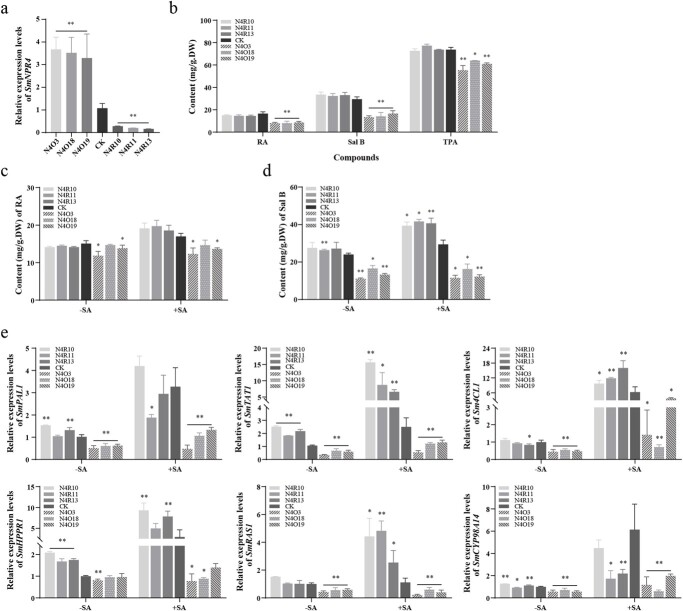
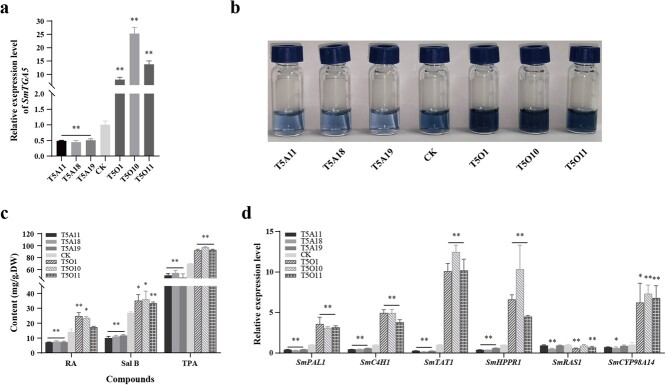
Phenolic acids are the main bioactive compounds in , which can be increased by salicylic acid (SA) elicitation. However, the specific molecular mechanism remains unclear. The nonexpresser of PR genes 1 (NPR1) and its family members are essential components of the SA signaling pathway. Here, we report an NPR protein, SmNPR4, that showed strong expression in hairy root after SA treatment, acting as a negative moderator of SA-induced phenolic acid biosynthesis in (). Moreover, a basic leucine zipper family transcription factor SmTGA5 was identified and was found to interact with SmNPR4. SmTGA5 activates the expression of phenolic acid biosynthesis gene through binding to the element. Finally, a series of biochemical assays and dual gene overexpression analysis demonstrated that the SmNPR4 significantly inhibited the function of SmTGA5, and SA can alleviate the inhibitory effect of SmNPR4 on SmTGA5. Overall, our results reveal the molecular mechanism of salicylic acid regulating phenolic acid biosynthesis in and provide new insights for SA signaling to regulate secondary metabolic biosynthesis.
酚酸是[植物名称]中的主要生物活性化合物,水杨酸(SA)诱导可使其含量增加。然而,具体的分子机制仍不清楚。病程相关基因非表达子1(NPR1)及其家族成员是SA信号通路的重要组成部分。在此,我们报道了一种NPR蛋白SmNPR4,其在SA处理后的毛状根中强烈表达,作为[植物名称]中SA诱导的酚酸生物合成的负调控因子。此外,还鉴定了一个碱性亮氨酸拉链家族转录因子SmTGA5,并发现其与SmNPR4相互作用。SmTGA5通过结合[基因名称]元件激活酚酸生物合成基因的表达。最后,一系列生化分析和双基因过表达分析表明,SmNPR4显著抑制SmTGA5的功能,SA可减轻SmNPR4对SmTGA5的抑制作用。总体而言,我们的结果揭示了水杨酸调节[植物名称]中酚酸生物合成的分子机制,并为SA信号调控次生代谢生物合成提供了新的见解。