Nie Xiumin, Li Xueying, Lv Bingbing, Shao Shuai, Zhang Bin, Dong Juane
College of Life Sciences, Northwest A&F University, No. 22 Xinong Road, Yangling, Shaanxi, 712100, China.
Hortic Res. 2025 Mar 25;12(7):uhaf096. doi: 10.1093/hr/uhaf096. eCollection 2025 Jul.
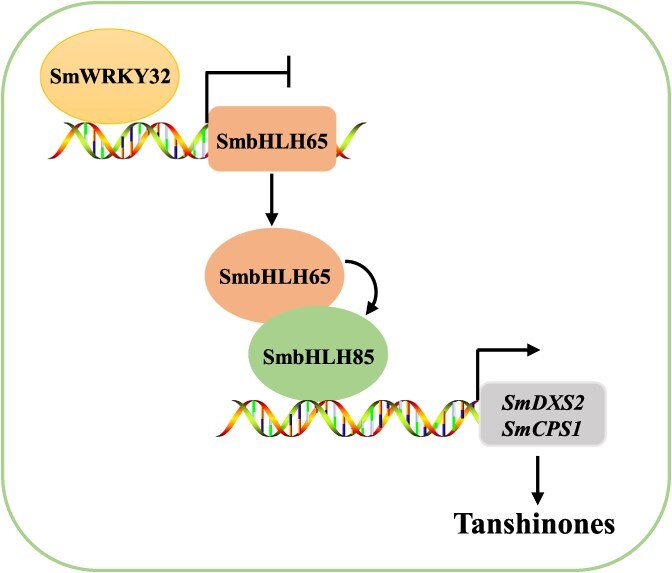
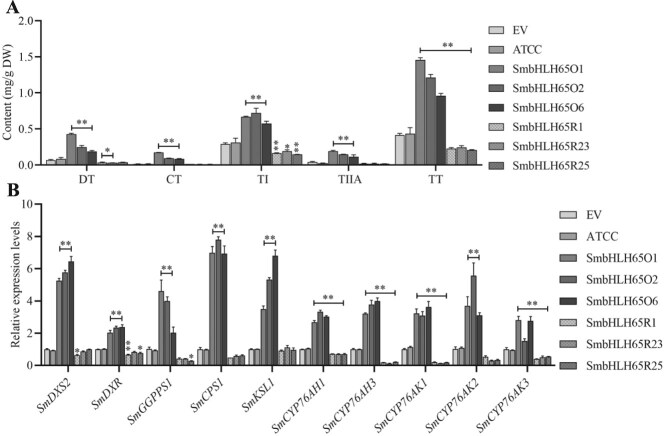
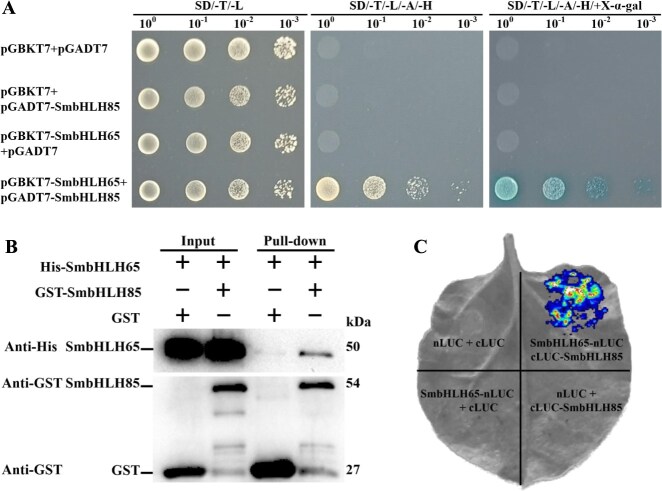
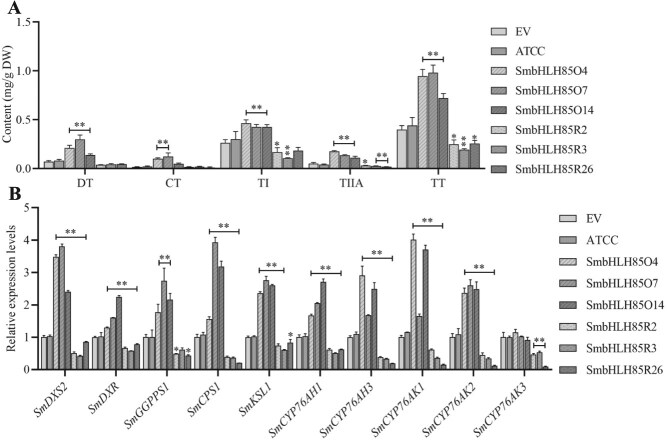
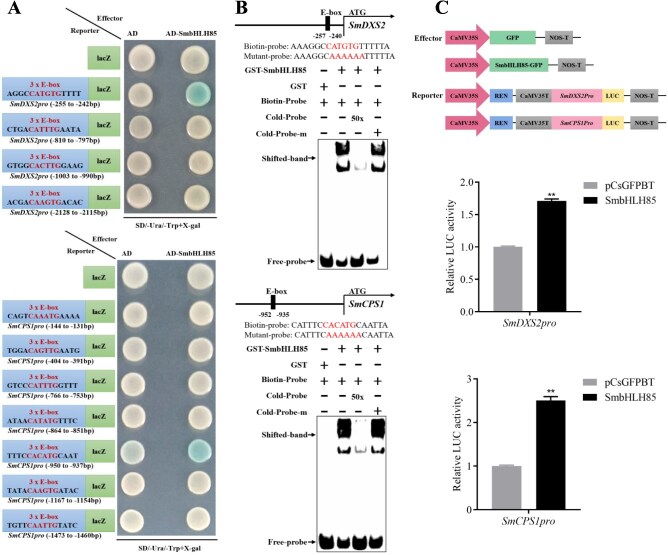
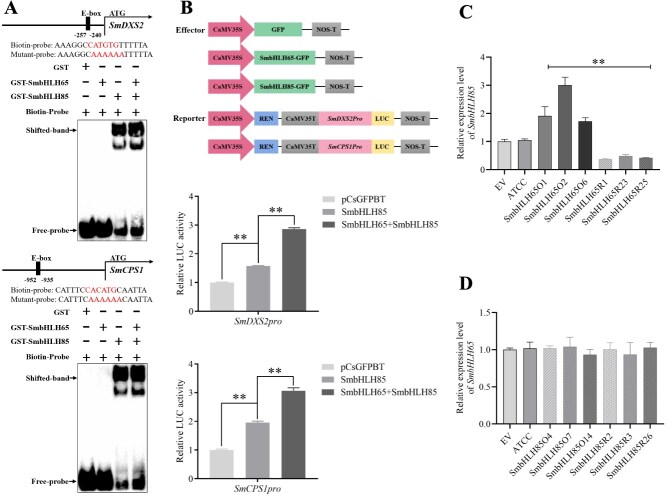
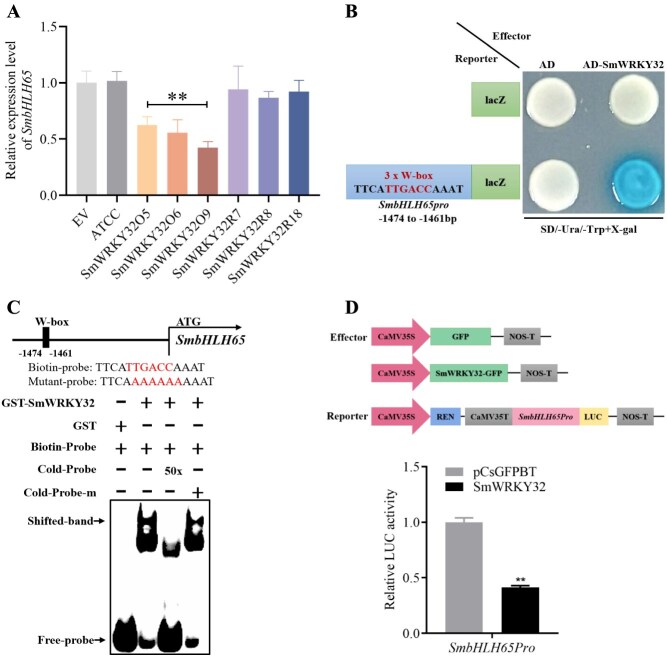
Tanshinones are valuable compounds found in , and gaining a deeper understanding of their transcriptional regulation mechanisms is a key strategy for increasing their content. Previous research revealed that SmWRKY32 acts as a repressor of tanshinone synthesis. This study identified the SmbHLH65 transcription factor, whose expression was significantly reduced in the overexpression transcriptome. Overexpression of stimulated tanshinone accumulation, while its silencing resulted in a decrease in tanshinone content. However, SmbHLH65 does not directly target the key enzyme genes involved in tanshinone synthesis. Subsequently, we discovered the SmbHLH65-interacting protein SmbHLH85. SmbHLH85 facilitates tanshinone biosynthesis by directly upregulating and . Further investigation demonstrated that SmbHLH65 not only promotes the expression of but also enhances its binding to the promoters of and , thereby amplifying the activation of these biosynthetic genes. Additionally, SmWRKY32 directly binds to the promoter to suppress its activity. In summary, these findings reveal that the regulatory module SmWRKY32-SmbHLH65/SmbHLH85 controls tanshinone synthesis in . This study uncovers a novel transcriptional regulatory mechanism, offering fresh insights into the complex network controlling tanshinone biosynthesis.
丹参酮是从[具体来源未给出]中发现的有价值的化合物,深入了解它们的转录调控机制是提高其含量的关键策略。先前的研究表明,SmWRKY32作为丹参酮合成的抑制因子。本研究鉴定了SmbHLH65转录因子,其在[具体对象未明确]过表达转录组中的表达显著降低。SmbHLH65的过表达刺激了丹参酮的积累,而其沉默导致丹参酮含量降低。然而,SmbHLH65并不直接靶向参与丹参酮合成的关键酶基因。随后,我们发现了与SmbHLH65相互作用的蛋白SmbHLH85。SmbHLH85通过直接上调[具体基因未明确]和[具体基因未明确]促进丹参酮生物合成。进一步研究表明,SmbHLH65不仅促进[具体基因未明确]的表达,还增强其与[具体基因未明确]和[具体基因未明确]启动子的结合,从而放大这些生物合成基因的激活。此外,SmWRKY32直接结合[具体基因未明确]启动子以抑制其活性。总之,这些发现揭示了调控模块SmWRKY32 - SmbHLH65/SmbHLH85控制[具体对象未明确]中丹参酮的合成。本研究揭示了一种新的转录调控机制,为控制丹参酮生物合成的复杂网络提供了新的见解。