Department of Pathology, Heping Hospital Affiliated to Changzhi Medical College, Changzhi, Shanxi, China.
Department of Pathology, Changzhi Medical College the First Clinical College, Changzhi, Shanxi, China.
Front Endocrinol (Lausanne). 2023 May 19;14:1159055. doi: 10.3389/fendo.2023.1159055. eCollection 2023.
The negative effects of obesity on hepatic steatosis and fibrosis have received considerable attention in recent years. The weight-adjusted-waist index (WWI) reflects weight-independent centripetal obesity. Herein, we provide the first investigation of a link between WWI, hepatic steatosis, and liver fibrosis.
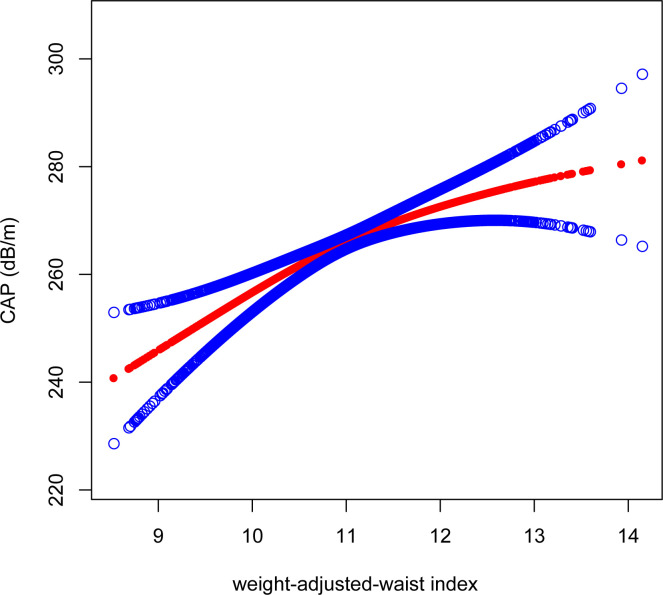
We used data from the National Health and Nutrition Examination Survey 2017-2020 to conduct a cross-sectional study. The linear relationship between WWI, controlled attenuation parameters, and liver stiffness measurements (LSM) was investigated using multivariate linear regression models. The nonlinear relationship was described using fitted smoothed curves and threshold effect analyses. Subgroup analyses were performed based on gender, age, body mass index, diabetes, hypertension, drinking, and smoking.
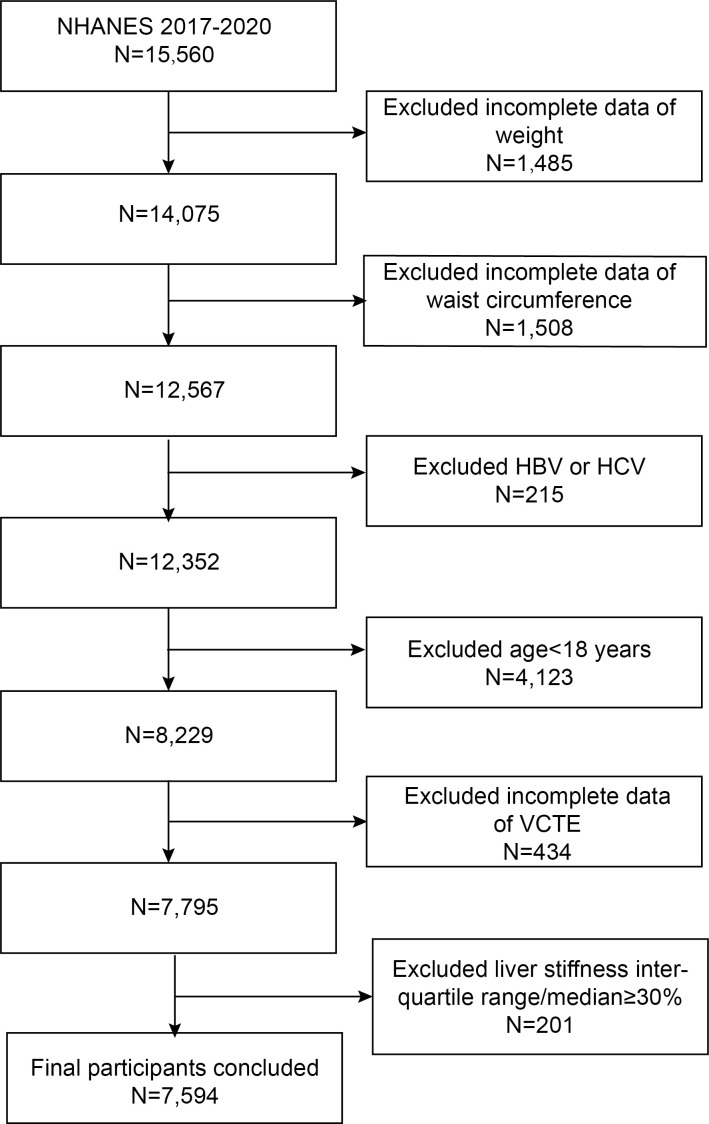
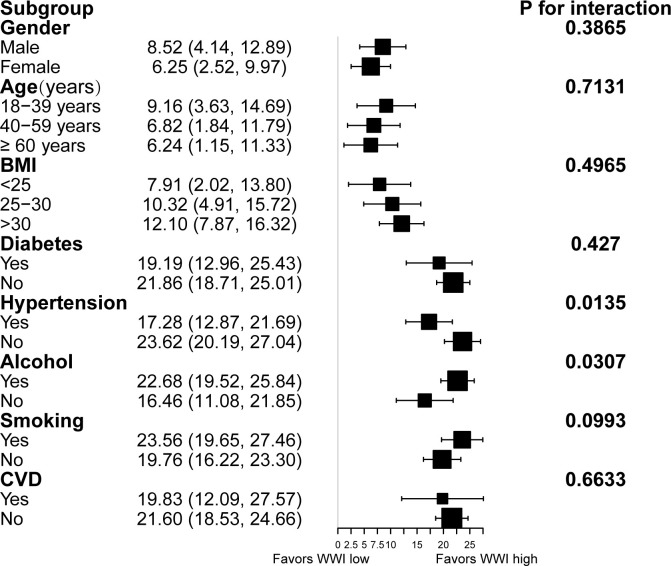
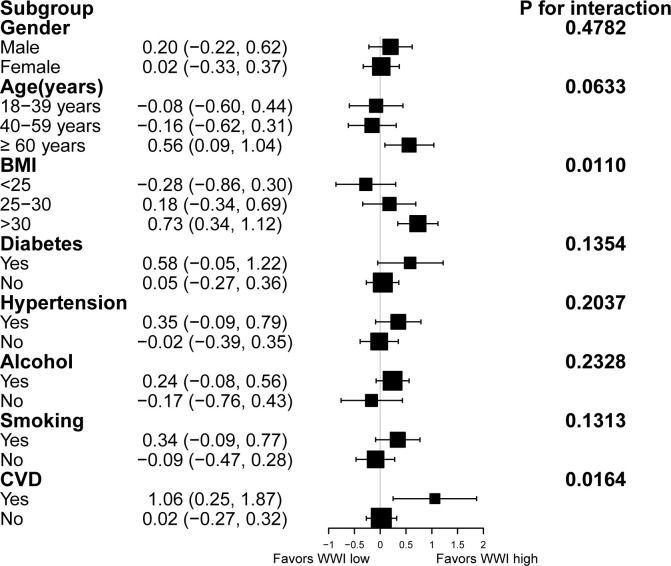
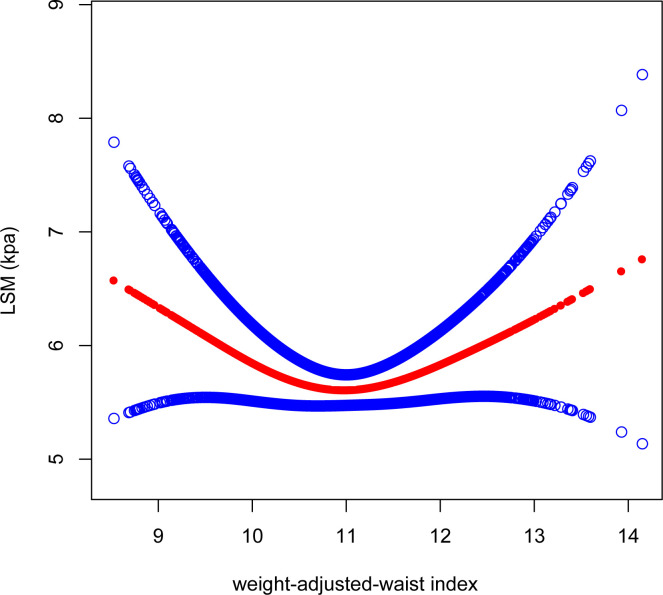
This population-based study included 7,594 people, 50.74% of whom were men and 49.26% of whom were women. Multivariate linear regression analysis revealed a significant positive relationship between WWI and hepatic steatosis [CAP, β=7.60, 95% confidence interval (CI) (4.42, 10.78), P<0.0001]. This positive association was stronger when excessive alcohol intake was present compared to when it was absent (P for interaction = 0.031), and when hypertension was present compared to when it was not (P for interaction = 0.014). The linear relationship between WWI and liver fibrosis was not statistically significant on multiple regression analysis [LSM, β=0.03, 95% CI (-0.26, 0.32), P=0.84]. However, a U-shaped association was seen between WWI and LSM, with a negative correlation when WWI< 10.92 and a positive correlation when WWI > 10.92.
We report a strong association between WWI and hepatic steatosis, and suggest that it may potentially be used as a simple anthropometric index to predict hepatic steatosis.
近年来,肥胖对肝脂肪变性和纤维化的负面影响受到了广泛关注。体重调整腰围指数(WWI)反映了与体重无关的向心性肥胖。本文首次探讨了 WWI 与肝脂肪变性和肝纤维化之间的关系。
我们使用 2017-2020 年全国健康和营养调查的数据进行了一项横断面研究。采用多元线性回归模型探讨了 WWI 与受控衰减参数(CAP)和肝硬度测量值(LSM)之间的线性关系。采用拟合平滑曲线和阈值效应分析描述了非线性关系。根据性别、年龄、体重指数、糖尿病、高血压、饮酒和吸烟情况进行了亚组分析。
这项基于人群的研究共纳入 7594 人,其中 50.74%为男性,49.26%为女性。多元线性回归分析显示,WWI 与肝脂肪变性呈显著正相关[CAP,β=7.60,95%置信区间(CI)(4.42,10.78),P<0.0001]。与不饮酒相比,过量饮酒时这种正相关更强(交互作用 P 值=0.031),与无高血压相比,有高血压时这种正相关更强(交互作用 P 值=0.014)。多元回归分析显示,WWI 与肝纤维化之间无统计学显著线性关系[LSM,β=0.03,95%CI(-0.26,0.32),P=0.84]。然而,WWI 与 LSM 之间存在 U 形关联,当 WWI<10.92 时呈负相关,当 WWI>10.92 时呈正相关。
我们报告了 WWI 与肝脂肪变性之间的强烈关联,并表明它可能可作为一种简单的人体测量指数,用于预测肝脂肪变性。