Lai Lee-Lun, Huang Po-Han, Stemme Göran, Niklaus Frank, Gylfason Kristinn B
Division of Micro and Nanosystems, School of Electrical Engineering and Computer Science, KTH Royal Institute of Technology, Stockholm 10044, Sweden.
ACS Nano. 2024 Apr 23;18(16):10788-10797. doi: 10.1021/acsnano.3c11030. Epub 2024 Mar 29.
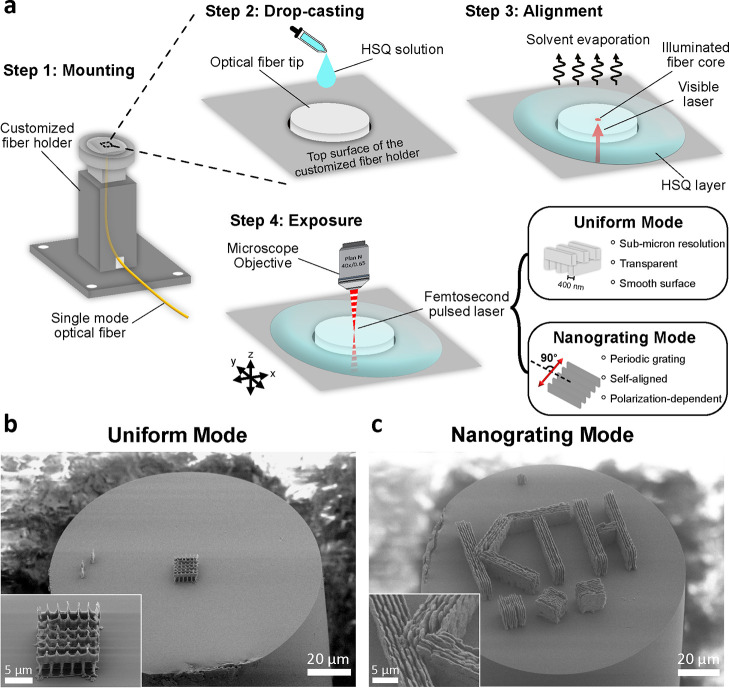
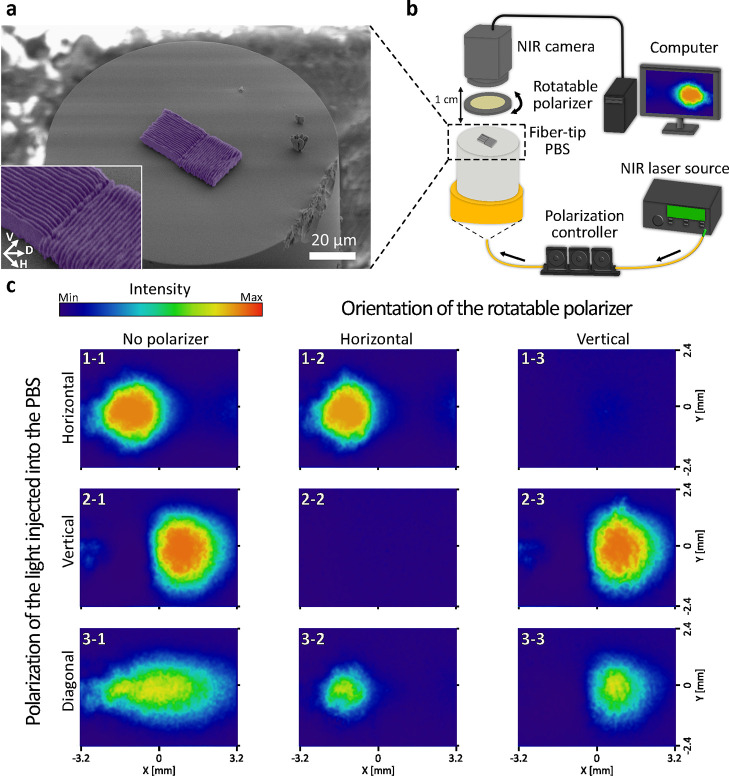
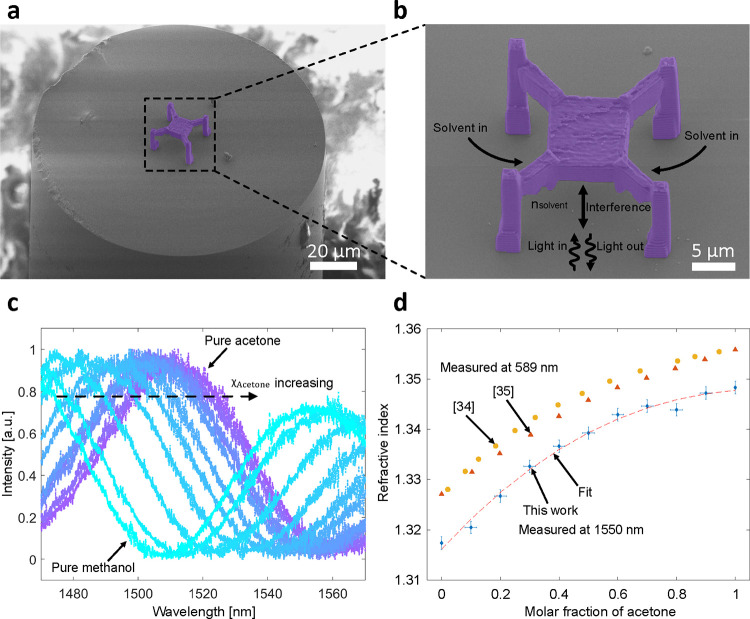
Integration of functional materials and structures on the tips of optical fibers has enabled various applications in micro-optics, such as sensing, imaging, and optical trapping. Direct laser writing is a 3D printing technology that holds promise for fabricating advanced micro-optical structures on fiber tips. To date, material selection has been limited to organic polymer-based photoresists because existing methods for 3D direct laser writing of inorganic materials involve high-temperature processing that is not compatible with optical fibers. However, organic polymers do not feature stability and transparency comparable to those of inorganic glasses. Herein, we demonstrate 3D direct laser writing of inorganic glass with a subwavelength resolution on optical fiber tips. We show two distinct printing modes that enable the printing of solid silica glass structures ("Uniform Mode") and self-organized subwavelength gratings ("Nanograting Mode"), respectively. We illustrate the utility of our approach by printing two functional devices: (1) a refractive index sensor that can measure the indices of binary mixtures of acetone and methanol at near-infrared wavelengths and (2) a compact polarization beam splitter for polarization control and beam steering in an all-in-fiber system. By combining the superior material properties of glass with the plug-and-play nature of optical fibers, this approach enables promising applications in fields such as fiber sensing, optical microelectromechanical systems (MEMS), and quantum photonics.
在光纤尖端集成功能材料和结构已实现了微光学领域的各种应用,如传感、成像和光镊。直接激光写入是一种3D打印技术,有望在光纤尖端制造先进的微光学结构。迄今为止,材料选择仅限于有机聚合物基光刻胶,因为现有的无机材料3D直接激光写入方法涉及高温处理,这与光纤不兼容。然而,有机聚合物的稳定性和透明度不如无机玻璃。在此,我们展示了在光纤尖端以亚波长分辨率进行无机玻璃的3D直接激光写入。我们展示了两种不同的打印模式,分别能够打印固体二氧化硅玻璃结构(“均匀模式”)和自组织亚波长光栅(“纳米光栅模式”)。我们通过打印两个功能器件来说明我们方法的实用性:(1)一种折射率传感器,可在近红外波长下测量丙酮和甲醇二元混合物的折射率;(2)一种紧凑型偏振分束器,用于全光纤系统中的偏振控制和光束转向。通过将玻璃的优异材料特性与光纤的即插即用特性相结合,这种方法在光纤传感、光学微机电系统(MEMS)和量子光子学等领域实现了有前景的应用。