Department of Human Anatomy and Histology, School Medicine, University of Zaragoza, Zaragoza, Spain.
Tissue Microenvironment (TME) Lab. Aragón Institute of Engineering Research (I3A), University of Zaragoza, Zaragoza, Spain.
BMC Med Educ. 2023 Jun 6;23(1):413. doi: 10.1186/s12909-023-04379-x.
Game-based learning (GBL) is effective for increasing participation, creativity, and student motivation. However, the discriminative value of GBL for knowledge acquisition has not yet been proven. The aim of this study is to assess the value of Kahoot! as a discriminative tool for formative assessment in medical education in two different subjects.
A prospective experimental study was conducted on a sample of 173 students enrolled in neuroanatomy (2021-2022). One hundred twenty-five students individually completed the Kahoot! prior to the final exam. In addition, students enrolled in human histology during two academic courses were included in the study. The control group course (2018-2019) received a traditional teaching methodology (N = 211), while Kahoot! was implemented during 2020-2021 (N = 200). All students completed similar final exams for neuroanatomy and human histology based on theory tests and image exams.
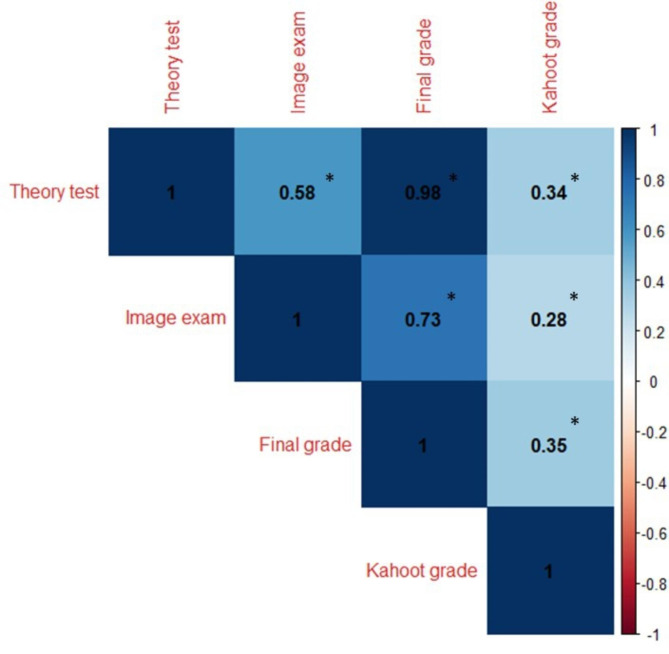
The correlation between the Kahoot score and the final grade was analyzed for all students enrolled in neuroanatomy who completed both exercises. The correlation between the Kahoot exercise and the theory test, image exam and final grade was significantly positive in all cases (r = 0.334 p < 0.001, r = 0.278 p = 0.002 and r = 0.355 p < 0.001, respectively). Moreover, students who completed the Kahoot! exercise obtained significantly higher grades in all parts of the exam. Regarding human histology, the theory tests, image exams and final grades were significantly higher when using Kahoot! versus the "traditional" methodology (p < 0.001, p < 0.001 and p = 0.014, respectively).
Our study demonstrates for the first time that Kahoot! can be used to improve and predict the final grade in medical education subjects.
基于游戏的学习(GBL)对于提高参与度、创造力和学生的学习动机很有效。然而,GBL 对于知识获取的区分价值尚未得到证实。本研究旨在评估 Kahoot! 在医学教育中两个不同学科的形成性评估中的区分工具价值。
对 173 名神经解剖学学生(2021-2022 年)进行前瞻性实验研究。125 名学生在期末考试前单独完成了 Kahoot!。此外,在两个学术课程中学习人体组织学的学生也被纳入研究。对照组课程(2018-2019 年)接受传统教学方法(N=211),而 Kahoot! 则在 2020-2021 年期间实施(N=200)。所有学生都参加了神经解剖学和人体组织学的类似期末考试,考试内容包括理论测试和图像测试。
对所有完成两项练习的神经解剖学学生进行了 Kahoot 得分与期末考试成绩之间的相关性分析。在所有情况下,Kahoot 练习与理论测试、图像考试和期末考试成绩之间的相关性均呈显著正相关(r=0.334,p<0.001,r=0.278,p=0.002 和 r=0.355,p<0.001)。此外,完成 Kahoot! 练习的学生在考试的所有部分都获得了显著更高的成绩。关于人体组织学,使用 Kahoot! 与“传统”方法相比,理论测试、图像考试和期末考试成绩均显著更高(p<0.001,p<0.001 和 p=0.014)。
我们的研究首次表明,Kahoot! 可用于提高和预测医学教育科目的期末考试成绩。