Tian Jia-Wen, Zhang He-Jing, Li Si-Yuan, Guo Yong-Lin, Chen Gang, Yu Zi-Li
The State Key Laboratory Breeding Base of Basic Science of Stomatology (Hubei-MOST) & Key Laboratory of Oral Biomedicine Ministry of Education, School and Hospital of Stomatology, Wuhan University, Wuhan 430079, China.
Department of Oral and Maxillofacial Surgery, School and Hospital of Stomatology, Wuhan University, Wuhan 430079, China.
J Cancer. 2023 May 8;14(8):1321-1334. doi: 10.7150/jca.84632. eCollection 2023.
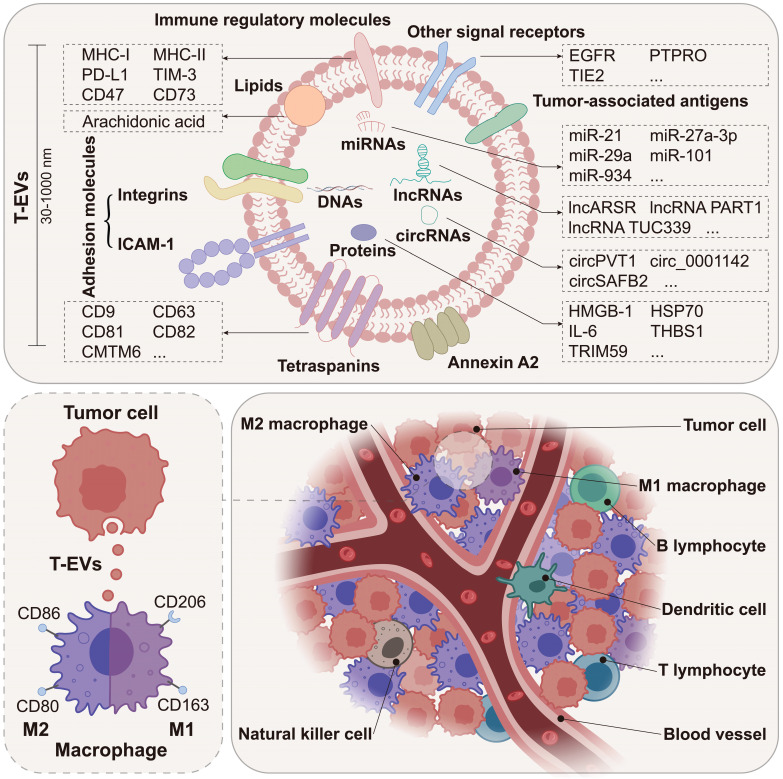
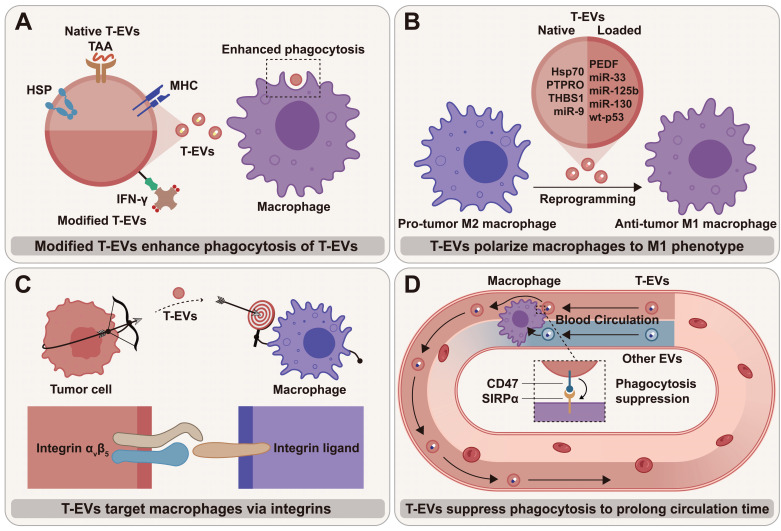
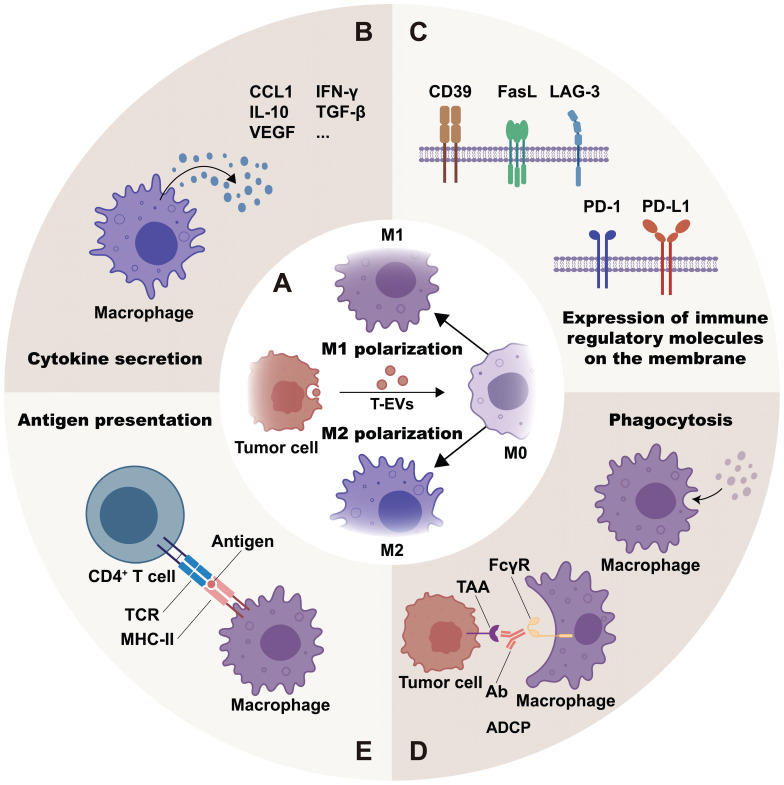
Tumor tissues consist of tumor cells and tumor stroma, which is structured by non-tumor cells and the extracellular matrix. Macrophages are the predominant immune cells in the tumor microenvironment (TME). Based on the intimate interaction between macrophages and tumor cells, macrophages are closely involved in tumor initiation and progression, playing a key role in tumor formation, angiogenesis, metastasis, and immune escape. Extracellular vesicles (EVs) are a group of membrane-enclosed structures secreted by almost all cell types. As crucial mediators of cell-to-cell communication, EVs play a role in various physiological processes and the development of diseases including cancer. According to numerous studies, tumor cell-derived extracellular vesicles (T-EVs) could highly modulate the phenotypes and functions of macrophages, thus promoting tumor development. Herein, we comprehensively introduce the role of T-EVs in regulating the M1/M2 phenotypes and immune functions of macrophages, including cytokine secretion, expression of immune regulatory molecules on the membrane, phagocytosis, and antigen presentation. More importantly, based on the regulatory effects of T-EVs on macrophages, we propose several potential therapeutic approaches that may guide future attempts to increase the effectiveness of cancer therapy.
肿瘤组织由肿瘤细胞和肿瘤基质组成,肿瘤基质由非肿瘤细胞和细胞外基质构成。巨噬细胞是肿瘤微环境(TME)中主要的免疫细胞。基于巨噬细胞与肿瘤细胞之间的密切相互作用,巨噬细胞密切参与肿瘤的起始和进展,在肿瘤形成、血管生成、转移和免疫逃逸中发挥关键作用。细胞外囊泡(EVs)是几乎所有细胞类型分泌的一组膜包被结构。作为细胞间通讯的关键介质,EVs在各种生理过程以及包括癌症在内的疾病发展中发挥作用。根据众多研究,肿瘤细胞衍生的细胞外囊泡(T-EVs)可高度调节巨噬细胞的表型和功能,从而促进肿瘤发展。在此,我们全面介绍T-EVs在调节巨噬细胞的M1/M2表型和免疫功能中的作用,包括细胞因子分泌、膜上免疫调节分子的表达、吞噬作用和抗原呈递。更重要的是,基于T-EVs对巨噬细胞的调节作用,我们提出了几种潜在的治疗方法,这些方法可能为未来提高癌症治疗效果的尝试提供指导。