Department of Otolaryngology Head and Neck Surgery, The First Affiliated Hospital of Zhengzhou University, Zhengzhou, China.
Department of Otorhinolaryngology, Zhengzhou Seventh People's Hospital, Zhengzhou, China.
PeerJ. 2023 Jun 1;11:e15469. doi: 10.7717/peerj.15469. eCollection 2023.
Early diagnosis and treatment can improve the survival rates of patients with laryngeal squamous cell carcinoma (LSCC). Therefore, it is necessary to discover new biomarkers for laryngeal cancer screening and early diagnosis.
We collected fasting plasma from LSCC patients and healthy volunteers, as well as cancer and para-carcinoma tissues from LSCC patients, and performed quantitative detection of amino acid levels using liquid chromatography-mass spectrometry. We used overall analysis and multivariate statistical analysis to screen out the statistically significant differential amino acids in the plasma and tissue samples, conducted receiver operating characteristic (ROC) analysis of the differential amino acids to evaluate the sensitivity and specificity of the differential amino acids, and finally determined the diagnostic value of amino acids for laryngeal cancer. Additionally, we identified amino acids in the plasma and tissue samples that are valuable for the early diagnosis of laryngeal cancer classified according to the tumor-node-metastasis (TNM) classification.
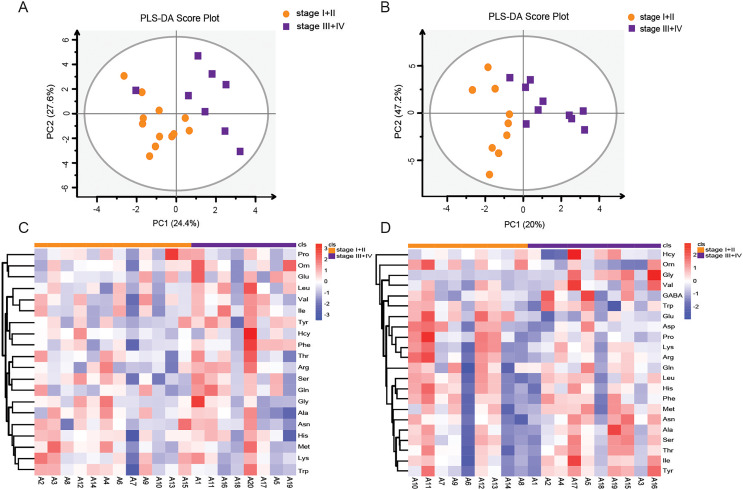
Asparagine (Asp) and homocysteine (Hcy) were two amino acids of common significance in plasma and tissue samples, and their specificity and sensitivity analysis showed that they may be new biomarkers for the diagnosis and treatment of LSCC. According to the TNM staging system, phenylalanine (Phe) and isoleucine (Ile) were screened out in the plasma of LSCC patients at early (I and II) and advanced (III and IV) stages; ornithine hydrochloride (Orn), glutamic acid (Glu), and Glycine (Gly) were selected in the tissue. These dysregulated amino acids found in LSCC patients may be useful as clinical biomarkers for the early diagnosis and screening of LSCC.
早期诊断和治疗可以提高喉鳞状细胞癌(LSCC)患者的生存率。因此,有必要发现新的生物标志物用于喉癌筛查和早期诊断。
我们收集了 LSCC 患者和健康志愿者的空腹血浆,以及 LSCC 患者的癌组织和癌旁组织,并使用液相色谱-质谱法对氨基酸水平进行定量检测。我们采用整体分析和多变量统计分析筛选出血浆和组织样本中具有统计学意义的差异氨基酸,对差异氨基酸进行接收者操作特征(ROC)分析,评价差异氨基酸的敏感性和特异性,最终确定氨基酸对喉癌的诊断价值。此外,我们根据肿瘤-淋巴结-转移(TNM)分类,鉴定了血浆和组织样本中对喉癌早期诊断有价值的氨基酸。
天冬酰胺(Asp)和同型半胱氨酸(Hcy)是血浆和组织样本中两个具有共同意义的氨基酸,其特异性和敏感性分析表明,它们可能是 LSCC 诊断和治疗的新生物标志物。根据 TNM 分期系统,在 LSCC 患者的血浆中筛选出早期(I 和 II 期)和晚期(III 和 IV 期)的苯丙氨酸(Phe)和异亮氨酸(Ile);在组织中选择了盐酸鸟氨酸(Orn)、谷氨酸(Glu)和甘氨酸(Gly)。这些在 LSCC 患者中失调的氨基酸可能作为 LSCC 早期诊断和筛查的临床生物标志物有用。