CENTAI, Turin, Italy.
Sci Rep. 2023 Jun 7;13(1):9268. doi: 10.1038/s41598-023-35536-3.
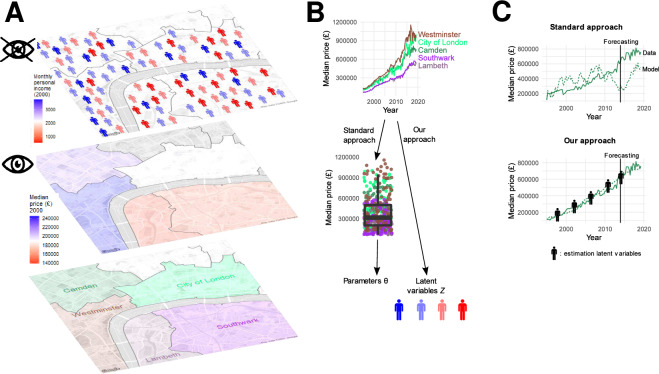
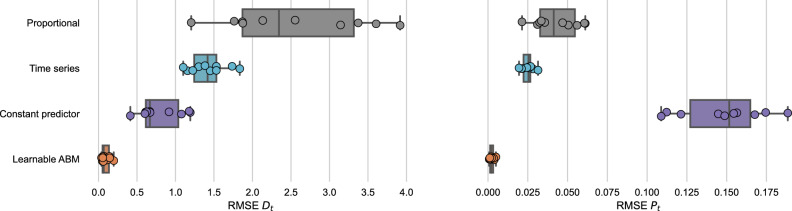
Agent-Based Models (ABMs) are used in several fields to study the evolution of complex systems from micro-level assumptions. However, a significant drawback of ABMs is their inability to estimate agent-specific (or "micro") variables, which hinders their ability to make accurate predictions using micro-level data. In this paper, we propose a protocol to learn the latent micro-variables of an ABM from data. We begin by translating an ABM into a probabilistic model characterized by a computationally tractable likelihood. Next, we use a gradient-based expectation maximization algorithm to maximize the likelihood of the latent variables. We showcase the efficacy of our protocol on an ABM of the housing market, where agents with different incomes bid higher prices to live in high-income neighborhoods. Our protocol produces accurate estimates of the latent variables while preserving the general behavior of the ABM. Moreover, our estimates substantially improve the out-of-sample forecasting capabilities of the ABM compared to simpler heuristics. Our protocol encourages modelers to articulate assumptions, consider the inferential process, and spot potential identification problems, thus making it a useful alternative to black-box data assimilation methods.
基于代理的模型(ABM)在多个领域中被用于从微观层面的假设研究复杂系统的演化。然而,ABM 的一个显著缺点是无法估计代理特定的(或“微观”)变量,这限制了它们使用微观层面数据进行准确预测的能力。在本文中,我们提出了一种从数据中学习 ABM 的潜在微观变量的协议。我们首先将 ABM 转换为具有可计算似然性的概率模型。接下来,我们使用基于梯度的期望最大化算法最大化潜在变量的似然。我们在住房市场的 ABM 上展示了我们协议的有效性,其中具有不同收入的代理为住在高收入社区而出价更高。我们的协议在保留 ABM 的一般行为的同时,产生了潜在变量的准确估计。此外,与更简单的启发式方法相比,我们的估计大大提高了 ABM 的样本外预测能力。我们的协议鼓励建模者阐明假设、考虑推理过程并发现潜在的识别问题,因此是一种替代黑盒数据同化方法的有用方法。