Raza Syed Ahsan, Sokale Itunu O, Thrift Aaron P
Section of Epidemiology and Population Sciences, Department of Medicine, Baylor College of Medicine, Houston, TX 77030, USA.
Dan L. Duncan Comprehensive Cancer Center, Baylor College of Medicine, Houston, TX 77030, USA.
Lancet Reg Health Am. 2023 May 30;23:100525. doi: 10.1016/j.lana.2023.100525. eCollection 2023 Jul.
The phenotype of combined heavy alcohol consumption and obesity has the potential to pose as a considerable health burden in the U.S. No studies using nationally representative data in the U.S. have reported their secular joint prevalence trends. We estimated the prevalence and examined the joint trends of heavy alcohol use and obesity over time among adult U.S. men and women in different age groups and according to race/ethnicity.
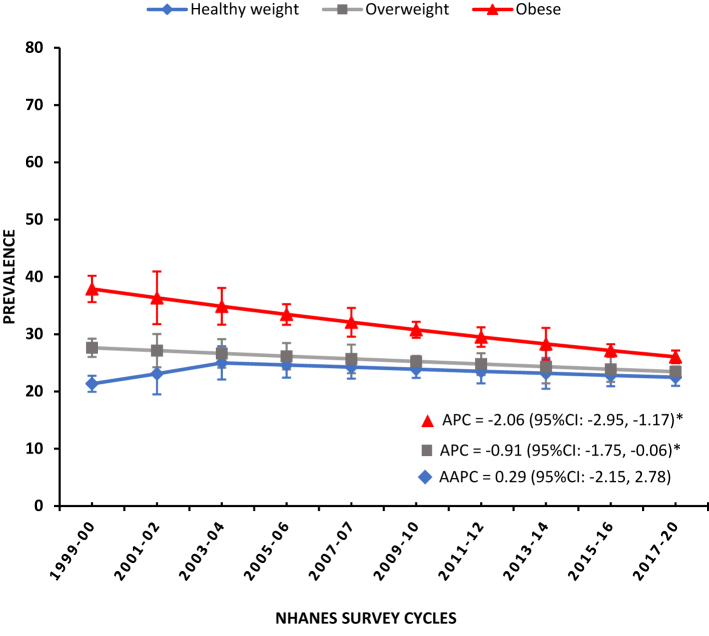
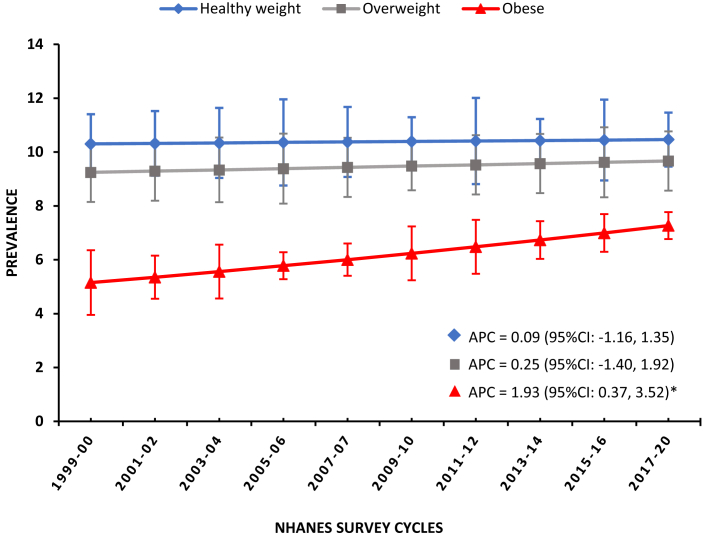
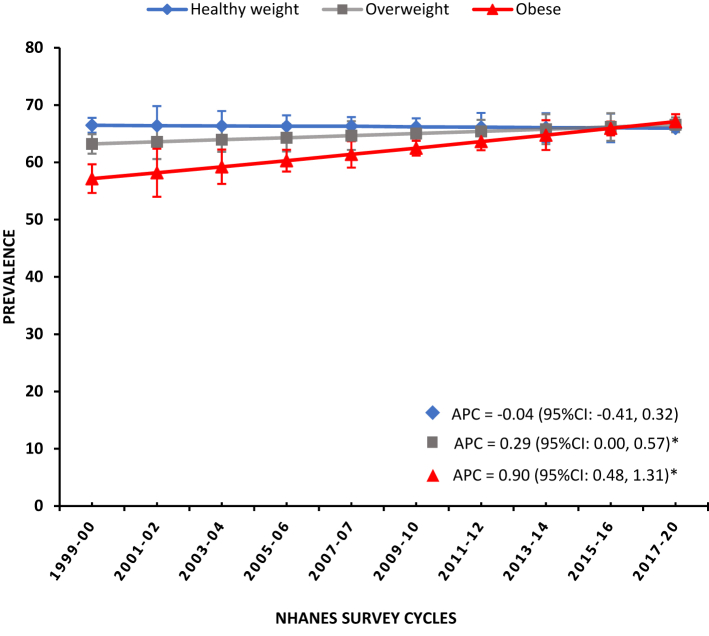
Using data from 10 cycles of the U.S. National Health and Nutrition Examination Survey (NHANES) from 1999 to 2020, we examined secular trends in the combined phenotype of heavy drinking and obesity overall and by age-group, sex, and race/ethnicity. The main outcome measures were prevalence of heavy alcohol consumption (>14 drinks/week in men and >7 drinks/week in women) and obesity (BMI ≥30).
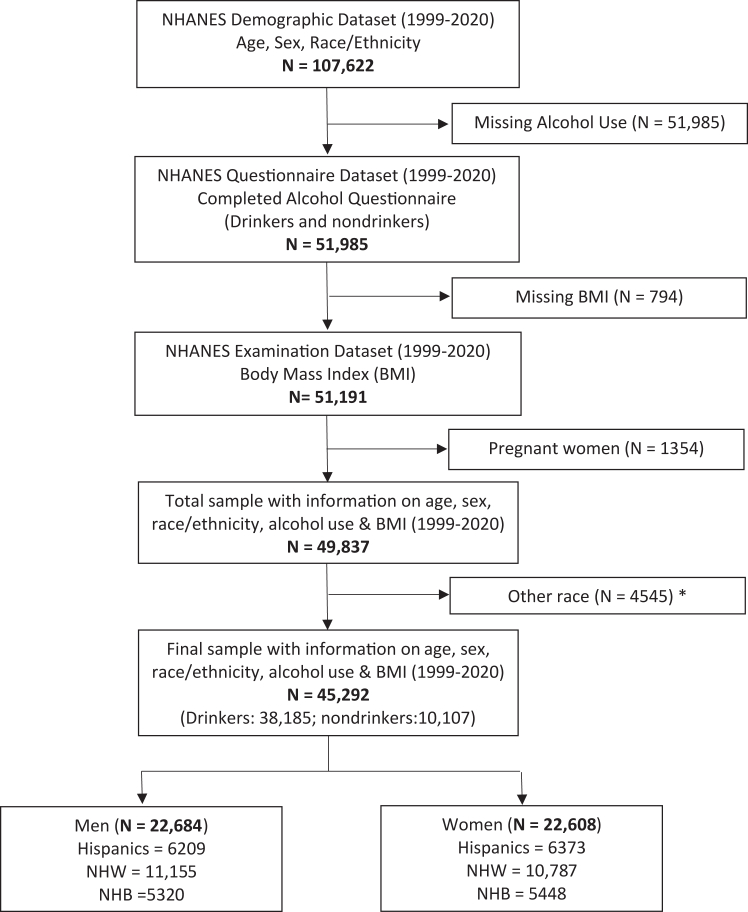
In 45,292 adults (22,684 men, mean age 49.26 years; and 22,608 women, mean age 49.86), the overall weighted prevalence of combined heavy alcohol drinking and obesity increased from 1.8% (95% CI: 1.2%, 3.1%) in 1999-2000 to 3.1% (95% CI: 2.7%, 3.7%) in 2017-2020 representing an increase of 72% over time. In the joinpoint regression, the combined phenotype of heavy alcohol consumption and obesity increased by 3.25% (95% CI: 1.67%, 4.85%) per year overall from 1999 to 2017. An increasing trend of 9.94% (95% CI: 2.37%, 18.06%) per year was observed among adults aged between 40 and 59 years from 2007 onwards. Prevalence of heavy alcohol consumption in obesity increased at a faster rate among women (APC, 3.96%; 95% CI: 2.14%, 5.82%) than men (APC, 2.47%; 95% CI: 0.63%, 4.35%), and increased among non-Hispanic Whites (APC, 4.12%; 95% CI: 1.50%, 6.82%) and non-Hispanic Blacks (APC, 2.78%; 95% CI: 0.47%, 5.14%), but not Hispanics.
The prevalence of combined heavy alcohol consumption and obesity increased overall in the U.S., but the rate of increase differed by age, sex, and race/ethnic groups. Given their independent and potential synergistic effects on premature mortality, public health policies on alcohol consumption need to reflect the background obesity epidemic.
Cancer Prevention & Research Institute of Texas (CPRIT) for the Systems Epidemiology of Cancer Training (SECT) Program (RP210037; PI: A. Thrift).
大量饮酒与肥胖相结合的这种表型有可能在美国造成相当大的健康负担。美国尚无研究利用全国代表性数据报告其长期联合患病率趋势。我们估算了美国成年男性和女性中不同年龄组以及按种族/族裔划分的大量饮酒和肥胖的患病率,并研究了其随时间的联合趋势。
利用1999年至2020年美国国家健康和营养检查调查(NHANES)10个周期的数据,我们研究了大量饮酒与肥胖相结合的表型总体上以及按年龄组、性别和种族/族裔划分的长期趋势。主要结局指标为大量饮酒(男性每周超过14杯,女性每周超过7杯)和肥胖(体重指数≥30)的患病率。
在45292名成年人(22684名男性,平均年龄49.26岁;22608名女性,平均年龄49.86岁)中,大量饮酒与肥胖相结合的总体加权患病率从1999 - 2000年的1.8%(95%置信区间:1.2%,3.1%)增至2017 - 2020年的3.1%(95%置信区间:2.7%,3.7%),随时间增加了72%。在连接点回归分析中,1999年至2017年期间,大量饮酒与肥胖相结合的表型总体上每年增加3.25%(95%置信区间:1.67%,4.85%)。2007年起,40至59岁成年人中观察到每年9.94%(95%置信区间:2.37%,18.06%)的上升趋势。肥胖人群中大量饮酒的患病率在女性中(年度百分比变化,3.96%;95%置信区间:2.14%,5.82%)比男性中(年度百分比变化,2.47%;95%置信区间:0.63%,4.35%)上升得更快,在非西班牙裔白人(年度百分比变化,4.12%;95%置信区间:1.50%,6.82%)和非西班牙裔黑人(年度百分比变化,2.78%;95%置信区间:0.47%,5.14%)中有所上升,但在西班牙裔中未上升。
在美国,大量饮酒与肥胖相结合的患病率总体上升,但上升速度因年龄、性别和种族/族裔群体而异。鉴于它们对过早死亡具有独立及潜在协同效应,关于饮酒的公共卫生政策需要考虑肥胖流行这一背景情况。
德克萨斯州癌症预防与研究所(CPRIT)的癌症系统流行病学培训(SECT)项目(RP210037;项目负责人:A. 思里夫特)