Rosales Thiécla Katiane Osvaldt, Fabi João Paulo
Department of Food Science and Experimental Nutrition, School of Pharmaceutical Science, University of São Paulo, São Paulo, SP, Brazil.
Food Research Center (FoRC), CEPID-FAPESP (Research, Innovation and Dissemination Centers, São Paulo Research Foundation), São Paulo, SP, Brazil.
Front Nutr. 2023 May 24;10:1144677. doi: 10.3389/fnut.2023.1144677. eCollection 2023.
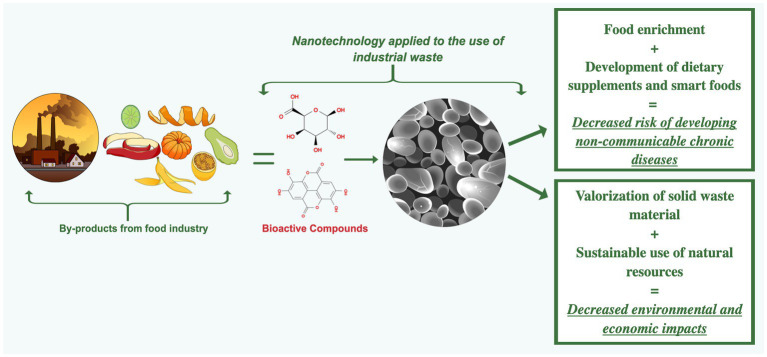
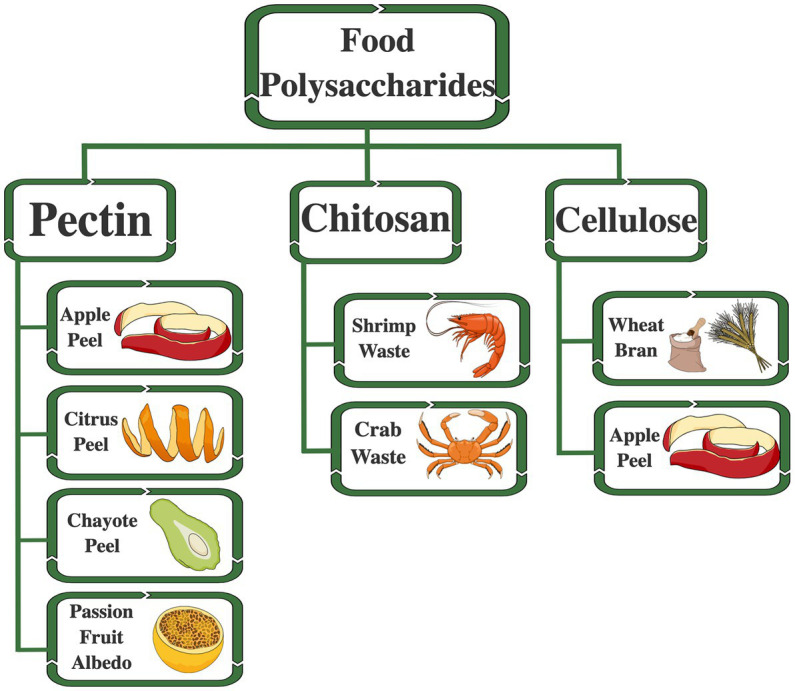
In the last decades, evidence has indicated the beneficial properties of dietary polyphenols. and studies support that the regular intake of these compounds may be a strategy to reduce the risks of some chronic non-communicable diseases. Despite their beneficial properties, they are poorly bioavailable compounds. Thus, the main objective of this review is to explore how nanotechnology improves human health while reducing environmental impacts with the sustainable use of vegetable residues, from extraction to the development of functional foods and supplements. This extensive literature review discusses different studies based on the application of nanotechnology to stabilize polyphenolic compounds and maintain their physical-chemical stability. Food industries commonly generate a significant amount of solid waste. Exploring the bioactive compounds of solid waste has been considered a sustainable strategy in line with emerging global sustainability needs. Nanotechnology can be an efficient tool to overcome the challenge of molecular instability, especially using polysaccharides such as pectin as assembling material. Complex polysaccharides are biomaterials that can be extracted from citrus and apple peels (from the juice industries) and constitute promising wall material stabilizing chemically sensitive compounds. Pectin is an excellent biomaterial to form nanostructures, as it has low toxicity, is biocompatible, and is resistant to human enzymes. The potential extraction of polyphenols and polysaccharides from residues and their inclusion in food supplements may be a possible application to reduce environmental impacts and constitutes an approach for effectively including bioactive compounds in the human diet. Extracting polyphenolics from industrial waste and using nanotechnology may be feasible to add value to food by-products, reduce impacts on nature and preserve the properties of these compounds.
在过去几十年中,有证据表明膳食多酚具有有益特性。并且研究支持,定期摄入这些化合物可能是降低某些慢性非传染性疾病风险的一种策略。尽管它们具有有益特性,但却是生物利用度较低的化合物。因此,本综述的主要目的是探讨纳米技术如何通过可持续利用蔬菜残渣(从提取到功能性食品和补充剂的开发)来改善人类健康,同时减少对环境的影响。这一广泛的文献综述讨论了基于纳米技术应用来稳定多酚类化合物并保持其物理化学稳定性的不同研究。食品工业通常会产生大量固体废物。探索固体废物中的生物活性化合物已被视为符合全球新兴可持续发展需求的一种可持续策略。纳米技术可以成为克服分子不稳定性挑战的有效工具,特别是使用果胶等多糖作为组装材料。复杂多糖是可从柑橘和苹果皮(来自果汁行业)中提取的生物材料,是稳定化学敏感化合物的有前景的壁材。果胶是形成纳米结构的优良生物材料,因为它毒性低、具有生物相容性且对人体酶具有抗性。从残渣中潜在提取多酚和多糖并将其纳入食品补充剂可能是减少环境影响的一种可行应用,并且构成了将生物活性化合物有效纳入人类饮食的一种方法。从工业废料中提取多酚类物质并利用纳米技术可能可行,从而为食品副产品增加价值、减少对自然的影响并保留这些化合物的特性。