University of Pittsburgh School of Medicine, Department of Pediatrics, Pittsburgh, PA, USA.
University of Pittsburgh School of Medicine, Program in Microbiology and Immunology, Pittsburgh, PA, USA.
Commun Biol. 2023 Jun 9;6(1):620. doi: 10.1038/s42003-023-04994-w.
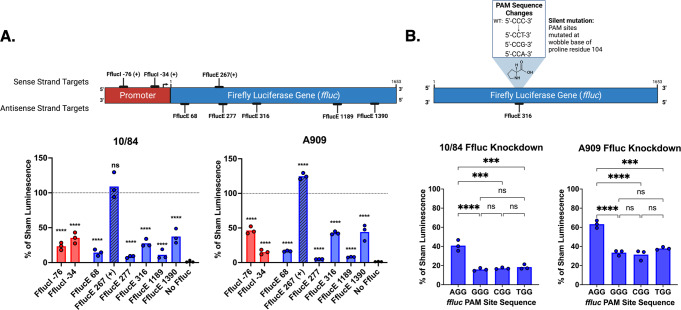
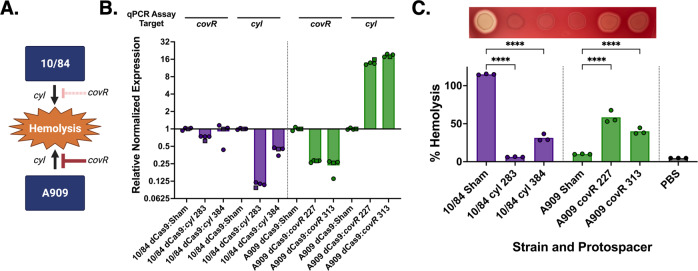
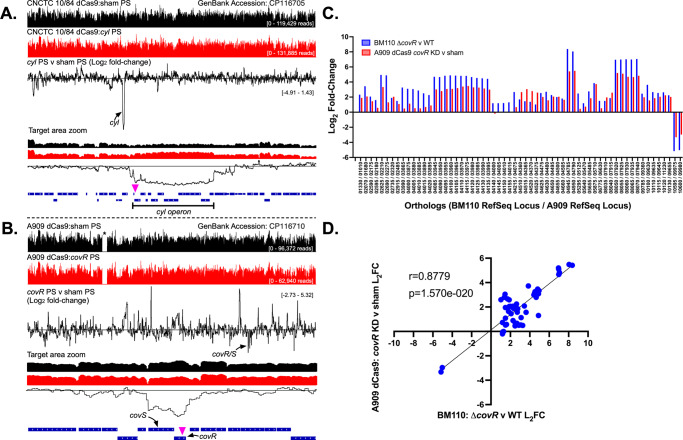
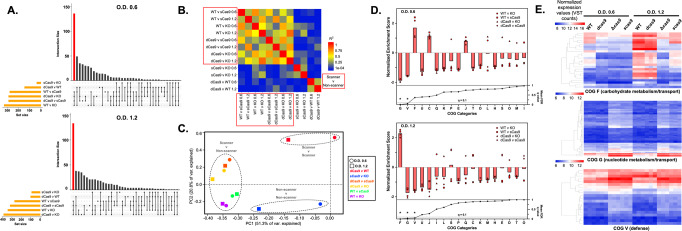
Group B Streptococcus (GBS; S. agalactiae) causes chorioamnionitis, neonatal sepsis, and can also cause disease in healthy or immunocompromised adults. GBS possesses a type II-A CRISPR-Cas9 system, which defends against foreign DNA within the bacterial cell. Several recent publications have shown that GBS Cas9 influences genome-wide transcription through a mechanism uncoupled from its function as a specific, RNA-programmable endonuclease. We examine GBS Cas9 effects on genome-wide transcription through generation of several isogenic variants with specific functional defects. We compare whole-genome RNA-seq from Δcas9 GBS with a full-length Cas9 gene deletion; dcas9 defective in its ability to cleave DNA but still able to bind to frequently occurring protospacer adjacent motifs; and scas9 that retains its catalytic domains but is unable to bind protospacer adjacent motifs. Comparing scas9 GBS to the other variants, we identify nonspecific protospacer adjacent motif binding as a driver of genome-wide, Cas9 transcriptional effects in GBS. We also show that Cas9 transcriptional effects from nonspecific scanning tend to influence genes involved in bacterial defense and nucleotide or carbohydrate transport and metabolism. While genome-wide transcription effects are detectable by analysis of next-generation sequencing, they do not result in virulence changes in a mouse model of sepsis. We also demonstrate that catalytically inactive dCas9 expressed from the GBS chromosome can be used with a straightforward, plasmid-based, single guide RNA expression system to suppress transcription of specific GBS genes without potentially confounding off-target effects. We anticipate that this system will be useful for study of nonessential and essential gene roles in GBS physiology and pathogenesis.
B 群链球菌(GBS;无乳链球菌)可引起绒毛膜羊膜炎、新生儿败血症,也可导致健康或免疫功能低下的成人发病。GBS 拥有 II-A 型 CRISPR-Cas9 系统,该系统可抵御细菌细胞内的外源 DNA。最近的几项研究表明,GBS Cas9 通过一种与其作为特定 RNA 可编程内切酶的功能解耦的机制影响全基因组转录。我们通过生成几种具有特定功能缺陷的同基因变体来检查 GBS Cas9 对全基因组转录的影响。我们将 Δcas9 GBS 的全基因组 RNA-seq 与全长 Cas9 基因缺失进行了比较;dcas9 可切割 DNA,但仍能与频繁出现的原间隔基序结合;scas9 保留其催化结构域,但不能与原间隔基序结合。与其他变体相比,我们发现非特异性原间隔基序结合是 GBS Cas9 转录全基因组效应的驱动因素。我们还表明,非特异性扫描的 Cas9 转录效应倾向于影响涉及细菌防御和核苷酸或碳水化合物运输和代谢的基因。虽然通过下一代测序的分析可以检测到全基因组转录效应,但它们不会导致败血症小鼠模型中的毒力变化。我们还证明,从 GBS 染色体表达的无催化活性的 dCas9 可以与简单的质粒基单指导 RNA 表达系统一起使用,以抑制特定 GBS 基因的转录,而不会产生潜在的脱靶效应。我们预计该系统将有助于研究 GBS 生理和发病机制中非必需和必需基因的作用。