Medical Support Center for the Japan Environment and Children's Study, National Research Institute for Child Health and Development, Tokyo 157-8535, Japan.
Nutrients. 2023 May 30;15(11):2568. doi: 10.3390/nu15112568.
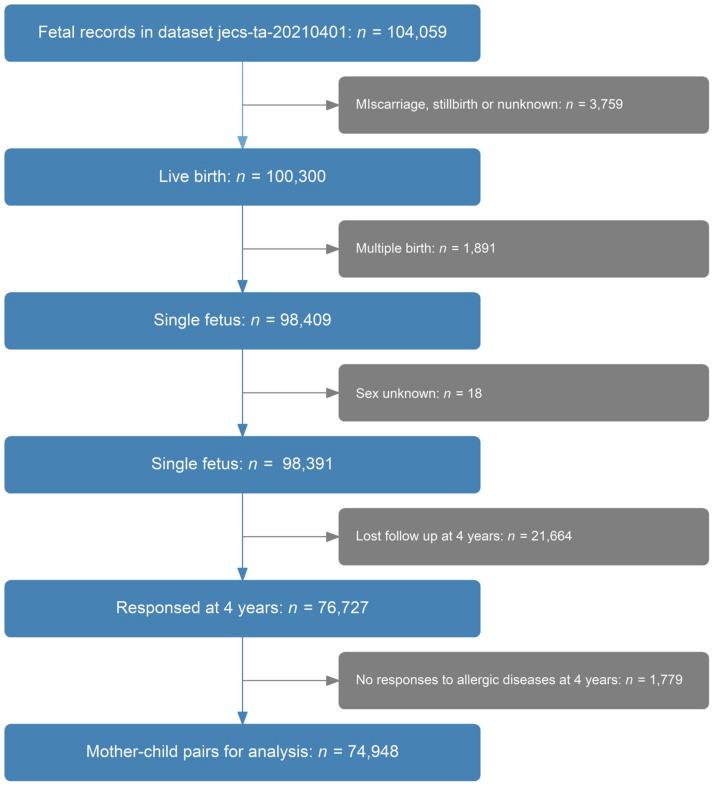
Maternal dietary zinc intake and childhood allergy have inconsistent relationships. Thus, this study aimed to evaluate the influence of low maternal dietary zinc intake during pregnancy on developing pediatric allergic diseases. This study was designed using the Japan Environment and Children's Study dataset. The model building used data from 74,948 mother-child pairs. Maternal dietary zinc intake was estimated based on the food frequency questionnaire, collecting the intake information of 171 food and beverage items. Fitted logistic regression models and generalized estimating equation models (GEEs) estimated the association between energy-adjusted zinc intake and childhood allergic conditions. The energy-adjusted zinc intake did not affect the risk of developing allergic disorders (wheeze, asthma, atopic dermatitis, rhinitis, and food allergy) in offspring. The GEE model revealed similar insignificant odds ratios. No significant association was found between zinc intake during pregnancy and allergic diseases in offspring in early childhood. Further study remains necessary to examine the association between zinc and allergy with reliable zinc status biomarkers in the body.
母亲的膳食锌摄入量与儿童过敏之间的关系不一致。因此,本研究旨在评估妊娠期间母亲膳食锌摄入不足对儿童过敏性疾病发展的影响。本研究使用了日本环境与儿童研究数据集进行设计。模型构建使用了来自 74948 对母婴对的数据。根据食物频率问卷估算了母亲的膳食锌摄入量,收集了 171 种食物和饮料的摄入量信息。拟合的逻辑回归模型和广义估计方程模型(GEE)估计了能量调整后的锌摄入量与儿童过敏情况之间的关联。能量调整后的锌摄入量不会影响后代发生过敏疾病(喘息、哮喘、特应性皮炎、鼻炎和食物过敏)的风险。GEE 模型也揭示了相似的无显著性比值比。妊娠期间锌摄入量与儿童早期过敏疾病之间没有显著关联。需要进一步研究,以使用可靠的体内锌状态生物标志物来检验锌与过敏之间的关系。