Department of Mechanical Engineering, University of Saskatchewan, Saskatoon, SK S7N 5A9, Canada.
College of Pharmacy and Nutrition, University of Saskatchewan, Saskatoon, SK S7N 5E5, Canada.
Sensors (Basel). 2023 Jun 2;23(11):5300. doi: 10.3390/s23115300.
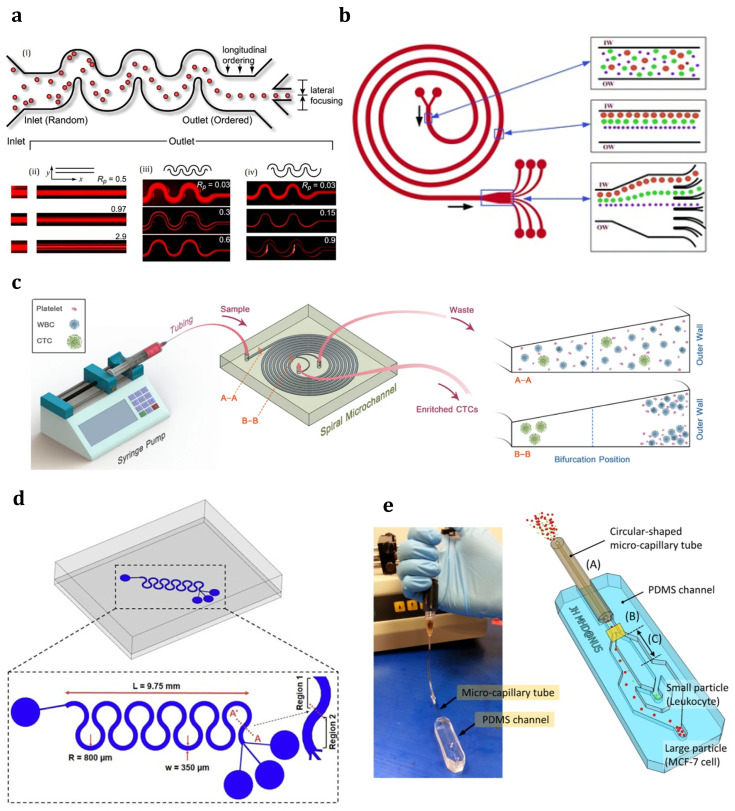
The treatment of cancers is a significant challenge in the healthcare context today. Spreading circulating tumor cells (CTCs) throughout the body will eventually lead to cancer metastasis and produce new tumors near the healthy tissues. Therefore, separating these invading cells and extracting cues from them is extremely important for determining the rate of cancer progression inside the body and for the development of individualized treatments, especially at the beginning of the metastasis process. The continuous and fast separation of CTCs has recently been achieved using numerous separation techniques, some of which involve multiple high-level operational protocols. Although a simple blood test can detect the presence of CTCs in the blood circulation system, the detection is still restricted due to the scarcity and heterogeneity of CTCs. The development of more reliable and effective techniques is thus highly desired. The technology of microfluidic devices is promising among many other bio-chemical and bio-physical technologies. This paper reviews recent developments in the two types of microfluidic devices, which are based on the size and/or density of cells, for separating cancer cells. The goal of this review is to identify knowledge or technology gaps and to suggest future works.
当今,癌症的治疗是医疗保健领域的一大挑战。肿瘤细胞循环(CTC)扩散到全身后,最终会导致癌症转移,并在健康组织附近产生新的肿瘤。因此,分离这些入侵细胞并从中提取线索,对于确定体内癌症的进展速度以及制定个体化治疗方案非常重要,尤其是在转移过程的早期。目前,已经有许多分离技术可以实现 CTC 的连续快速分离,其中一些技术涉及多个高级操作方案。虽然简单的血液检查可以检测到血液系统中 CTC 的存在,但由于 CTC 的稀缺性和异质性,检测仍然受到限制。因此,人们非常希望开发出更可靠、更有效的技术。在众多生物化学和生物物理技术中,微流控器件技术很有前景。本文综述了基于细胞大小和/或密度的两种微流控分离癌细胞的装置的最新进展。本文的目的是确定知识或技术差距,并提出未来的工作方向。