Departments of Public Health, Xinjiang Medical University, Urumqi, 830011, China.
State Key Laboratory of Pathogenesis, Prevention and Treatment of High Incidence Diseases in Central Asia, Clinical Medical Research Institute, The First Affiliated Hospital of Xinjiang Medical University, Urumqi, 830011, China.
BMC Public Health. 2023 Jun 14;23(1):1139. doi: 10.1186/s12889-023-16091-y.
Shift work, with its growing prevalence globally, disrupts the body's inherent circadian rhythm. This disruption may escalate the risk of chronic diseasesxacerbate chronic disease risk by dysregulating physiological, behavioral, and psychosocial pathways. This study aimed to evaluate the effect of shift work on type 2 diabetes (T2DM) and Retinol binding protein 4 (RBP4) level.
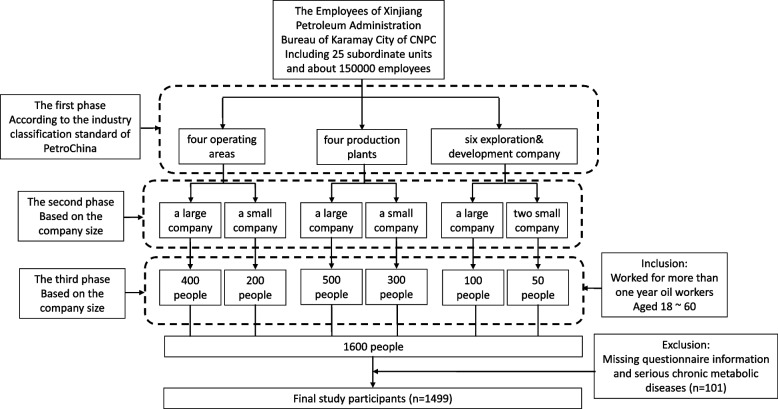
The current study employed a multi-stage stratified cluster sampling technique, examining 1499 oilfield workers from the OHSPIW cohort who participated in occupational health assessments between March 2017 and June 2018.The evaluation involved shift work, sleep quality, T2DM status with questionnaires and plasma RBP4 levels in blood samples. Statistical analysis includes, Chi-square tests, t-tests, multivariate logistic regression analyses, and multivariate linear mixed models.
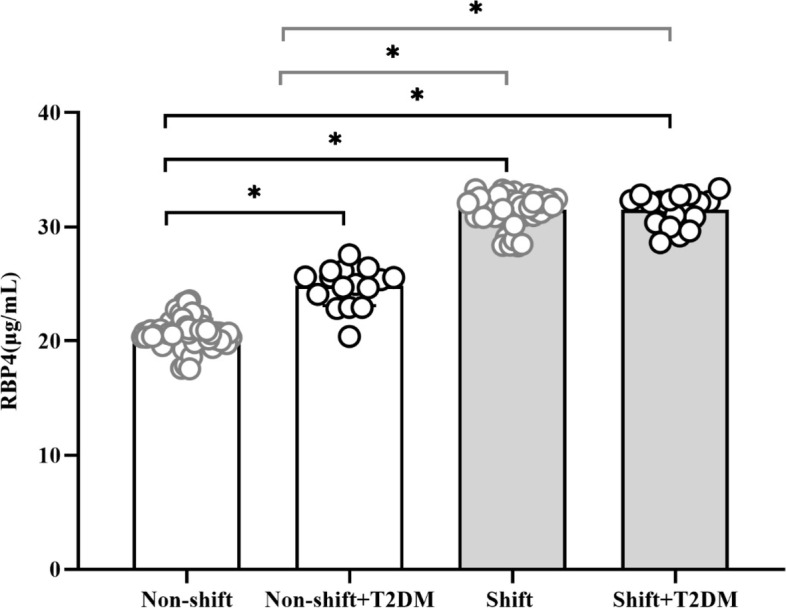
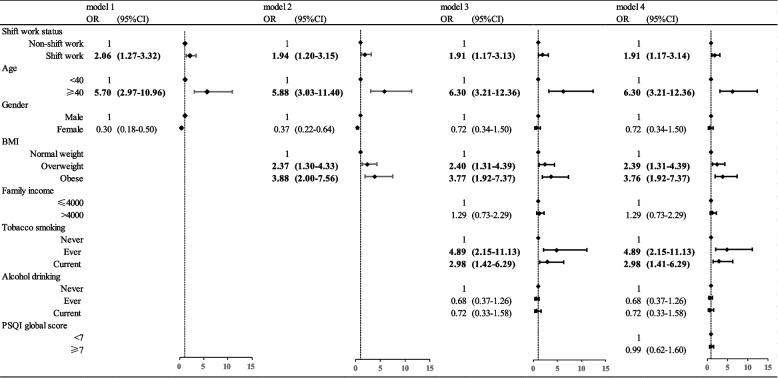
The prevalence rate of T2DM in shift workers (6.56%) was significantly higher than in day workers (4.21%) (OR = 1.60, 95% CI: 1.01-2.53), with no significant difference found in the family history of diabetes, hypertension, or other chronic heart diseases (P = 0.378). The shift worker (6.89 ± 3.35) also exhibited distinctly higher PSQI scores than day workers (5.99 ± 2.87) (P < 0.001). Adjusting the age, gender, BMI, family income, tobacco smoking, alcohol drinking and PSQI, hailed shift work as a risk factor for T2DM (OR = 1.91, 95% CI: 1.17-3.14). The pairwise comparison revealed significant differences in RBP4 levels across different groups: shift and non-shift workers both with and without T2DM (P < 0.001). The RBP4 level of the shift group without T2DM was higher than the non-shift group without T2DM (P < 0.05). The levels of RBP4 level in shift and non-shift groups with T2DM was higher than those without T2DM (P < 0.05). The multivariate linear mixed model showed that when age, gender, BMI, diabetes, PSQI, family income, smoking and drinking remained unchanged, the RBP4 level of the shift workers increased by an average of 9.51 μg/mL compared with the day workers.
Shift work is associated with an increased risk of T2DM and high levels of RBP4. Follow-up of RBP4 could facilitateearly detection of T2DM among shift workers.
随着全球范围内轮班工作的日益普及,这种工作方式扰乱了人体内在的生物钟节律。这种扰乱可能通过调节生理、行为和心理社会途径,加剧慢性疾病的风险。本研究旨在评估轮班工作对 2 型糖尿病(T2DM)和视黄醇结合蛋白 4(RBP4)水平的影响。
本研究采用多阶段分层聚类抽样技术,对 2017 年 3 月至 2018 年 6 月期间参加职业健康评估的 1499 名 OHSPIW 队列中的油田工人进行了评估。评估包括轮班工作、睡眠质量、问卷调查的 T2DM 状况以及血液样本中的血浆 RBP4 水平。统计分析包括卡方检验、t 检验、多变量逻辑回归分析和多变量线性混合模型。
轮班工人(6.56%)的 T2DM 患病率明显高于白班工人(4.21%)(OR=1.60,95%CI:1.01-2.53),糖尿病、高血压或其他慢性心脏病家族史无显著差异(P=0.378)。轮班工人(6.89±3.35)的 PSQI 评分也明显高于白班工人(5.99±2.87)(P<0.001)。调整年龄、性别、BMI、家庭收入、吸烟、饮酒和 PSQI 后,轮班工作被认为是 T2DM 的危险因素(OR=1.91,95%CI:1.17-3.14)。两两比较显示,不同组之间 RBP4 水平存在显著差异:轮班和非轮班工人均有和无 T2DM(P<0.001)。无 T2DM 的轮班组的 RBP4 水平高于无 T2DM 的非轮班组(P<0.05)。有 T2DM 的轮班和非轮班组的 RBP4 水平均高于无 T2DM 的组(P<0.05)。多变量线性混合模型显示,当年龄、性别、BMI、糖尿病、PSQI、家庭收入、吸烟和饮酒保持不变时,与白班工人相比,轮班工人的 RBP4 水平平均增加了 9.51μg/ml。
轮班工作与 T2DM 风险增加和 RBP4 水平升高有关。对 RBP4 的随访可以帮助轮班工人早期发现 T2DM。