Department of Biochemistry and Molecular Genetics, University of Louisville, Louisville, KY, USA.
Brown Cancer Center, University of Louisville School of Medicine, 505 S. Hancock St. Rm 204, Louisville, KY, 40202, USA.
Cell Oncol (Dordr). 2023 Dec;46(6):1659-1673. doi: 10.1007/s13402-023-00832-7. Epub 2023 Jun 15.
Recent studies have uncovered the near-ubiquitous presence of microbes in solid tumors of diverse origins. Previous literature has shown the impact of specific bacterial species on the progression of cancer. We propose that local microbial dysbiosis enables certain cancer phenotypes through provisioning of essential metabolites directly to tumor cells.
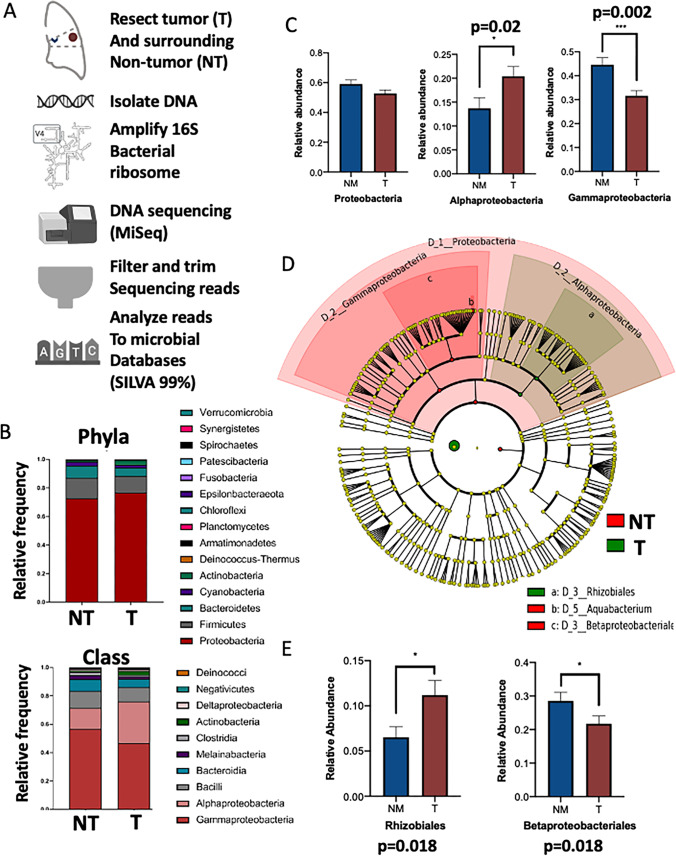
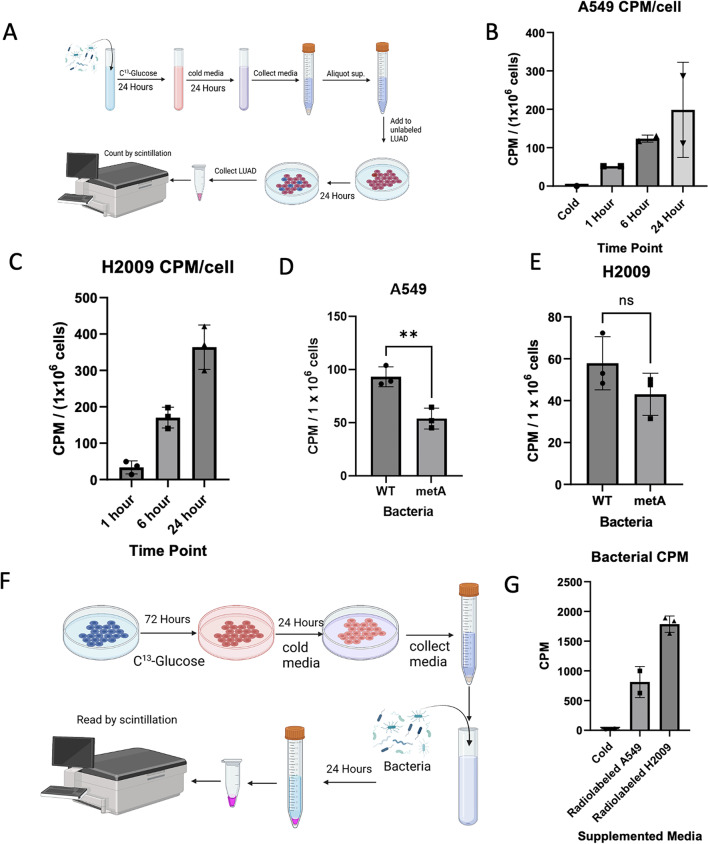
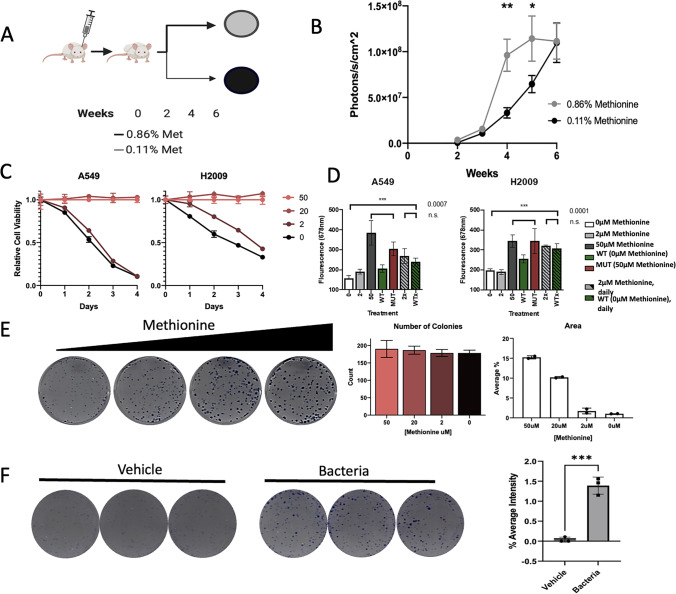
16S rDNA sequencing of 75 patient lung samples revealed the lung tumor microbiome specifically enriched for bacteria capable of producing methionine. Wild-type (WT) and methionine auxotrophic (metA mutant) E. coli cells were used to condition cell culture media and the proliferation of lung adenocarcinoma (LUAD) cells were measured using SYTO60 staining. Further, colony forming assay, Annexin V Staining, BrdU, AlamarBlue, western blot, qPCR, LINE microarray and subcutaneous injection with methionine modulated feed were used to analyze cellular proliferation, cell-cycle, cell death, methylation potential, and xenograft formation under methionine restriction. Moreover, C-labeled glucose was used to illustrate the interplay between tumor cells and bacteria.
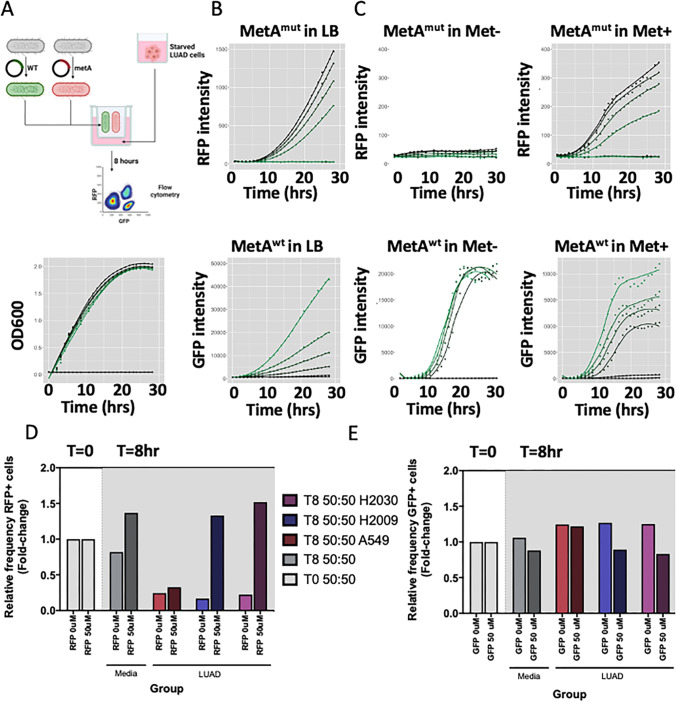
RESULTS/DISCUSSION: Our results show bacteria found locally within the tumor microenvironment are enriched for methionine synthetic pathways, while having reduced S-adenosylmethionine metabolizing pathways. As methionine is one of nine essential amino acids that mammals are unable to synthesize de novo, we investigated a potentially novel function for the microbiome, supplying essential nutrients, such as methionine, to cancer cells. We demonstrate that LUAD cells can utilize methionine generated by bacteria to rescue phenotypes that would otherwise be inhibited due to nutrient restriction. In addition to this, with WT and metA mutant E. coli, we saw a selective advantage for bacteria with an intact methionine synthetic pathway to survive under the conditions induced by LUAD cells. These results would suggest that there is a potential bi-directional cross-talk between the local microbiome and adjacent tumor cells. In this study, we focused on methionine as one of the critical molecules, but we also hypothesize that additional bacterial metabolites may also be utilized by LUAD. Indeed, our radiolabeling data suggest that other biomolecules are shared between cancer cells and bacteria. Thus, modulating the local microbiome may have an indirect effect on tumor development, progression, and metastasis.
最近的研究揭示了微生物在起源各异的实体瘤中的普遍存在。先前的文献表明了特定细菌物种对癌症进展的影响。我们提出,局部微生物失调通过直接向肿瘤细胞提供必需代谢物来使某些癌症表型得以实现。
对 75 例患者肺样本的 16S rDNA 测序揭示了肺部肿瘤微生物组特别富含能够产生蛋氨酸的细菌。使用野生型(WT)和蛋氨酸营养缺陷型(metA 突变体)大肠杆菌细胞来调节细胞培养物培养基,并使用 SYTO60 染色测量肺腺癌(LUAD)细胞的增殖。此外,还使用集落形成测定、膜联蛋白 V 染色、BrdU、AlamarBlue、western blot、qPCR、LINE 微阵列和皮下注射蛋氨酸调制饲料来分析在蛋氨酸限制下细胞增殖、细胞周期、细胞死亡、甲基化潜能和异种移植形成。此外,还使用 C 标记的葡萄糖来阐明肿瘤细胞和细菌之间的相互作用。
结果/讨论:我们的结果表明,在肿瘤微环境中局部发现的细菌富含蛋氨酸合成途径,而具有减少的 S-腺苷甲硫氨酸代谢途径。由于蛋氨酸是哺乳动物无法从头合成的九种必需氨基酸之一,我们研究了微生物组的一个潜在新功能,即向癌细胞提供必需营养素,如蛋氨酸。我们证明 LUAD 细胞可以利用细菌产生的蛋氨酸来挽救由于营养限制否则会受到抑制的表型。除此之外,对于 WT 和 metA 突变体大肠杆菌,我们看到具有完整蛋氨酸合成途径的细菌在 LUAD 细胞诱导的条件下具有生存的选择性优势。这些结果表明,局部微生物组和相邻肿瘤细胞之间可能存在潜在的双向交叉对话。在这项研究中,我们专注于蛋氨酸作为关键分子之一,但我们还假设其他细菌代谢物也可能被 LUAD 利用。事实上,我们的放射性标记数据表明,癌症细胞和细菌之间共享其他生物分子。因此,调节局部微生物组可能会对肿瘤的发展、进展和转移产生间接影响。