The College of Life Sciences, Northwest University, 229 Taibai Road, Xi'an, 710069, Shaanxi, China.
Department of Pharmacy, Xijing Hospital, Air Force Medical University, Xi'an, 710032, China.
BMC Complement Med Ther. 2023 Jun 15;23(1):197. doi: 10.1186/s12906-023-03991-0.
The dried bark of Ailanthus altissima (Mill.) Swingle is widely used in traditional Chinese medicine for the treatment of ulcerative colitis. The objective of this study was to explore the therapeutic basis of the dried bark of Ailanthus altissima (Mill.) Swingle for the treatment of ulcerative colitis based on Virtual Screening-Molecular Docking-Activity Evaluation technology.
By searching the Traditional Chinese Medicine Systems Pharmacology TCMSP Database and Analysis Platform, 89 compounds were obtained from the chemical components of the dried bark of Ailanthus altissima (Mill.) Swingle. Then, after preliminarily screening the compounds based on Lipinski's rule of five and other relevant conditions, the AutoDock Vina molecular docking software was used to evaluate the affinity of the compounds to ulcerative colitis-related target proteins and their binding modes through use of the scoring function to identify the best candidate compounds. Further verification of the compound's properties was achieved through in vitro experiments.
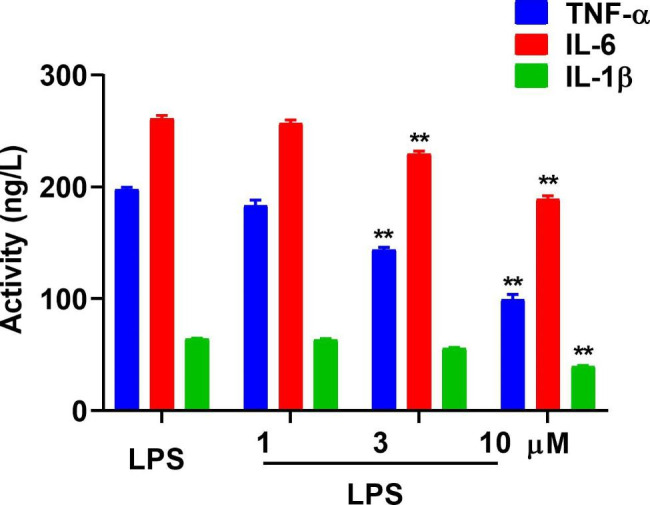
Twenty-two compounds obtained from the secondary screening were molecularly docked with ulcerative colitis-related target proteins (IL-1R, TLR, EGFR, TGFR, and Wnt) using AutoDock Vina. The free energies of the highest scoring compounds binding to the active cavity of human IL-1R, TLR, EGFR, TGFR, and Wnt proteins were - 8.7, - 8.0, - 9.2, - 7.7, and - 8.5 kcal/mol, respectively. The potential compounds, dehydrocrebanine, ailanthone, and kaempferol, were obtained through scoring function and docking mode analysis. Furthermore, the potential compound ailanthone (1, 3, and 10 µM) was found to have no significant effect on cell proliferation, though at 10 µM it reduced the level of pro-inflammatory factors caused by lipopolysaccharide.
Among the active components of the dried bark of Ailanthus altissima (Mill.) Swingle, ailanthone plays a major role in its anti-inflammatory properties. The present study shows that ailanthone has advantages in cell proliferation and in inhibiting of inflammation, but further animal research is needed to confirm its pharmaceutical potential.
臭椿树皮在传统中药中被广泛用于治疗溃疡性结肠炎。本研究旨在基于虚拟筛选-分子对接-活性评价技术,探讨臭椿树皮治疗溃疡性结肠炎的治疗基础。
通过检索中药系统药理学 TCMSP 数据库和分析平台,从臭椿树皮的化学成分中获得 89 种化合物。然后,在基于 Lipinski 五规则和其他相关条件初步筛选化合物后,使用 AutoDock Vina 分子对接软件,通过评分函数评估化合物与溃疡性结肠炎相关靶蛋白的亲和力及其结合模式,以识别最佳候选化合物。进一步通过体外实验验证化合物的性质。
通过 AutoDock Vina 将从二次筛选中获得的 22 种化合物与溃疡性结肠炎相关靶蛋白(IL-1R、TLR、EGFR、TGFR 和 Wnt)进行分子对接。与人类 IL-1R、TLR、EGFR、TGFR 和 Wnt 蛋白活性腔结合的评分最高化合物的自由能分别为-8.7、-8.0、-9.2、-7.7 和-8.5 kcal/mol。通过评分函数和对接模式分析,获得了潜在化合物脱氢克班宁、臭椿酮和山柰酚。此外,发现潜在化合物臭椿酮(1、3 和 10 µM)对细胞增殖没有显著影响,但在 10 µM 时,它降低了脂多糖引起的促炎因子水平。
在臭椿树皮的活性成分中,臭椿酮在其抗炎特性中起主要作用。本研究表明,臭椿酮在细胞增殖和抑制炎症方面具有优势,但需要进一步的动物研究来证实其药物潜力。