Maqbool Javeria, Anwar Haseeb, Rasul Azhar, Imran Ali, Saadullah Malik, Malik Shoaib Ahmad, Shabbir Asghar, Akram Rabia, Sajid Faiqa, Zafar Shamaila, Saeed Suman, Akram Muhammad Numan, Islam Fakhar, Hussain Ghulam, Islam Saiful
Neurochemicalbiology and Genetics Laboratory (NGL), Department of Physiology, Faculty of Life Sciences Government College University Faisalabad Pakistan.
Laboratorie of Neuroimmunologia, Department of Physiology and Pharmacology Sapienza University Rome Italy.
Food Sci Nutr. 2023 Feb 6;11(6):2767-2775. doi: 10.1002/fsn3.3255. eCollection 2023 Jun.
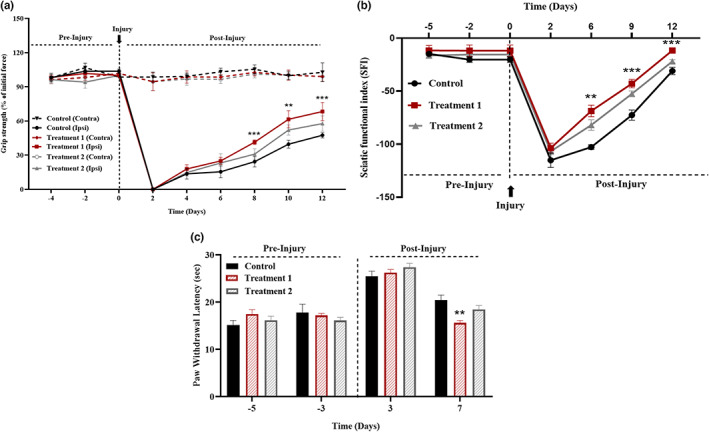
Peripheral nerve injuries are one of those complex medical conditions for which a highly effective first-line treatment is currently missing. The use of natural compound as medicines to treat various disorders has a long history. Our previous research explored that crude L. accelerated the recovery of sensorimotor functions following nerve injury. The purpose of the current study was to investigate the effects of n-Hexane and ethyl acetate extracts of L. leaves on the muscle function restoration in a mouse model after sciatic nerve injury. For this purpose, albino mice ( = 18) were equally divided into control and two treatment groups. The control group was fed on a plain diet while treatment groups were given a diet having n-Hexane (treatment 1) and ethyl acetate (treatment 2) extracts of L. (10 mg/kg body weight), respectively. The hot plate test (M = 15.61, SD = 2.61, = .001), grip strength (M = 68.32, SD = 3.22, < .001), and sciatic functional index (SFI) (M = 11.59, SD = 6.54, = .012) assessment indicated significant amelioration in treatment 1 as compared to treatment 2 group. Furthermore, muscle fiber cross-sectional area revealed a noticeable improvement (M = 182,319, SD = 35.80, = .013) in treatment 1 while muscle mass ratio of Gastrocnemius (M = 0.64, SD = 0.08, = .427) and Tibialis anterior (M = 0.57, SD = 0.04, = .209) indicated nonsignificant change. A prominent increase in total antioxidant capacity (TAC) (M = 3.76, SD = 0.38, < .001) and momentous decrease in total oxidant status (TOS) (M = 11.28, SD = 5.71, < .001) along with blood glucose level indicated significant difference (M = 105.5, SD = 9.12, < 0.001) in treatment 1 group. These results suggest that treatment 1 has the ability to speed up functional recovery after a peripheral nerve lesion. Further research is necessary, nevertheless, to better understand the extract's actual curative properties and the mechanisms that improve functional restoration.
周围神经损伤是目前缺乏高效一线治疗方法的复杂医学病症之一。使用天然化合物作为药物治疗各种疾病有着悠久的历史。我们之前的研究发现,[植物名称未完整给出]粗提物能加速神经损伤后感觉运动功能的恢复。本研究的目的是调查[植物名称未完整给出]叶的正己烷和乙酸乙酯提取物对坐骨神经损伤小鼠模型肌肉功能恢复的影响。为此,将18只白化小鼠平均分为对照组和两个治疗组。对照组给予普通饮食,而治疗组分别给予含有[植物名称未完整给出]正己烷提取物(治疗1组)和乙酸乙酯提取物(治疗2组)的饮食(10毫克/千克体重)。热板试验(均值M = 15.61,标准差SD = 2.61,p = 0.001)、握力(均值M = 68.32,标准差SD = 3.22,p < 0.001)和坐骨神经功能指数(SFI)(均值M = 11.59,标准差SD = 6.54,p = 0.012)评估表明,与治疗2组相比,治疗1组有显著改善。此外,肌肉纤维横截面积显示治疗1组有明显改善(均值M = 182,319,标准差SD = 35.80,p = 0.013),而腓肠肌(均值M = 0.64,标准差SD = 0.08,p = 0.427)和胫前肌(均值M = 0.57,标准差SD = 0.04,p = 0.209)的肌肉质量比表明无显著变化。治疗1组的总抗氧化能力(TAC)显著增加(均值M = 3.76,标准差SD = 0.38,p < 0.001),总氧化状态(TOS)显著降低(均值M = 11.28,标准差SD = 5.71,p < 0.001),同时血糖水平也有显著差异(均值M = 105.5,标准差SD = 9.12,p < 0.001)。这些结果表明,治疗1组有能力加速周围神经损伤后的功能恢复。然而,仍需要进一步研究以更好地了解提取物的实际治疗特性以及改善功能恢复的机制。