Schultz Júnia, Modolon Flúvio, Peixoto Raquel Silva, Rosado Alexandre Soares
Red Sea Research Center, King Abdullah University of Science and Technology, Thuwal, Saudi Arabia.
Computational Bioscience Research Center, King Abdullah University of Science and Technology, Thuwal, Saudi Arabia.
Front Microbiol. 2023 Jun 2;14:1167718. doi: 10.3389/fmicb.2023.1167718. eCollection 2023.
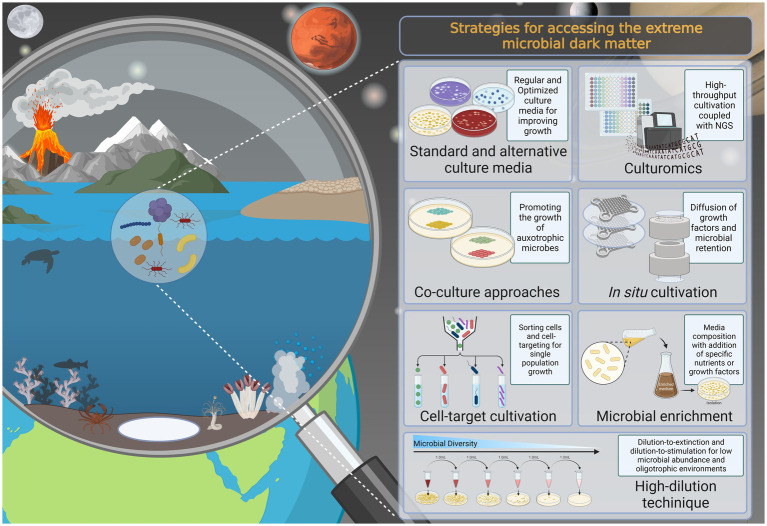
More than 20,000 species of prokaryotes (less than 1% of the estimated number of Earth's microbial species) have been described thus far. However, the vast majority of microbes that inhabit extreme environments remain uncultured and this group is termed "microbial dark matter." Little is known regarding the ecological functions and biotechnological potential of these underexplored extremophiles, thus representing a vast untapped and uncharacterized biological resource. Advances in microbial cultivation approaches are key for a detailed and comprehensive characterization of the roles of these microbes in shaping the environment and, ultimately, for their biotechnological exploitation, such as for extremophile-derived bioproducts (extremozymes, secondary metabolites, CRISPR Cas systems, and pigments, among others), astrobiology, and space exploration. Additional efforts to enhance culturable diversity are required due to the challenges imposed by extreme culturing and plating conditions. In this review, we summarize methods and technologies used to recover the microbial diversity of extreme environments, while discussing the advantages and disadvantages associated with each of these approaches. Additionally, this review describes alternative culturing strategies to retrieve novel taxa with their unknown genes, metabolisms, and ecological roles, with the ultimate goal of increasing the yields of more efficient bio-based products. This review thus summarizes the strategies used to unveil the hidden diversity of the microbiome of extreme environments and discusses the directions for future studies of microbial dark matter and its potential applications in biotechnology and astrobiology.
到目前为止,已描述的原核生物超过20000种(不到地球微生物物种估计数量的1%)。然而,绝大多数栖息在极端环境中的微生物仍未得到培养,这一类群被称为“微生物暗物质”。对于这些未被充分探索的极端微生物的生态功能和生物技术潜力知之甚少,因此它们代表了一种巨大的未开发和未表征的生物资源。微生物培养方法的进步对于详细、全面地表征这些微生物在塑造环境中的作用至关重要,最终对于它们的生物技术开发也至关重要,例如用于极端微生物衍生的生物产品(极端酶、次生代谢产物、CRISPR Cas系统和色素等)、天体生物学和太空探索。由于极端培养和平板接种条件带来的挑战,需要做出更多努力来提高可培养的多样性。在这篇综述中,我们总结了用于恢复极端环境中微生物多样性的方法和技术,同时讨论了每种方法的优缺点。此外,这篇综述描述了替代培养策略,以检索具有未知基因、代谢和生态作用的新分类群,最终目标是提高更高效的生物基产品的产量。因此,这篇综述总结了用于揭示极端环境微生物群落隐藏多样性的策略,并讨论了微生物暗物质未来研究的方向及其在生物技术和天体生物学中的潜在应用。