Yang Zi-Wen, Lian Zheng-Han, Liu Lan, Fang Bao-Zhu, Li Wen-Jun, Jiao Jian-Yu
State Key Laboratory of Biocontrol, Guangdong Provincial Key Laboratory of Plant Resources and Southern Marine Science and Engineering Guangdong Laboratory (Zhuhai), School of Life Sciences Sun Yat-Sen University Guangzhou China.
State Key Laboratory of Desert and Oasis Ecology, Key Laboratory of Ecological Safety and Sustainable Development in Arid Lands, Xinjiang Institute of Ecology and Geography Chinese Academy of Sciences Urumqi China.
Imeta. 2023 Jun 12;2(3):e123. doi: 10.1002/imt2.123. eCollection 2023 Aug.
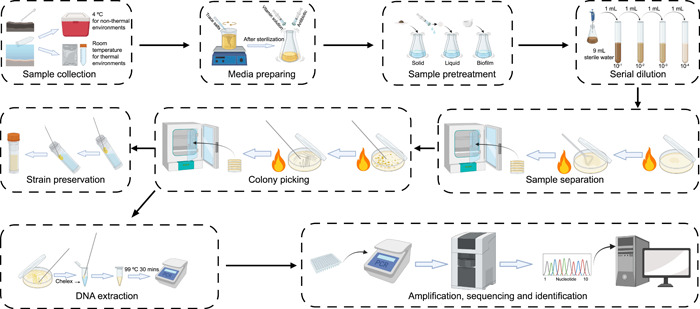
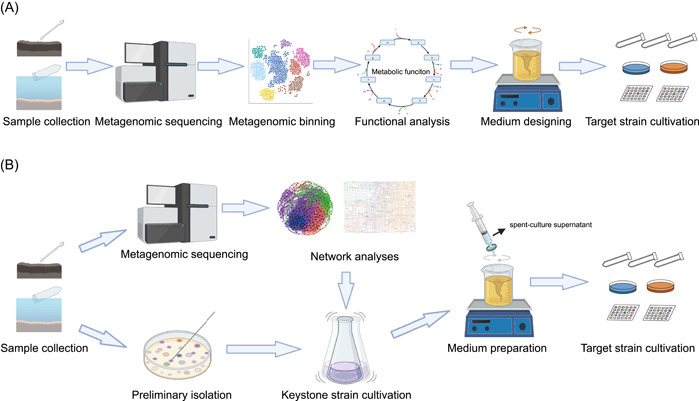
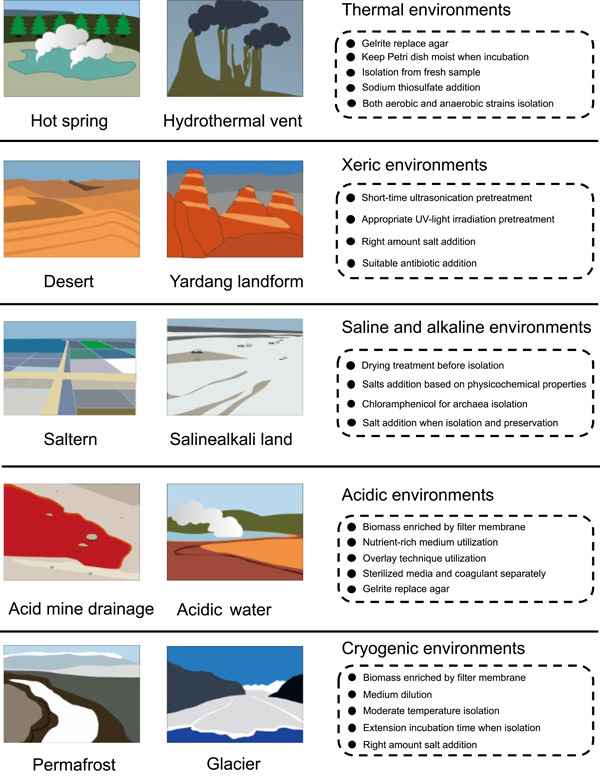
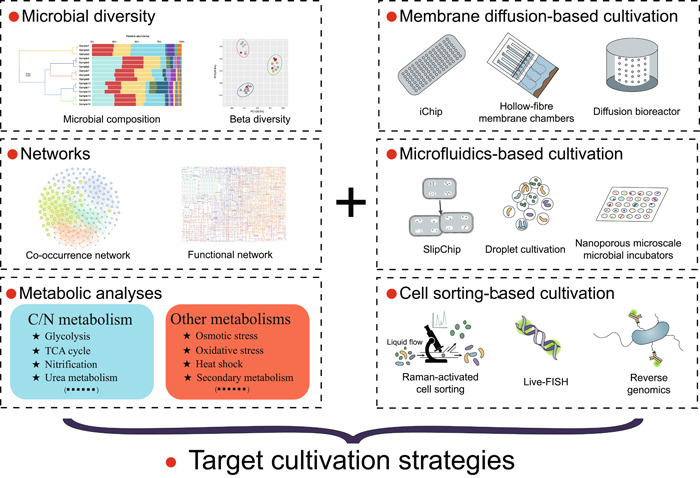
The great majority of microorganisms are as-yet-uncultivated, mostly found in extreme environments. High-throughput sequencing provides data-rich genomes from single-cell and metagenomic techniques, which has enabled researchers to obtain a glimpse of the unexpected genetic diversity of "microbial dark matter." However, cultivating microorganisms from extreme environments remains essential for dissecting and utilizing the functions of extremophiles. Here, we provide a straightforward protocol for efficiently isolating prokaryotic microorganisms from different extreme habitats (thermal, xeric, saline, alkaline, acidic, and cryogenic environments), which was established through previous successful work and our long-term experience in extremophile resource mining. We propose common processes for extremophile isolation at first and then summarize multiple cultivation strategies for recovering prokaryotic microorganisms from extreme environments and meanwhile provide specific isolation tips that are always overlooked but important. Furthermore, we propose the use of multi-omics-guided microbial cultivation approaches for culturing these as-yet-uncultivated microorganisms and two examples are provided to introduce how these approaches work. In summary, the protocol allows researchers to significantly improve the isolation efficiency of pure cultures and novel taxa, which therefore paves the way for the protection and utilization of microbial resources from extreme environments.
绝大多数微生物尚未得到培养,大多存在于极端环境中。高通量测序通过单细胞和宏基因组技术提供了数据丰富的基因组,这使研究人员能够初步了解“微生物暗物质”中意想不到的遗传多样性。然而,从极端环境中培养微生物对于剖析和利用嗜极微生物的功能仍然至关重要。在此,我们提供了一个直接的方案,用于从不同的极端栖息地(热、干旱、盐碱、碱性、酸性和低温环境)高效分离原核微生物,该方案是基于之前的成功工作以及我们在嗜极微生物资源挖掘方面的长期经验建立的。我们首先提出嗜极微生物分离的通用流程,然后总结从极端环境中复苏原核微生物的多种培养策略,同时提供一些总是被忽视但很重要的具体分离技巧。此外,我们建议使用多组学指导的微生物培养方法来培养这些尚未培养的微生物,并提供两个例子来说明这些方法的工作原理。总之,该方案使研究人员能够显著提高纯培养物和新分类群的分离效率,从而为极端环境微生物资源的保护和利用铺平道路。