Translational Research Institute, Henan Provincial People's Hospital, School of Clinical Medicine, Henan University, Zhengzhou, 450046, China.
School of Basic Medical Sciences, Henan University, Zhengzhou, 450046, China.
J Transl Med. 2023 Jun 20;21(1):401. doi: 10.1186/s12967-023-04232-1.
Although the executive pathways of senescence are known, the underlying control mechanisms are diverse and not fully understood, particularly how cancer cells avoid triggering senescence despite experiencing exacerbated stress conditions within the tumor microenvironment.
Mass spectrometry (MS)-based proteomic screening was used to identify differentially regulated genes in serum-starved hepatocellular carcinoma cells and RNAi employed to determine knockdown phenotypes of prioritized genes. Thereafter, gene function was investigated using cell proliferation assays (colony-formation, CCK-8, Edu incorporation and cell cycle) together with cellular senescence assays (SA-β-gal, SAHF and SASP). Gene overexpression and knockdown techniques were applied to examine mRNA and protein regulation in combination with luciferase reporter and proteasome degradation assays, respectively. Flow cytometry was applied to detect changes in cellular reactive oxygen species (ROS) and in vivo gene function examined using a xenograft model.
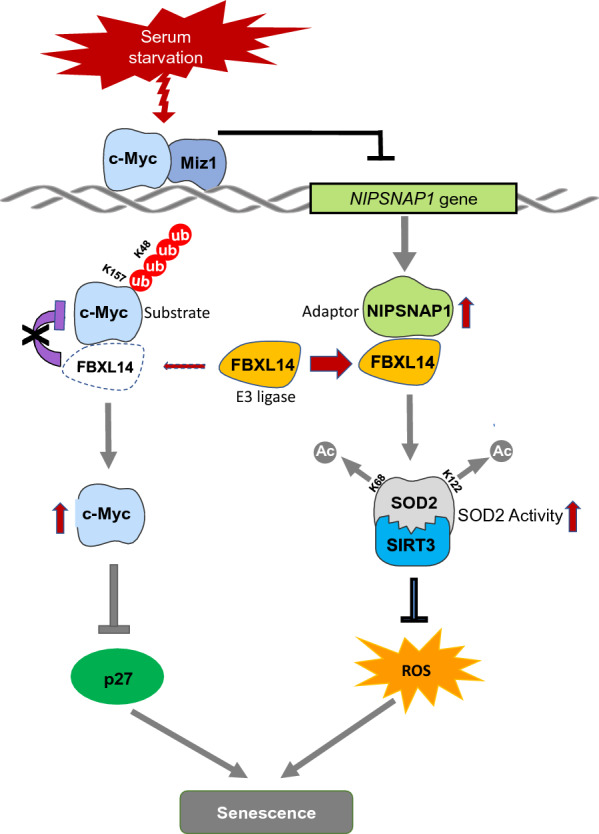
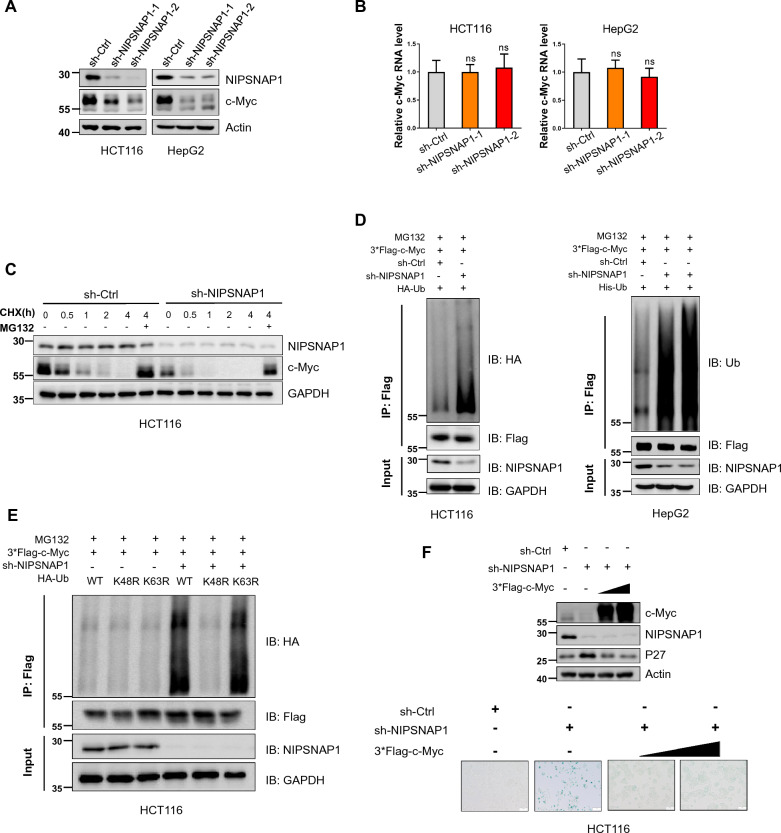
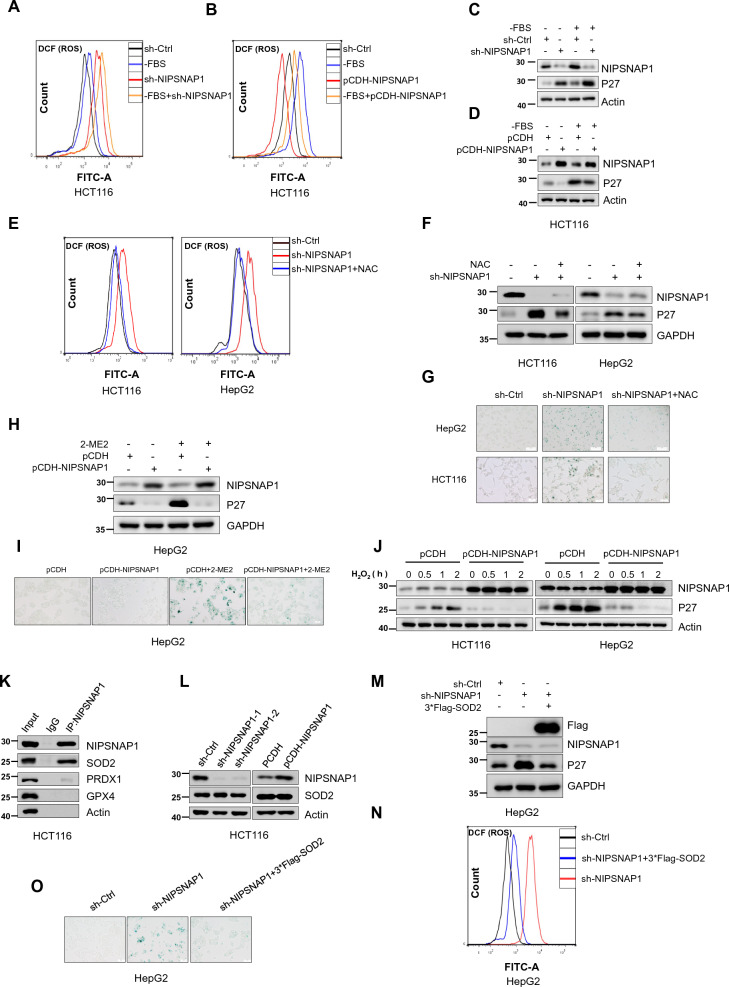
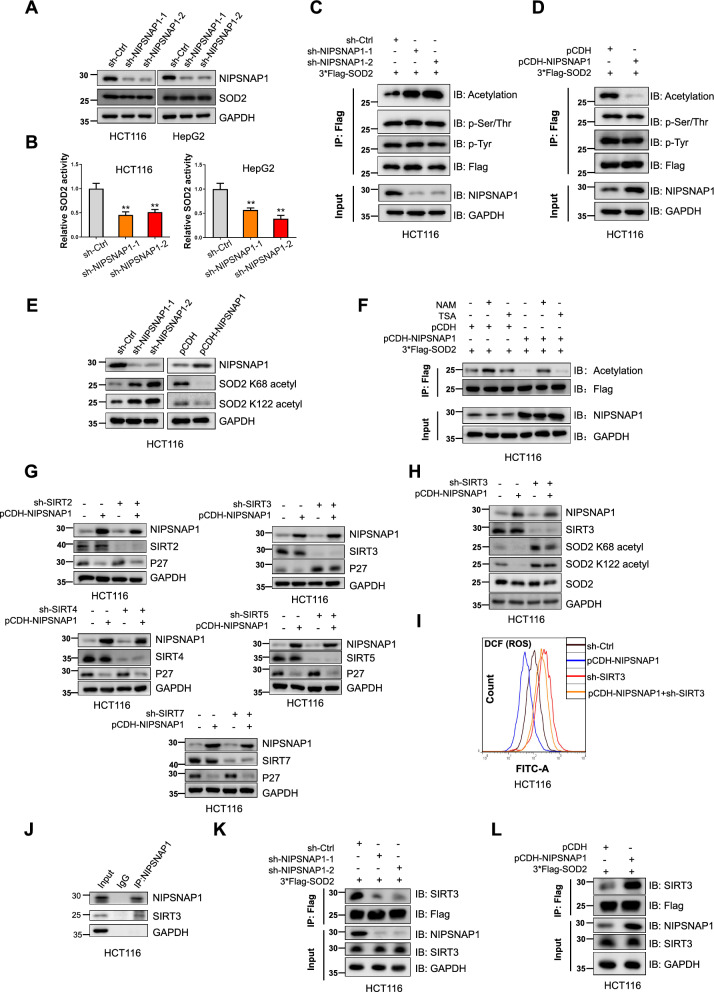
Among the genes induced by serum deprivation, NIPSNAP1 was selected for investigation. Subsequent experiments revealed that NIPSNAP1 promotes cancer cell proliferation and inhibits P27-dependent induction of senescence via dual mechanisms. Firstly, NIPSNAP1 maintains the levels of c-Myc by sequestering the E3 ubiquitin ligase FBXL14 to prevent the proteasome-mediated turnover of c-Myc. Intriguingly, NIPSNAP1 levels are restrained by transcriptional repression mediated by c-Myc-Miz1, with repression lifted in response to serum withdrawal, thus identifying feedback regulation between NIPSNAP1 and c-Myc. Secondly, NIPSNAP1 was shown to modulate ROS levels by promoting interactions between the deacetylase SIRT3 and superoxide dismutase 2 (SOD2). Consequent activation of SOD2 serves to maintain cellular ROS levels below the critical levels required to induce cell cycle arrest and senescence. Importantly, the actions of NIPSNAP1 in promoting cancer cell proliferation and preventing senescence were recapitulated in vivo using xenograft models.
Together, these findings reveal NIPSNAP1 as an important mediator of c-Myc function and a negative regulator of cellular senescence. These findings also provide a theoretical basis for cancer therapy where targeting NIPSNAP1 invokes cellular senescence.
尽管衰老的执行途径是已知的,但潜在的控制机制是多样化的,尚未完全理解,特别是癌细胞如何在肿瘤微环境中经历加剧的应激条件下避免触发衰老。
使用基于质谱(MS)的蛋白质组学筛选来鉴定血清饥饿的肝癌细胞中差异调节的基因,并使用 RNAi 确定优先基因的敲低表型。此后,通过细胞增殖测定(集落形成、CCK-8、Edu 掺入和细胞周期)以及细胞衰老测定(SA-β-半乳糖、SAHF 和 SASP)研究基因功能。应用基因过表达和敲低技术,结合荧光素酶报告和蛋白酶体降解测定,分别研究 mRNA 和蛋白质调节。应用流式细胞术检测细胞内活性氧(ROS)的变化,应用异种移植模型检测体内基因功能。
在血清剥夺诱导的基因中,选择 NIPSNAP1 进行研究。后续实验表明,NIPSNAP1 通过两种机制促进癌细胞增殖并抑制 P27 依赖性衰老诱导。首先,NIPSNAP1 通过隔离 E3 泛素连接酶 FBXL14 来维持 c-Myc 的水平,从而防止 c-Myc 的蛋白酶体介导的降解。有趣的是,NIPSNAP1 的水平受到 c-Myc-Miz1 介导的转录抑制的限制,并且在血清去除时解除抑制,从而鉴定出 NIPSNAP1 和 c-Myc 之间的反馈调节。其次,NIPSNAP1 通过促进去乙酰化酶 SIRT3 和超氧化物歧化酶 2(SOD2)之间的相互作用来调节 ROS 水平。随后 SOD2 的激活有助于将细胞内 ROS 水平维持在低于诱导细胞周期停滞和衰老所需的临界水平以下。重要的是,在异种移植模型中,NIPSNAP1 在促进癌细胞增殖和防止衰老中的作用得到了重现。
总之,这些发现揭示了 NIPSNAP1 作为 c-Myc 功能的重要介质和细胞衰老的负调节剂。这些发现还为癌症治疗提供了理论基础,其中靶向 NIPSNAP1 会引发细胞衰老。