• 文献检索
  • 文档翻译
  • 深度研究
  • 学术资讯
  • Suppr Zotero 插件Zotero 插件
  • 邀请有礼
  • 套餐&价格
  • 历史记录
应用&插件
Suppr Zotero 插件Zotero 插件浏览器插件Mac 客户端Windows 客户端微信小程序
定价
高级版会员购买积分包购买API积分包
服务
文献检索文档翻译深度研究API 文档MCP 服务
关于我们
关于 Suppr公司介绍联系我们用户协议隐私条款
关注我们

Suppr 超能文献

核心技术专利:CN118964589B侵权必究
粤ICP备2023148730 号-1Suppr @ 2026

文献检索

告别复杂PubMed语法,用中文像聊天一样搜索,搜遍4000万医学文献。AI智能推荐,让科研检索更轻松。

立即免费搜索

文件翻译

保留排版,准确专业,支持PDF/Word/PPT等文件格式,支持 12+语言互译。

免费翻译文档

深度研究

AI帮你快速写综述,25分钟生成高质量综述,智能提取关键信息,辅助科研写作。

立即免费体验

一种用于每日空气质量指数预测的混合模型及其在面对新冠疫情封锁影响时的性能

A hybrid model for daily air quality index prediction and its performance in the face of impact effect of COVID-19 lockdown.

作者信息

Li Yuting, Li Ruying

机构信息

School of Environmental Science and Engineering, Tianjin University, Tianjin 300350, PR China.

出版信息

Process Saf Environ Prot. 2023 Aug;176:673-684. doi: 10.1016/j.psep.2023.06.021. Epub 2023 Jun 14.

DOI:10.1016/j.psep.2023.06.021
PMID:37350802
原文链接:https://pmc.ncbi.nlm.nih.gov/articles/PMC10264166/
Abstract

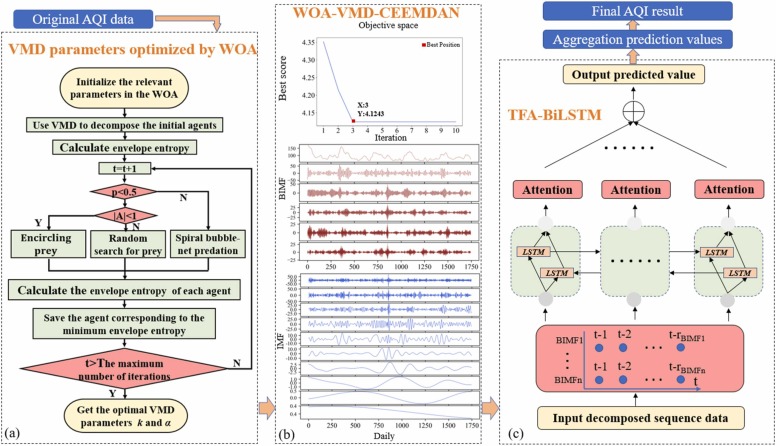
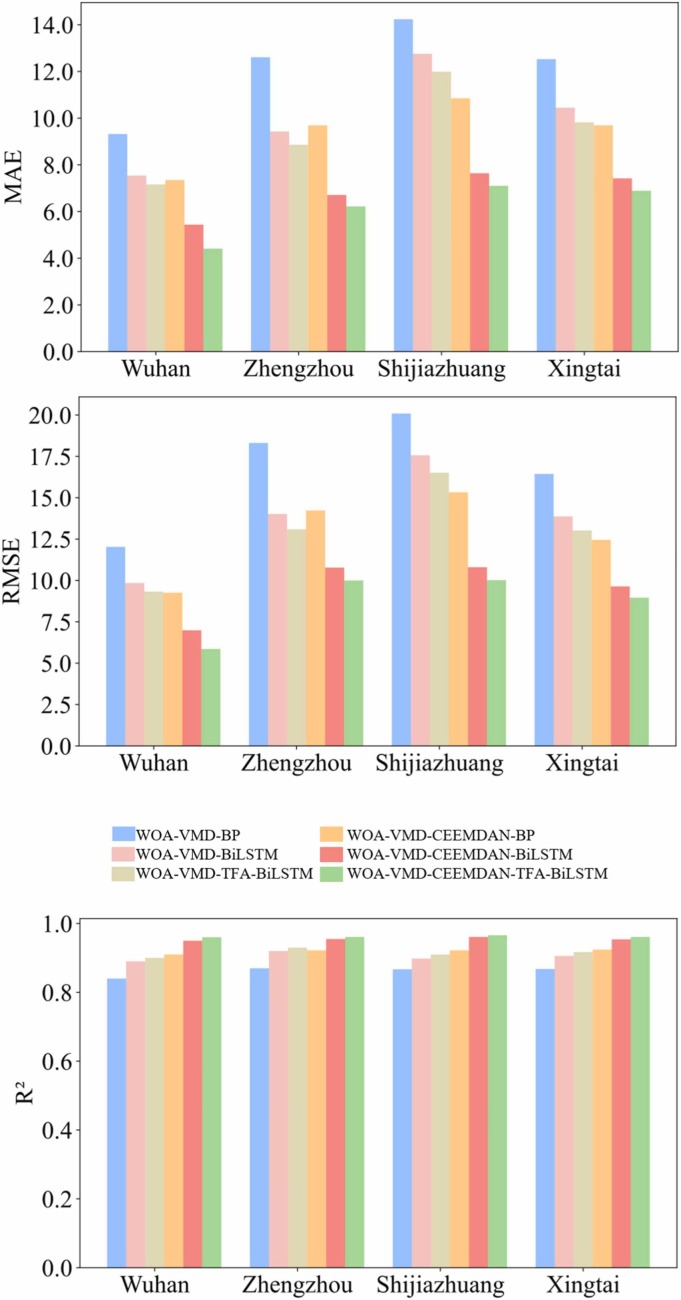
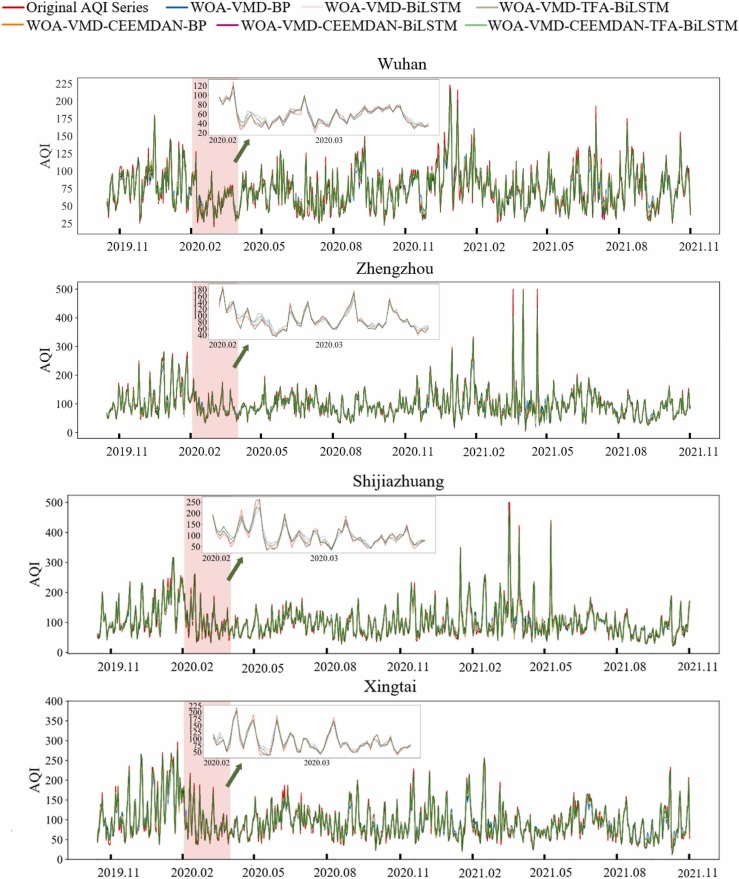
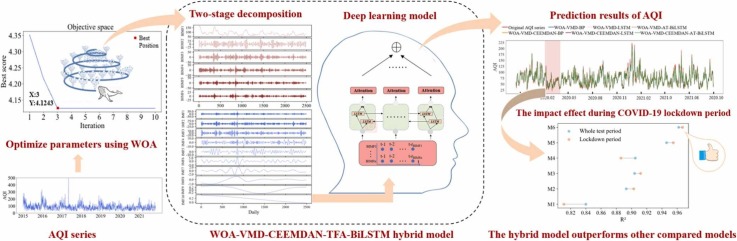
Accurate and dependable air quality forecasting is critical to environmental and human health. However, most methods usually aim to improve overall prediction accuracy but neglect the accuracy for unexpected incidents. In this study, a hybrid model was developed for air quality index (AQI) forecasting, and its performance during COVID-19 lockdown was analyzed. Specifically, the variational mode decomposition (VMD) was employed to decompose the original AQI sequence into some subsequences with the parameters optimized by the Whale optimization algorithm (WOA), and the residual sequence was further decomposed by the complete ensemble empirical mode decomposition with adaptive noise (CEEMDAN). On this basis, a deep learning method bidirectional long short-term memory coupled with added time filter layer and attention mechanism (TFA-BiLSTM) was employed to explore the latent dynamic characteristics of each subsequence. This WOA-VMD-CEEMDAN-TFA-BiLSTM hybrid model was used to forecast AQI values for four cities in China, and results verified that the accuracy of the hybrid model outperformed other proposed models, achieving R values of 0.96-0.97. In addition, the improvement in MAE (34.71-49.65%) and RMSE (32.82-48.07%) were observed over single decomposition-based model. Notably, during the epidemic lockdown period, the hybrid model had significant superiority over other proposed models for AQI prediction.

摘要

准确可靠的空气质量预测对环境和人类健康至关重要。然而,大多数方法通常旨在提高整体预测准确性,却忽视了对意外事件的预测准确性。在本研究中,开发了一种用于空气质量指数(AQI)预测的混合模型,并分析了其在新冠疫情封锁期间的性能。具体而言,采用变分模态分解(VMD)将原始AQI序列分解为一些子序列,其参数通过鲸鱼优化算法(WOA)进行优化,残差序列再通过自适应噪声完全集合经验模态分解(CEEMDAN)进一步分解。在此基础上,采用一种深度学习方法——结合了附加时间滤波层和注意力机制的双向长短期记忆网络(TFA-BiLSTM)——来探索每个子序列的潜在动态特征。该WOA-VMD-CEEMDAN-TFA-BiLSTM混合模型用于预测中国四个城市的AQI值,结果验证了该混合模型的准确性优于其他提出的模型,R值达到0.96 - 0.97。此外,与基于单一分解的模型相比,平均绝对误差(MAE)改善了34.71 - 49.65%,均方根误差(RMSE)改善了32.82 - 48.07%。值得注意的是,在疫情封锁期间,该混合模型在AQI预测方面比其他提出的模型具有显著优势。
https://cdn.ncbi.nlm.nih.gov/pmc/blobs/bc7a/10264166/86bf7b95ce03/gr8_lrg.jpg
https://cdn.ncbi.nlm.nih.gov/pmc/blobs/bc7a/10264166/1531eb521e3b/ga1_lrg.jpg
https://cdn.ncbi.nlm.nih.gov/pmc/blobs/bc7a/10264166/f88e407518a3/gr1_lrg.jpg
https://cdn.ncbi.nlm.nih.gov/pmc/blobs/bc7a/10264166/273091028477/gr2_lrg.jpg
https://cdn.ncbi.nlm.nih.gov/pmc/blobs/bc7a/10264166/78cad838b591/gr3_lrg.jpg
https://cdn.ncbi.nlm.nih.gov/pmc/blobs/bc7a/10264166/a892f39e32a8/gr4_lrg.jpg
https://cdn.ncbi.nlm.nih.gov/pmc/blobs/bc7a/10264166/6edbf19dc9ca/gr5_lrg.jpg
https://cdn.ncbi.nlm.nih.gov/pmc/blobs/bc7a/10264166/e1db3bb741a1/gr6_lrg.jpg
https://cdn.ncbi.nlm.nih.gov/pmc/blobs/bc7a/10264166/b9f944e68a4c/gr7_lrg.jpg
https://cdn.ncbi.nlm.nih.gov/pmc/blobs/bc7a/10264166/86bf7b95ce03/gr8_lrg.jpg
https://cdn.ncbi.nlm.nih.gov/pmc/blobs/bc7a/10264166/1531eb521e3b/ga1_lrg.jpg
https://cdn.ncbi.nlm.nih.gov/pmc/blobs/bc7a/10264166/f88e407518a3/gr1_lrg.jpg
https://cdn.ncbi.nlm.nih.gov/pmc/blobs/bc7a/10264166/273091028477/gr2_lrg.jpg
https://cdn.ncbi.nlm.nih.gov/pmc/blobs/bc7a/10264166/78cad838b591/gr3_lrg.jpg
https://cdn.ncbi.nlm.nih.gov/pmc/blobs/bc7a/10264166/a892f39e32a8/gr4_lrg.jpg
https://cdn.ncbi.nlm.nih.gov/pmc/blobs/bc7a/10264166/6edbf19dc9ca/gr5_lrg.jpg
https://cdn.ncbi.nlm.nih.gov/pmc/blobs/bc7a/10264166/e1db3bb741a1/gr6_lrg.jpg
https://cdn.ncbi.nlm.nih.gov/pmc/blobs/bc7a/10264166/b9f944e68a4c/gr7_lrg.jpg
https://cdn.ncbi.nlm.nih.gov/pmc/blobs/bc7a/10264166/86bf7b95ce03/gr8_lrg.jpg

相似文献

1
A hybrid model for daily air quality index prediction and its performance in the face of impact effect of COVID-19 lockdown.一种用于每日空气质量指数预测的混合模型及其在面对新冠疫情封锁影响时的性能
Process Saf Environ Prot. 2023 Aug;176:673-684. doi: 10.1016/j.psep.2023.06.021. Epub 2023 Jun 14.
2
A multi-scale evolutionary deep learning model based on CEEMDAN, improved whale optimization algorithm, regularized extreme learning machine and LSTM for AQI prediction.一种基于CEEMDAN、改进鲸鱼优化算法、正则化极限学习机和长短期记忆网络的多尺度进化深度学习模型用于空气质量指数预测。
Environ Res. 2022 Dec;215(Pt 1):114228. doi: 10.1016/j.envres.2022.114228. Epub 2022 Sep 6.
3
A new hybrid prediction model of air quality index based on secondary decomposition and improved kernel extreme learning machine.一种基于二次分解和改进核极限学习机的空气质量指数混合预测模型。
Chemosphere. 2022 Oct;305:135348. doi: 10.1016/j.chemosphere.2022.135348. Epub 2022 Jun 17.
4
An AQI decomposition ensemble model based on SSA-LSTM using improved AMSSA-VMD decomposition reconstruction technique.基于 SSA-LSTM 的 AQI 分解集成模型,使用改进的 AMSSA-VMD 分解重构技术。
Environ Res. 2023 Sep 1;232:116365. doi: 10.1016/j.envres.2023.116365. Epub 2023 Jun 8.
5
A hybrid multi-scale fusion paradigm for AQI prediction based on the secondary decomposition.基于二次分解的 AQI 预测的混合多尺度融合范例
Environ Sci Pollut Res Int. 2024 May;31(22):32694-32713. doi: 10.1007/s11356-024-33346-2. Epub 2024 Apr 25.
6
A novel hybrid model for air quality index forecasting based on two-phase decomposition technique and modified extreme learning machine.基于两阶段分解技术和改进的极限学习机的空气质量指数预测新型混合模型。
Sci Total Environ. 2017 Feb 15;580:719-733. doi: 10.1016/j.scitotenv.2016.12.018. Epub 2016 Dec 16.
7
A new hybrid optimization prediction model for PM2.5 concentration considering other air pollutants and meteorological conditions.一种考虑其他空气污染物和气象条件的新型混合优化PM2.5浓度预测模型。
Chemosphere. 2022 Nov;307(Pt 3):135798. doi: 10.1016/j.chemosphere.2022.135798. Epub 2022 Aug 11.
8
Combined model of air quality index forecasting based on the combination of complementary empirical mode decomposition and sequence reconstruction.基于互补经验模态分解和序列重构组合的空气质量指数预测组合模型。
Environ Pollut. 2023 Jan 1;316(Pt 2):120628. doi: 10.1016/j.envpol.2022.120628. Epub 2022 Nov 9.
9
A novel optimal-hybrid model for daily air quality index prediction considering air pollutant factors.一种考虑空气污染物因素的用于每日空气质量指数预测的新型最优混合模型。
Sci Total Environ. 2019 Sep 15;683:808-821. doi: 10.1016/j.scitotenv.2019.05.288. Epub 2019 May 22.
10
An ensemble LSTM-based AQI forecasting model with decomposition-reconstruction technique via CEEMDAN and fuzzy entropy.一种基于集成长短期记忆网络(LSTM)的空气质量指数(AQI)预测模型,该模型采用通过完备经验模态分解与自适应噪声(CEEMDAN)和模糊熵的分解-重构技术。
Air Qual Atmos Health. 2022;15(12):2299-2311. doi: 10.1007/s11869-022-01252-6. Epub 2022 Sep 30.

引用本文的文献

1
Ensemble stacking of machine learning models for air quality prediction for Hyderabad city in India.用于印度海得拉巴市空气质量预测的机器学习模型集成堆叠
iScience. 2025 Jan 25;28(2):111894. doi: 10.1016/j.isci.2025.111894. eCollection 2025 Feb 21.
2
Traffic Flow Prediction in 5G-Enabled Intelligent Transportation Systems Using Parameter Optimization and Adaptive Model Selection.基于参数优化与自适应模型选择的5G智能交通系统中的交通流预测
Sensors (Basel). 2024 Oct 10;24(20):6529. doi: 10.3390/s24206529.
3
Optimized machine learning model for air quality index prediction in major cities in India.

本文引用的文献

1
Estimating changes in air pollutant levels due to COVID-19 lockdown measures based on a business-as-usual prediction scenario using data mining models: A case-study for urban traffic sites in Spain.基于数据挖掘模型的疫情封锁措施对空气污染物水平影响的估算:西班牙城市交通站点的案例研究。
Sci Total Environ. 2022 Jun 1;823:153786. doi: 10.1016/j.scitotenv.2022.153786. Epub 2022 Feb 10.
2
COVID-19 pandemic: What can we learn for better air quality and human health?COVID-19 大流行:我们能从改善空气质量和人类健康中学到什么?
J Infect Public Health. 2022 Feb;15(2):187-198. doi: 10.1016/j.jiph.2021.12.001. Epub 2021 Dec 4.
3
印度主要城市空气质量指数预测的优化机器学习模型。
Sci Rep. 2024 Mar 21;14(1):6795. doi: 10.1038/s41598-024-54807-1.
4
Recent progress of particle electrode materials in three-dimensional electrode reactor: synthesis strategy and electrocatalytic applications.三维电极反应器中粒子电极材料的最新进展:合成策略与电催化应用。
Environ Sci Pollut Res Int. 2024 Feb;31(8):11490-11506. doi: 10.1007/s11356-023-31807-8. Epub 2024 Jan 10.
An ensemble method to forecast 24-h ahead solar irradiance using wavelet decomposition and BiLSTM deep learning network.
一种使用小波分解和双向长短期记忆(BiLSTM)深度学习网络预测提前24小时太阳辐照度的集成方法。
Earth Sci Inform. 2022;15(1):291-306. doi: 10.1007/s12145-021-00723-1. Epub 2021 Nov 17.
4
Implications of COVID-19 on global environmental pollution and carbon emissions with strategies for sustainability in the COVID-19 era.新型冠状病毒肺炎对全球环境污染和碳排放的影响,以及在新型冠状病毒肺炎时代实现可持续性的策略。
Sci Total Environ. 2022 Feb 25;809:151657. doi: 10.1016/j.scitotenv.2021.151657. Epub 2021 Nov 16.
5
Impacts of COVID-19 on air quality in mid-eastern China: An insight into meteorology and emissions.新冠疫情对中国中东地区空气质量的影响:气象学与排放情况洞察
Atmos Environ (1994). 2021 Dec 1;266:118750. doi: 10.1016/j.atmosenv.2021.118750. Epub 2021 Sep 24.
6
The casual effects of COVID-19 lockdown on air quality and short-term health impacts in China.新冠疫情封锁对中国空气质量和短期健康影响的偶然作用。
Environ Pollut. 2021 Dec 1;290:117988. doi: 10.1016/j.envpol.2021.117988. Epub 2021 Aug 20.
7
Predicting polycyclic aromatic hydrocarbons in surface water by a multiscale feature extraction-based deep learning approach.基于多尺度特征提取的深度学习方法预测地表水中的多环芳烃。
Sci Total Environ. 2021 Dec 10;799:149509. doi: 10.1016/j.scitotenv.2021.149509. Epub 2021 Aug 5.
8
Meta-analysis and comprehensive study of coronavirus outbreaks: SARS, MERS and COVID-19.冠状病毒爆发的荟萃分析和综合研究:SARS、MERS 和 COVID-19。
J Infect Public Health. 2021 Aug;14(8):1051-1064. doi: 10.1016/j.jiph.2021.06.007. Epub 2021 Jun 17.
9
PM2.5 concentration forecasting at surface monitoring sites using GRU neural network based on empirical mode decomposition.基于经验模态分解的 GRU 神经网络的地面监测站点 PM2.5 浓度预测。
Sci Total Environ. 2021 May 10;768:144516. doi: 10.1016/j.scitotenv.2020.144516. Epub 2021 Jan 8.
10
Improved ANFIS model for forecasting Wuhan City Air Quality and analysis COVID-19 lockdown impacts on air quality.改进的 ANFIS 模型用于预测武汉市空气质量,并分析 COVID-19 封锁对空气质量的影响。
Environ Res. 2021 Mar;194:110607. doi: 10.1016/j.envres.2020.110607. Epub 2020 Dec 17.