Chimeddorj Battogtokh, Bailie Christopher R, Mandakh Undram, Price David J, Bayartsogt Batzorig, Meagher Niamh, Altanbayar Oyunbaatar, Magvan Battur, Deleg Zolzaya, Gantumur Anuujin, Byambaa Otgonjargal, Nyamdavaa Enkhgerel, Enkhtugs Khangai, Munkhbayar Usukhbayar, Bayanjargal Batkhuu, Badamsambuu Tuyajargal, Dashtseren Myagmartseren, Amartuvshin Tsolmontuya, Narmandakh Zolmunkh, Togoo Khongorzul, Boldbaatar Enkh-Amar, Bat-Erdene Ariunzaya, Chimeddorj Usukhbayar, Nyamdavaa Khurelbaatar, Tsevegmid Erdembileg, Batjargal Ochbadrakh, Enebish Oyunsuren, Enebish Gerelmaa, Batchuluun Batzaya, Zulmunkh Gereltsetseg, Byambatsogt Ganbaatar, Enebish Temuulen, Le Linh-Vi, Bergeri Isabel, McVernon Jodie, Erkhembayar Ryenchindorj
Department of Microbiology and Infection Prevention Control, School of Biomedicine, Mongolian National University of Medical Sciences, Ulaanbaatar, Mongolia.
Institute of Biomedical Sciences, Mongolian National University of Medical Sciences, Ulaanbaatar, Mongolia.
Lancet Reg Health West Pac. 2023 Apr 10;36:100760. doi: 10.1016/j.lanwpc.2023.100760.
The COVID-19 pandemic has global impacts but is relatively understudied in developing countries. Mongolia, a lower-middle-income country, instituted strict control measures in early 2020 and avoided widespread transmission until vaccines became available in February, 2021. Mongolia achieved its 60% vaccination coverage goal by July 2021. We investigated the distribution and determinants of SARS-CoV-2 seroprevalence in Mongolia over 2020 and 2021.
We performed a longitudinal seroepidemiologic study aligned with WHO's Unity Studies protocols. We collected data from a panel of 5000 individuals in four rounds between October 2020 and December 2021. We selected participants through local health centres across Mongolia by age-stratified multi-stage cluster sampling. We tested serum for the presence of total antibodies against SARS-CoV-2 receptor-binding domain, and levels of anti-SARS-CoV-2 spike IgG and neutralising antibodies. We linked participant data with national mortality, COVID-19 case, and vaccination registries. We estimated population seroprevalence and vaccine uptake, as well as unvaccinated population prior-infection prevalence.
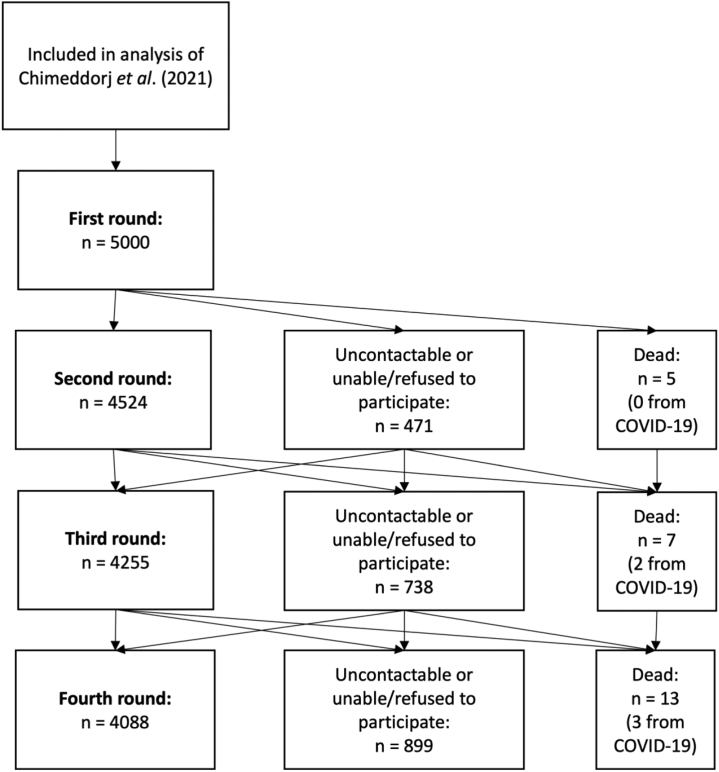
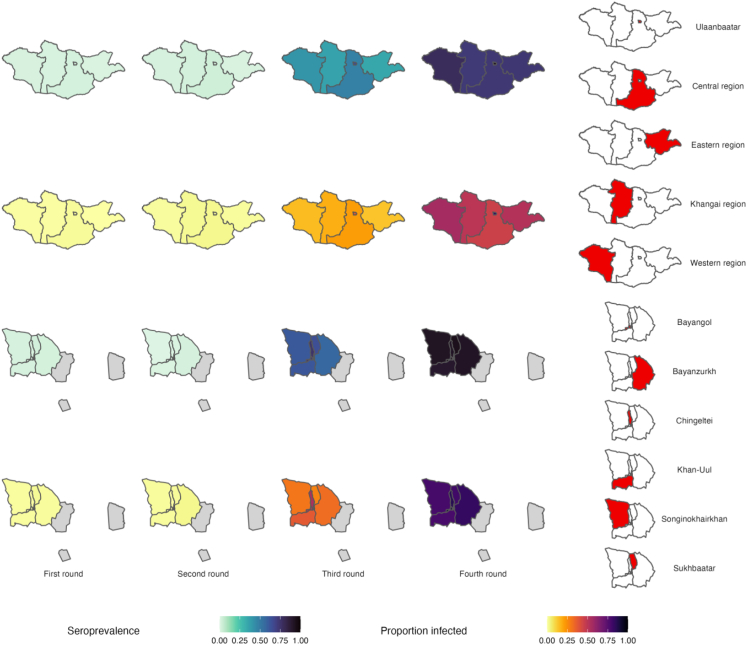
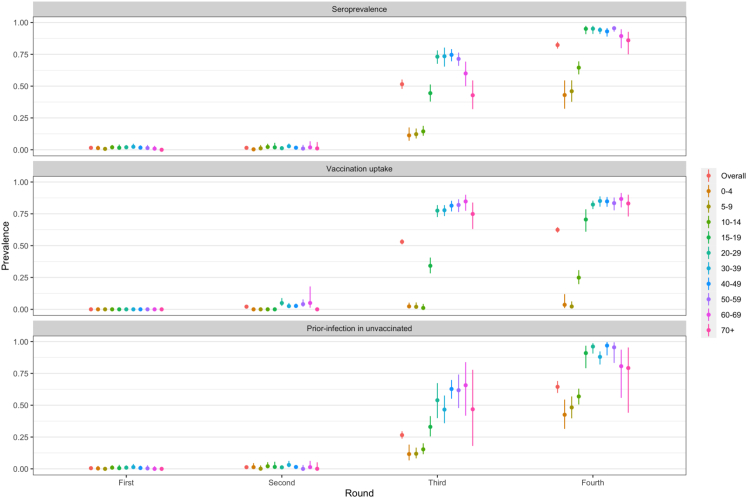
At the final round in late 2021, 82% (n = 4088) of participants completed follow-up. Estimated seroprevalence increased from 1.5% (95% CI: 1.2-2.0), to 82.3% (95% CI: 79.5-84.8) between late-2020 and late-2021. At the final round an estimated 62.4% (95% CI: 60.2-64.5) of the population were vaccinated, and of the unvaccinated population 64.5% (95% CI: 59.7-69.0) had been infected. Cumulative case ascertainment in the unvaccinated was 22.8% (95% CI: 19.1%-26.9%) and the overall infection-fatality ratio was 0.100% (95% CI: 0.088-0.124). Health workers had higher odds for being COVID-19 confirmed cases at all rounds. Males (1.72 (95% CI: 1.33-2.22)) and adults aged 20 and above (12.70 (95% CI: 8.14-20.26)) had higher odds for seroconverting by mid-2021. Among the seropositive, 87.1% (95% CI: 82.3%-90.8%) had SARS-CoV-2 neutralising antibodies by late 2021.
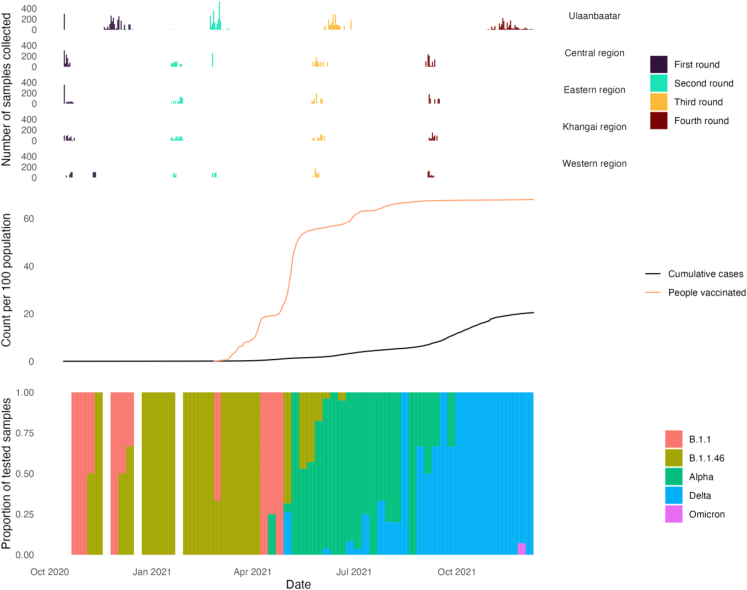
Our study enabled tracking of SARS-CoV-2 serological markers in the Mongolian population over one year. We found low SARS-CoV-2 seroprevalence in 2020 and early 2021, with seropositivity increasing over a 3-month interval in 2021 due to vaccine roll out and rapid infection of most of the unvaccinated population. Despite high seroprevalence in Mongolia amongst both vaccinated and unvaccinated individuals by end-2021, the SARS-CoV-2 Omicron immune escape variant caused a substantial epidemic.
World Health Organization, WHO UNITY Studies initiative, with funding by the COVID-19 Solidarity Response Fund and the German Federal Ministry of Health (BMG) COVID-19 Research and development. The Ministry of Health, Mongolia partially funded this study.
新冠疫情具有全球影响,但在发展中国家的研究相对较少。蒙古是一个中低收入国家,于2020年初实施了严格的管控措施,在2021年2月疫苗可用之前避免了病毒的广泛传播。蒙古在2021年7月实现了60%的疫苗接种覆盖率目标。我们调查了2020年至2021年期间蒙古新冠病毒血清流行率的分布及影响因素。
我们开展了一项符合世界卫生组织“团结研究”方案的纵向血清流行病学研究。在2020年10月至2021年12月期间分四轮从一组5000名个体中收集数据。我们通过蒙古各地的当地卫生中心,采用按年龄分层的多阶段整群抽样方法选取参与者。我们检测血清中针对新冠病毒受体结合域的总抗体、抗新冠病毒刺突蛋白IgG抗体水平及中和抗体。我们将参与者数据与国家死亡率、新冠病例及疫苗接种登记信息相链接。我们估算了人群血清流行率、疫苗接种率以及未接种人群的既往感染率。
在2021年末的最后一轮调查中,82%(n = 4088)的参与者完成了随访。2020年末至2021年末,估计血清流行率从1.5%(95%置信区间:1.2 - 2.0)升至82.3%(95%置信区间:79.5 - 84.8)。在最后一轮调查中,估计62.4%(95%置信区间:60.2 - 64.5)的人群接种了疫苗,在未接种人群中,64.5%(95%置信区间:59.7 - 69.0)曾被感染。未接种人群中的累计病例确诊率为22.8%(95%置信区间:19.1% - 26.9%),总体感染死亡率为0.100%(95%置信区间:0.088 - 0.124)。在所有轮次中,医护人员确诊新冠病例的几率更高。男性(1.72(95%置信区间:1.33 - 2.22))及20岁及以上成年人(12.70(95%置信区间:8.14 - 20.26))在2021年年中血清转化的几率更高。在血清阳性者中,到2021年末,87.1%(95%置信区间:82.3% - 90.8%)具有新冠病毒中和抗体。
我们的研究实现了对蒙古人群中新冠病毒血清学标志物长达一年的追踪。我们发现2020年及2021年初新冠病毒血清流行率较低,2021年由于疫苗接种及大多数未接种人群的快速感染,血清阳性率在3个月内上升。尽管到2021年末蒙古接种和未接种人群中的血清流行率都很高,但新冠病毒奥密克戎免疫逃逸变异株引发了大规模疫情。
世界卫生组织“团结研究”倡议,由新冠团结应对基金及德国联邦卫生部(BMG)新冠研发项目提供资金。蒙古卫生部为该研究提供了部分资金。