• 文献检索
  • 文档翻译
  • 深度研究
  • 学术资讯
  • Suppr Zotero 插件Zotero 插件
  • 邀请有礼
  • 套餐&价格
  • 历史记录
应用&插件
Suppr Zotero 插件Zotero 插件浏览器插件Mac 客户端Windows 客户端微信小程序
定价
高级版会员购买积分包购买API积分包
服务
文献检索文档翻译深度研究API 文档MCP 服务
关于我们
关于 Suppr公司介绍联系我们用户协议隐私条款
关注我们

Suppr 超能文献

核心技术专利:CN118964589B侵权必究
粤ICP备2023148730 号-1Suppr @ 2026

文献检索

告别复杂PubMed语法,用中文像聊天一样搜索,搜遍4000万医学文献。AI智能推荐,让科研检索更轻松。

立即免费搜索

文件翻译

保留排版,准确专业,支持PDF/Word/PPT等文件格式,支持 12+语言互译。

免费翻译文档

深度研究

AI帮你快速写综述,25分钟生成高质量综述,智能提取关键信息,辅助科研写作。

立即免费体验

使用机器学习和深度学习技术对新冠病毒(COVID-19)检测的全面综述。

A comprehensive review of COVID-19 detection with machine learning and deep learning techniques.

作者信息

Das Sreeparna, Ayus Ishan, Gupta Deepak

机构信息

Department of Computer Science and Engineering, National Institute of Technology Arunachal Pradesh, Jote, Arunachal Pradesh 791113 India.

Department of Computer Science and Engineering, ITER, Siksha 'O' Anusandhan Deemed to be University, Bhubaneswar, Odisha 751030 India.

出版信息

Health Technol (Berl). 2023 Jun 7:1-14. doi: 10.1007/s12553-023-00757-z.

DOI:10.1007/s12553-023-00757-z
PMID:37363343
原文链接:https://pmc.ncbi.nlm.nih.gov/articles/PMC10244837/
Abstract

PURPOSE

The first transmission of coronavirus to humans started in Wuhan city of China, took the shape of a pandemic called Corona Virus Disease 2019 (COVID-19), and posed a principal threat to the entire world. The researchers are trying to inculcate artificial intelligence (Machine learning or deep learning models) for the efficient detection of COVID-19. This research explores all the existing machine learning (ML) or deep learning (DL) models, used for COVID-19 detection which may help the researcher to explore in different directions. The main purpose of this review article is to present a compact overview of the application of artificial intelligence to the research experts, helping them to explore the future scopes of improvement.

METHODS

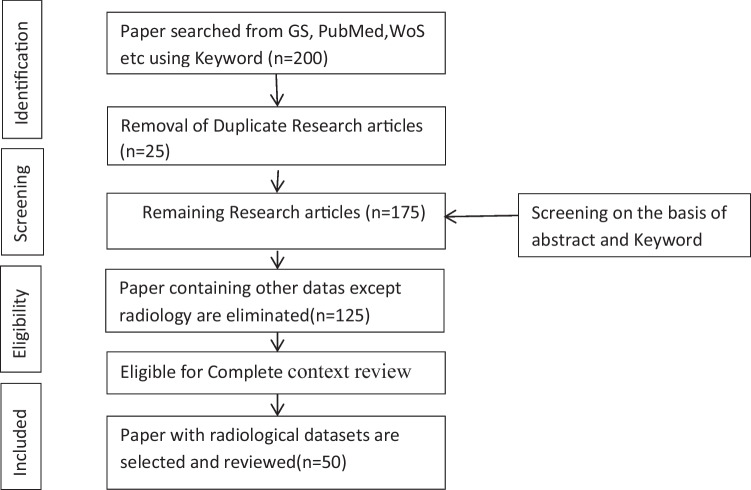
The researchers have used various machine learning, deep learning, and a combination of machine and deep learning models for extracting significant features and classifying various health conditions in COVID-19 patients. For this purpose, the researchers have utilized different image modalities such as CT-Scan, X-Ray, etc. This study has collected over 200 research papers from various repositories like Google Scholar, PubMed, Web of Science, etc. These research papers were passed through various levels of scrutiny and finally, 50 research articles were selected.

RESULTS

In those listed articles, the ML / DL models showed an accuracy of 99% and above while performing the classification of COVID-19. This study has also presented various clinical applications of various research. This study specifies the importance of various machine and deep learning models in the field of medical diagnosis and research.

CONCLUSION

In conclusion, it is evident that ML/DL models have made significant progress in recent years, but there are still limitations that need to be addressed. Overfitting is one such limitation that can lead to incorrect predictions and overburdening of the models. The research community must continue to work towards finding ways to overcome these limitations and make machine and deep learning models even more effective and efficient. Through this ongoing research and development, we can expect even greater advances in the future.

摘要

目的

冠状病毒首次传播至人类是在中国武汉市开始的,演变成了一场名为2019冠状病毒病(COVID-19)的大流行,并对整个世界构成了主要威胁。研究人员正试图引入人工智能(机器学习或深度学习模型)以实现对COVID-19的高效检测。本研究探讨了所有用于COVID-19检测的现有机器学习(ML)或深度学习(DL)模型,这可能有助于研究人员在不同方向上进行探索。这篇综述文章的主要目的是向研究专家简要介绍人工智能的应用,帮助他们探索未来改进的方向。

方法

研究人员使用了各种机器学习、深度学习以及机器学习与深度学习相结合的模型来提取显著特征并对COVID-19患者的各种健康状况进行分类。为此,研究人员利用了不同的图像模态,如CT扫描、X射线等。本研究从谷歌学术、PubMed、科学网等各种数据库中收集了200多篇研究论文。这些研究论文经过了多轮严格筛选,最终选出了50篇研究文章。

结果

在那些列出的文章中,ML/DL模型在对COVID-19进行分类时显示出99%及以上的准确率。本研究还展示了各项研究的不同临床应用。这项研究明确了各种机器学习和深度学习模型在医学诊断和研究领域的重要性。

结论

总之,很明显ML/DL模型近年来取得了显著进展,但仍存在需要解决的局限性。过拟合就是这样一种局限性,它可能导致错误的预测以及模型的负担过重。研究界必须继续努力寻找克服这些局限性的方法,使机器学习和深度学习模型更加有效和高效。通过持续的研究与开发,我们有望在未来取得更大的进展。
https://cdn.ncbi.nlm.nih.gov/pmc/blobs/2e4e/10244837/c302e76a2393/12553_2023_757_Fig2_HTML.jpg
https://cdn.ncbi.nlm.nih.gov/pmc/blobs/2e4e/10244837/98f81c19c790/12553_2023_757_Fig1_HTML.jpg
https://cdn.ncbi.nlm.nih.gov/pmc/blobs/2e4e/10244837/c302e76a2393/12553_2023_757_Fig2_HTML.jpg
https://cdn.ncbi.nlm.nih.gov/pmc/blobs/2e4e/10244837/98f81c19c790/12553_2023_757_Fig1_HTML.jpg
https://cdn.ncbi.nlm.nih.gov/pmc/blobs/2e4e/10244837/c302e76a2393/12553_2023_757_Fig2_HTML.jpg

相似文献

1
A comprehensive review of COVID-19 detection with machine learning and deep learning techniques.使用机器学习和深度学习技术对新冠病毒(COVID-19)检测的全面综述。
Health Technol (Berl). 2023 Jun 7:1-14. doi: 10.1007/s12553-023-00757-z.
2
Diagnosis of COVID-19 Using Machine Learning and Deep Learning: A Review.基于机器学习和深度学习的 COVID-19 诊断:综述。
Curr Med Imaging. 2021;17(12):1403-1418. doi: 10.2174/1573405617666210713113439.
3
A survey of machine learning-based methods for COVID-19 medical image analysis.基于机器学习的 COVID-19 医学图像分析方法研究综述。
Med Biol Eng Comput. 2023 Jun;61(6):1257-1297. doi: 10.1007/s11517-022-02758-y. Epub 2023 Jan 28.
4
Supervised and weakly supervised deep learning models for COVID-19 CT diagnosis: A systematic review.基于监督和弱监督的深度学习模型在 COVID-19 CT 诊断中的应用:一项系统综述。
Comput Methods Programs Biomed. 2022 May;218:106731. doi: 10.1016/j.cmpb.2022.106731. Epub 2022 Mar 5.
5
Combating COVID-19 Crisis using Artificial Intelligence (AI) Based Approach: Systematic Review.基于人工智能方法应对新冠疫情危机:系统综述
Curr Top Med Chem. 2024;24(8):737-753. doi: 10.2174/0115680266282179240124072121.
6
Applications of artificial intelligence in COVID-19 pandemic: A comprehensive review.人工智能在新冠疫情中的应用:一项全面综述。
Expert Syst Appl. 2021 Dec 15;185:115695. doi: 10.1016/j.eswa.2021.115695. Epub 2021 Aug 4.
7
Role of biological Data Mining and Machine Learning Techniques in Detecting and Diagnosing the Novel Coronavirus (COVID-19): A Systematic Review.生物数据挖掘和机器学习技术在检测和诊断新型冠状病毒 (COVID-19) 中的作用:系统评价。
J Med Syst. 2020 May 25;44(7):122. doi: 10.1007/s10916-020-01582-x.
8
Machine Learning, Deep Learning, and Mathematical Models to Analyze Forecasting and Epidemiology of COVID-19: A Systematic Literature Review.机器学习、深度学习和数学模型分析 COVID-19 的预测和流行病学:系统文献回顾。
Int J Environ Res Public Health. 2022 Apr 22;19(9):5099. doi: 10.3390/ijerph19095099.
9
An overview of deep learning techniques for COVID-19 detection: methods, challenges, and future works.用于新冠病毒(COVID-19)检测的深度学习技术综述:方法、挑战及未来工作
Multimed Syst. 2023;29(3):1603-1627. doi: 10.1007/s00530-023-01083-0. Epub 2023 Mar 25.
10
COVID-19 detection in CT and CXR images using deep learning models.使用深度学习模型进行 CT 和 CXR 图像中的 COVID-19 检测。
Biogerontology. 2022 Feb;23(1):65-84. doi: 10.1007/s10522-021-09946-7. Epub 2022 Jan 22.

引用本文的文献

1
Machine Learning Techniques Applied to COVID-19 Prediction: A Systematic Literature Review.应用于新冠肺炎预测的机器学习技术:系统文献综述
Bioengineering (Basel). 2025 May 13;12(5):514. doi: 10.3390/bioengineering12050514.
2
Detecting health misinformation: A comparative analysis of machine learning and graph convolutional networks in classification tasks.检测健康错误信息:机器学习与图卷积网络在分类任务中的比较分析
MethodsX. 2024 Apr 28;12:102737. doi: 10.1016/j.mex.2024.102737. eCollection 2024 Jun.

本文引用的文献

1
RETRACTED ARTICLE: Deep learning system to screen coronavirus disease 2019 pneumonia.撤稿文章:用于筛查2019冠状病毒病肺炎的深度学习系统。
Appl Intell (Dordr). 2023;53(4):4874. doi: 10.1007/s10489-020-01714-3. Epub 2020 Apr 22.
2
Advance Warning Methodologies for COVID-19 Using Chest X-Ray Images.利用胸部X光图像的COVID-19提前预警方法
IEEE Access. 2021 Mar 9;9:41052-41065. doi: 10.1109/ACCESS.2021.3064927. eCollection 2021.
3
COVID-CXNet: Detecting COVID-19 in frontal chest X-ray images using deep learning.COVID-CXNet:利用深度学习在胸部正位X光图像中检测新型冠状病毒肺炎
Multimed Tools Appl. 2022;81(21):30615-30645. doi: 10.1007/s11042-022-12156-z. Epub 2022 Apr 7.
4
Automated detection of COVID-19 through convolutional neural network using chest x-ray images.基于胸部 X 光图像的卷积神经网络 COVID-19 自动检测
PLoS One. 2022 Jan 21;17(1):e0262052. doi: 10.1371/journal.pone.0262052. eCollection 2022.
5
DL-CRC: Deep Learning-Based Chest Radiograph Classification for COVID-19 Detection: A Novel Approach.DL-CRC:基于深度学习的胸部X光片分类用于新冠病毒检测:一种新方法
IEEE Access. 2020 Sep 18;8:171575-171589. doi: 10.1109/ACCESS.2020.3025010. eCollection 2020.
6
A bi-stage feature selection approach for COVID-19 prediction using chest CT images.一种使用胸部CT图像进行COVID-19预测的双阶段特征选择方法。
Appl Intell (Dordr). 2021;51(12):8985-9000. doi: 10.1007/s10489-021-02292-8. Epub 2021 Apr 19.
7
Classification of COVID-19 in chest X-ray images using DeTraC deep convolutional neural network.使用DeTraC深度卷积神经网络对胸部X光图像中的新冠肺炎进行分类。
Appl Intell (Dordr). 2021;51(2):854-864. doi: 10.1007/s10489-020-01829-7. Epub 2020 Sep 5.
8
Unsupervised Deep Learning based Variational Autoencoder Model for COVID-19 Diagnosis and Classification.基于无监督深度学习的变分自编码器模型用于COVID-19诊断与分类
Pattern Recognit Lett. 2021 Nov;151:267-274. doi: 10.1016/j.patrec.2021.08.018. Epub 2021 Sep 22.
9
An optimal cascaded recurrent neural network for intelligent COVID-19 detection using Chest X-ray images.一种用于使用胸部X光图像进行智能新冠病毒检测的最优级联递归神经网络。
Appl Soft Comput. 2021 Dec;113:107878. doi: 10.1016/j.asoc.2021.107878. Epub 2021 Sep 8.
10
Auto informing COVID-19 detection result from x-ray/CT images based on deep learning.基于深度学习的 X 射线/CT 图像 COVID-19 自动检测结果告知。
Rev Sci Instrum. 2021 Aug 1;92(8):084102. doi: 10.1063/5.0059829.