Center for Mechanisms of Evolution, Biodesign Institute, Arizona State University, Tempe, AZ 85287.
Proc Natl Acad Sci U S A. 2023 Jul 4;120(27):e2306741120. doi: 10.1073/pnas.2306741120. Epub 2023 Jun 26.
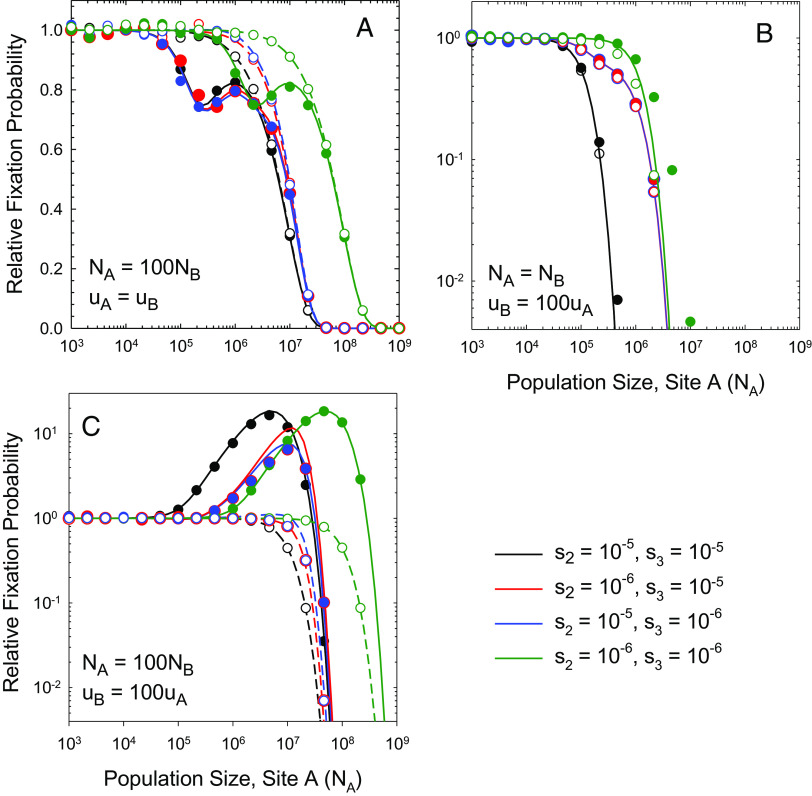
Most aspects of the molecular biology of cells involve tightly coordinated intermolecular interactions requiring specific recognition at the nucleotide and/or amino acid levels. This has led to long-standing interest in the degree to which constraints on interacting molecules result in conserved vs. accelerated rates of sequence evolution, with arguments commonly being made that molecular coevolution can proceed at rates exceeding the neutral expectation. Here, a fairly general model is introduced to evaluate the degree to which the rate of evolution at functionally interacting sites is influenced by effective population sizes (), mutation rates, strength of selection, and the magnitude of recombination between sites. This theory is of particular relevance to matters associated with interactions between organelle- and nuclear-encoded proteins, as the two genomic environments often exhibit dramatic differences in the power of mutation and drift. Although genes within low environments can drive the rate of evolution of partner genes experiencing higher , rates exceeding the neutral expectation require that the former also have an elevated mutation rate. Testable predictions, some counterintuitive, are presented on how patterns of coevolutionary rates should depend on the relative intensities of drift, selection, and mutation.
细胞的分子生物学的大多数方面都涉及到紧密协调的分子间相互作用,这需要在核苷酸和/或氨基酸水平上进行特异性识别。这导致了人们长期以来对相互作用分子的约束在多大程度上导致保守与加速的序列进化速度的兴趣,通常的观点是,分子协同进化可以以超过中性预期的速度进行。在这里,引入了一个相当普遍的模型来评估功能相互作用位点的进化速度受有效种群大小()、突变率、选择强度以及位点之间重组程度的影响程度。该理论与细胞器和核编码蛋白之间相互作用的相关问题特别相关,因为这两种基因组环境在突变和漂移的能力上往往存在显著差异。尽管在低 环境中的基因可以驱动经历更高 的伙伴基因的进化速度,但要超过中性预期的速度,前者还需要有更高的突变率。提出了一些具有挑战性的可测试预测,说明协同进化率的模式应该如何取决于漂移、选择和突变的相对强度。